

1 Dollar – United States
Non-circulating coins
Commemoration: United States Military Academy at West Point - Bicentennial
United States
Context
Material

References
KM: #Click to copy to clipboard338
Numista: #25437
Value
Exchange value: 1 USD = $1.00
Bullion value: $69.78
Inflation-adjusted value: 1.81 USD
Obverse
Description:
Academy Color Guard parading before the Cadet Chapel and Washington Hall.
Inscription:
1802 · LIBERTY · 2002
IN GOD
WE
TRUST
IN GOD
WE
TRUST
Script: Latin
Engraver: Thomas James Ferrell
Reverse
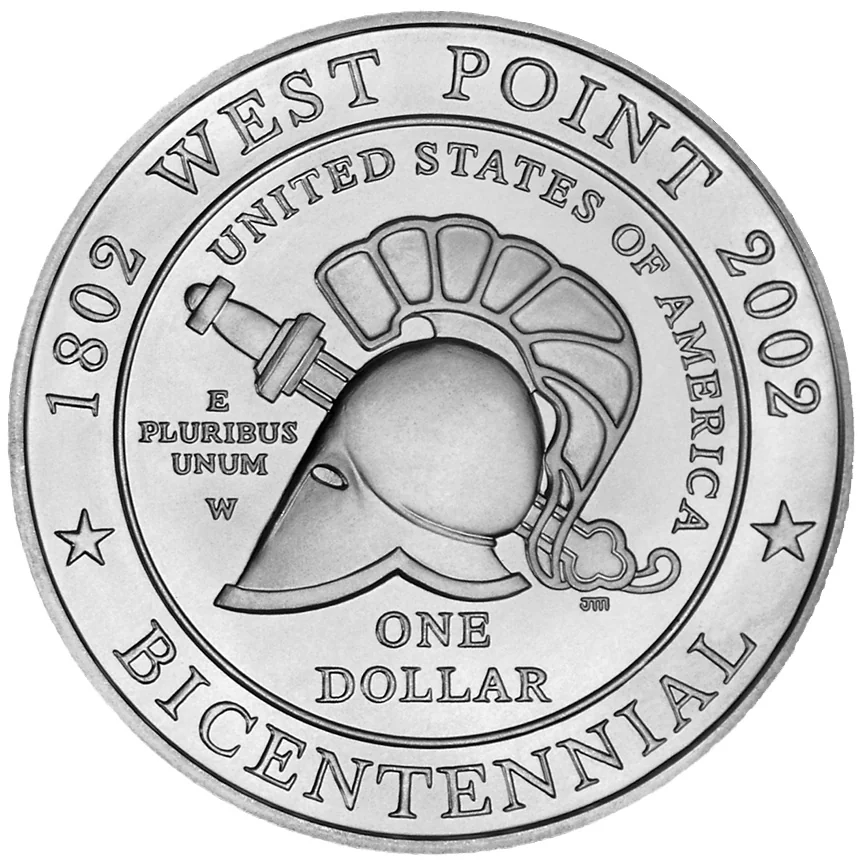
Description:
West Point Bicentennial logo: a helmet and sword from the crest.
Inscription:
1802 WEST POINT 2002
UNITED STATES OF AMERICA
E
PLURIBUS
UNUM
W
JM
ONE
DOLLAR
* BICENTENNIAL *
UNITED STATES OF AMERICA
E
PLURIBUS
UNUM
W
JM
ONE
DOLLAR
* BICENTENNIAL *
Script: Latin
Engraver: John M. Mercanti
Edge
Reeded
Mints
| Name | Mark |
|---|---|
| United States Mint of West Point | W |
Historical background
In 2002, the United States was navigating the economic aftermath of the September 11th attacks and the bursting of the dot-com bubble, which had officially pushed the economy into a recession in 2001. Against this backdrop, the U.S. dollar remained the world's dominant reserve currency, but it began a period of significant depreciation against major rivals, particularly the euro. This decline, which would become a multi-year trend, was driven by concerns over growing U.S. budget deficits, a widening current account deficit, and a shift in Federal Reserve policy toward historically low interest rates to stimulate recovery, making dollar-denominated assets less attractive to foreign investors.
Domestically, the currency was in a state of tangible transition. The new, more colorful and secure Series 2004 banknotes (starting with the $20 bill) were in the final stages of design and planning, with the Treasury aiming to combat advanced counterfeiting. Meanwhile, the public was still adapting to the recently introduced golden-colored Sacagawea dollar coin, a 2000 release that continued to see limited circulation despite government promotion. The focus on security was paramount, as technological advances in printing and scanning posed an increasing threat to the integrity of the older greenback designs.
Internationally, the dollar's weakness was a double-edged sword. It helped U.S. exporters by making their goods cheaper abroad, providing a needed boost to the manufacturing sector. However, it also raised concerns about the long-term stability of the global financial system, which relied heavily on the dollar. Notably, this period saw the euro, freshly introduced as physical currency in January 2002, steadily gain strength and credibility, beginning its ascent as a potential challenger to dollar hegemony, though it remained a distant second in global usage.
Domestically, the currency was in a state of tangible transition. The new, more colorful and secure Series 2004 banknotes (starting with the $20 bill) were in the final stages of design and planning, with the Treasury aiming to combat advanced counterfeiting. Meanwhile, the public was still adapting to the recently introduced golden-colored Sacagawea dollar coin, a 2000 release that continued to see limited circulation despite government promotion. The focus on security was paramount, as technological advances in printing and scanning posed an increasing threat to the integrity of the older greenback designs.
Internationally, the dollar's weakness was a double-edged sword. It helped U.S. exporters by making their goods cheaper abroad, providing a needed boost to the manufacturing sector. However, it also raised concerns about the long-term stability of the global financial system, which relied heavily on the dollar. Notably, this period saw the euro, freshly introduced as physical currency in January 2002, steadily gain strength and credibility, beginning its ascent as a potential challenger to dollar hegemony, though it remained a distant second in global usage.
🌟 Uncommon