

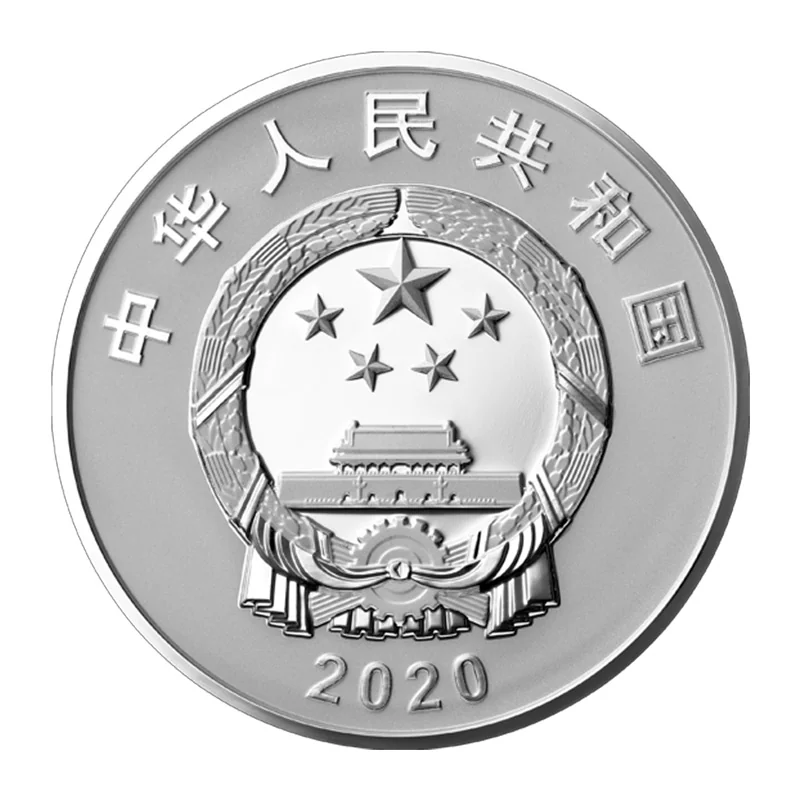
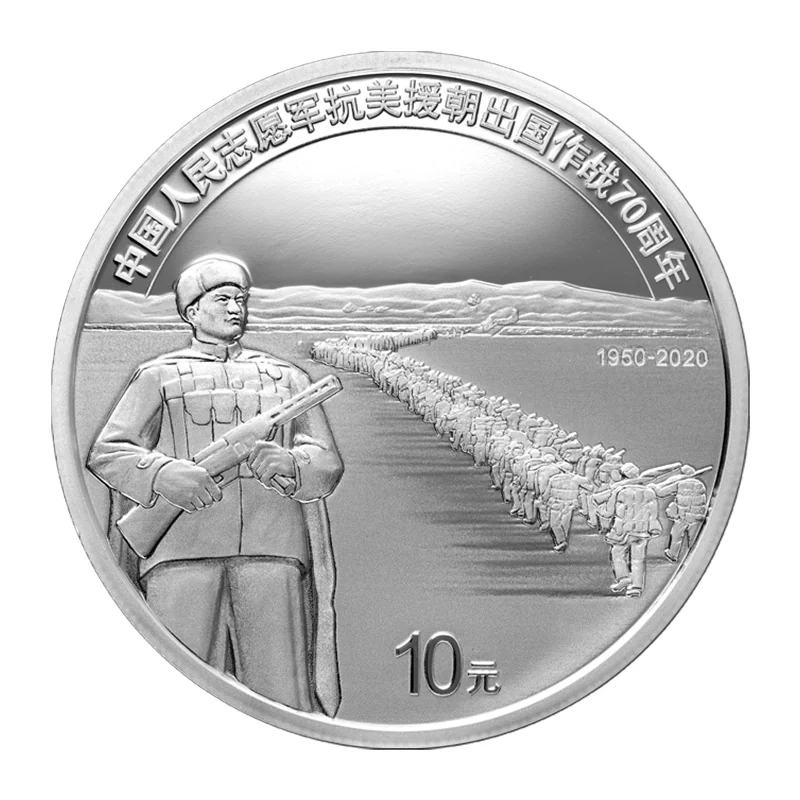
10 yuan (Korean War) – People's Republic of China
Add to wishlist
Non-circulating coins
Commemoration: 70th anniversary of the Korean War
China
Context
Year: 2020
Country: China
Issuer: People's Republic of China
Period:
(since 1949)
Currency:
(since 1955)
Total mintage: 60,000
Material
References
Numista: #254279
Value
Exchange value: 10 CNY
Bullion value: $76.68
Inflation-adjusted value: 10.53 CNY
Obverse
Reverse
Edge
Mintings
| Year | Mint Mark | Mintage | Quality | Collection |
|---|---|---|---|---|
| 2020 | — | 60,000 |
Historical background
In 2020, the People's Republic of China navigated a complex currency environment shaped by domestic pandemic pressures and global uncertainty. The year began with the yuan facing depreciation pressure due to the initial economic shock of COVID-19 lockdowns and disruptions to global supply chains. However, the People's Bank of China (PBOC) employed a managed float regime, carefully balancing stability with flexibility. A key policy focus was ensuring ample liquidity to support economic recovery while avoiding competitive devaluation, which led to a relatively stable yuan against a basket of currencies, even as it experienced volatility against a surging U.S. dollar.
The internationalization of the renminbi (RMB) saw mixed progress. While the crisis underscored the dollar's dominant role in global finance, China's quicker economic rebound and its inclusion in more global bond indices attracted foreign capital inflows. This helped support the currency's value. Furthermore, China accelerated digital currency research, with pilot tests of the Digital Currency Electronic Payment (DCEP) system expanding to major cities, positioning the country at the forefront of central bank digital currency development as a potential long-term tool for monetary policy and financial sovereignty.
By year's end, the yuan had strengthened significantly, closing at its highest level against the dollar in over two years. This appreciation was driven by China's strong export performance, a widening interest rate differential with other major economies, and sustained foreign investment inflows. The situation highlighted the dual nature of China's currency policy: a commitment to macroeconomic stability and controlled convertibility on the capital account, while progressively opening financial markets and innovating with digital currency technology to enhance the RMB's global role.
The internationalization of the renminbi (RMB) saw mixed progress. While the crisis underscored the dollar's dominant role in global finance, China's quicker economic rebound and its inclusion in more global bond indices attracted foreign capital inflows. This helped support the currency's value. Furthermore, China accelerated digital currency research, with pilot tests of the Digital Currency Electronic Payment (DCEP) system expanding to major cities, positioning the country at the forefront of central bank digital currency development as a potential long-term tool for monetary policy and financial sovereignty.
By year's end, the yuan had strengthened significantly, closing at its highest level against the dollar in over two years. This appreciation was driven by China's strong export performance, a widening interest rate differential with other major economies, and sustained foreign investment inflows. The situation highlighted the dual nature of China's currency policy: a commitment to macroeconomic stability and controlled convertibility on the capital account, while progressively opening financial markets and innovating with digital currency technology to enhance the RMB's global role.
✨ Legendary