

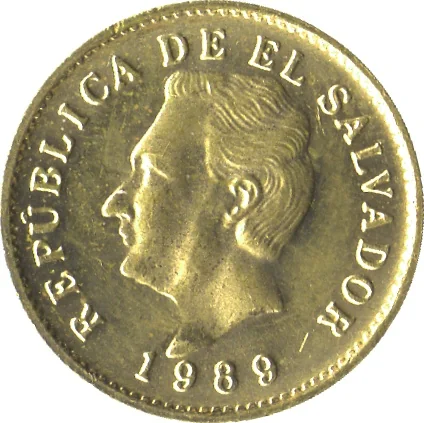
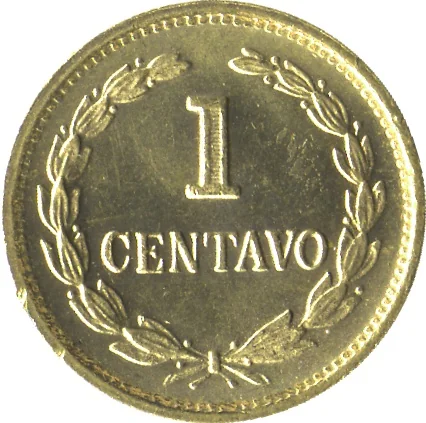
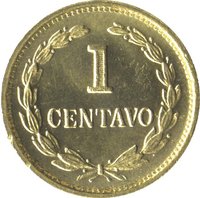
1 Centavo – El Salvador
El Salvador
Context
Years: 1989–1992
Issuer: El Salvador 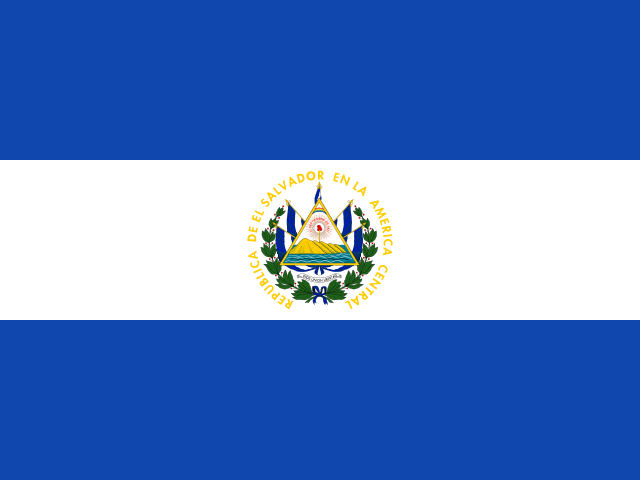
Issuing organization: Central Reserve Bank of El Salvador
Period:
(since 1841)
Currency:
(since 1892)
Demonetization: 1 January 2001
Total mintage: 36,000,000
Material
References
KM: #Click to copy to clipboard135.1a
Numista: #2516
Value
Exchange value: 0.01 SVC
Obverse
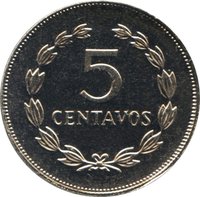
Reverse
Edge
Plain
Mints
| Name | Mark |
|---|---|
| VDM Metals / Vereinigte Deutsche Metallwerke | — |
Mintings
| Year | Mint Mark | Mintage | Quality | Collection |
|---|---|---|---|---|
| 1989 | — | 36,000,000 | ||
| 1992 | — | — |
Historical background
In 1989, El Salvador's currency situation was defined by the colón, which operated under a managed exchange rate system pegged to the US dollar. The Central Reserve Bank (BCR) set the official exchange rate, which had been held at ₡5.00 = US$1.00 since 1986. This fixed peg was a political and economic tool intended to provide stability amidst the nation's profound turmoil, as the country was in the ninth year of a brutal civil war that devastated infrastructure, displaced populations, and crippled the economy.
However, this official rate was largely artificial and unsustainable. A significant parallel black market for US dollars flourished, where the actual exchange rate was far weaker, often trading between ₡6 to ₡7 per dollar. This disparity reflected the severe underlying economic pressures: rampant inflation (reaching approximately 20% annually), a massive government deficit fueled by military spending, and a critical lack of foreign exchange reserves due to declining agricultural exports. The fixed rate created distortions, discouraging exports and encouraging capital flight as confidence in the colón waned.
The currency rigidity was a microcosm of the broader economic crisis. The government, reliant on substantial U.S. aid, used the fixed exchange rate to try to control inflation and signal stability, but it could not mask the profound weakness of the productive economy. By the end of 1989, pressures for a devaluation were mounting inexorably. This set the stage for a major economic shift the following year, when in 1990 the government was forced to implement a significant devaluation and adopt a crawling peg system, formally acknowledging the colón's overvaluation and ceding to market realities.
However, this official rate was largely artificial and unsustainable. A significant parallel black market for US dollars flourished, where the actual exchange rate was far weaker, often trading between ₡6 to ₡7 per dollar. This disparity reflected the severe underlying economic pressures: rampant inflation (reaching approximately 20% annually), a massive government deficit fueled by military spending, and a critical lack of foreign exchange reserves due to declining agricultural exports. The fixed rate created distortions, discouraging exports and encouraging capital flight as confidence in the colón waned.
The currency rigidity was a microcosm of the broader economic crisis. The government, reliant on substantial U.S. aid, used the fixed exchange rate to try to control inflation and signal stability, but it could not mask the profound weakness of the productive economy. By the end of 1989, pressures for a devaluation were mounting inexorably. This set the stage for a major economic shift the following year, when in 1990 the government was forced to implement a significant devaluation and adopt a crawling peg system, formally acknowledging the colón's overvaluation and ceding to market realities.
🌱 Common