

25 Paisa – Nepal
Nepal
Context
Years: 1967–1971
Issuer: Nepal 
Issuing organization: Nepal Rastra Bank
Ruler: Mahendra Bir Bikram Shah
Currency:
(since 1932)
Demonetized: Yes
Total mintage: 4,567
Material
References
KM: #Click to copy to clipboard773
Numista: #25149
Value
Exchange value: 0.25 NPR
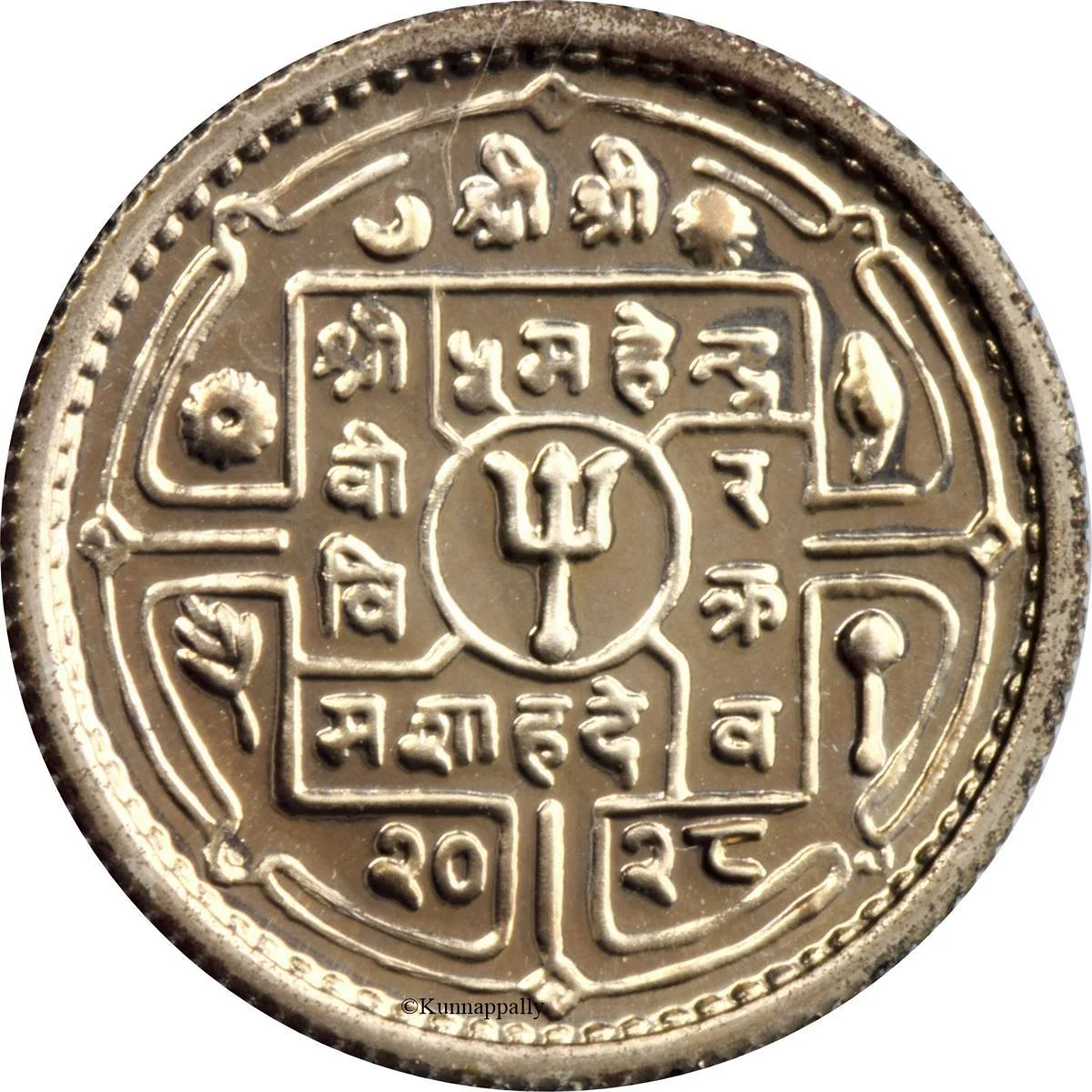
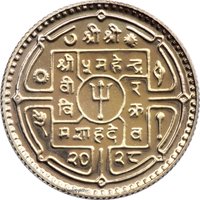
Obverse
Description:
Shah dynasty trident in circle.
Inscription:
श्री श्री
श्री ५महेन्द्र
वी र
वि क्र
म शाहदे व
२० २८
श्री ५महेन्द्र
वी र
वि क्र
म शाहदे व
२० २८
Translation:
Shri Shri
Shri 5 Mahendra
Veera
Vikrama
Shahadeva
20 28
Shri 5 Mahendra
Veera
Vikrama
Shahadeva
20 28
Script: Devanagari
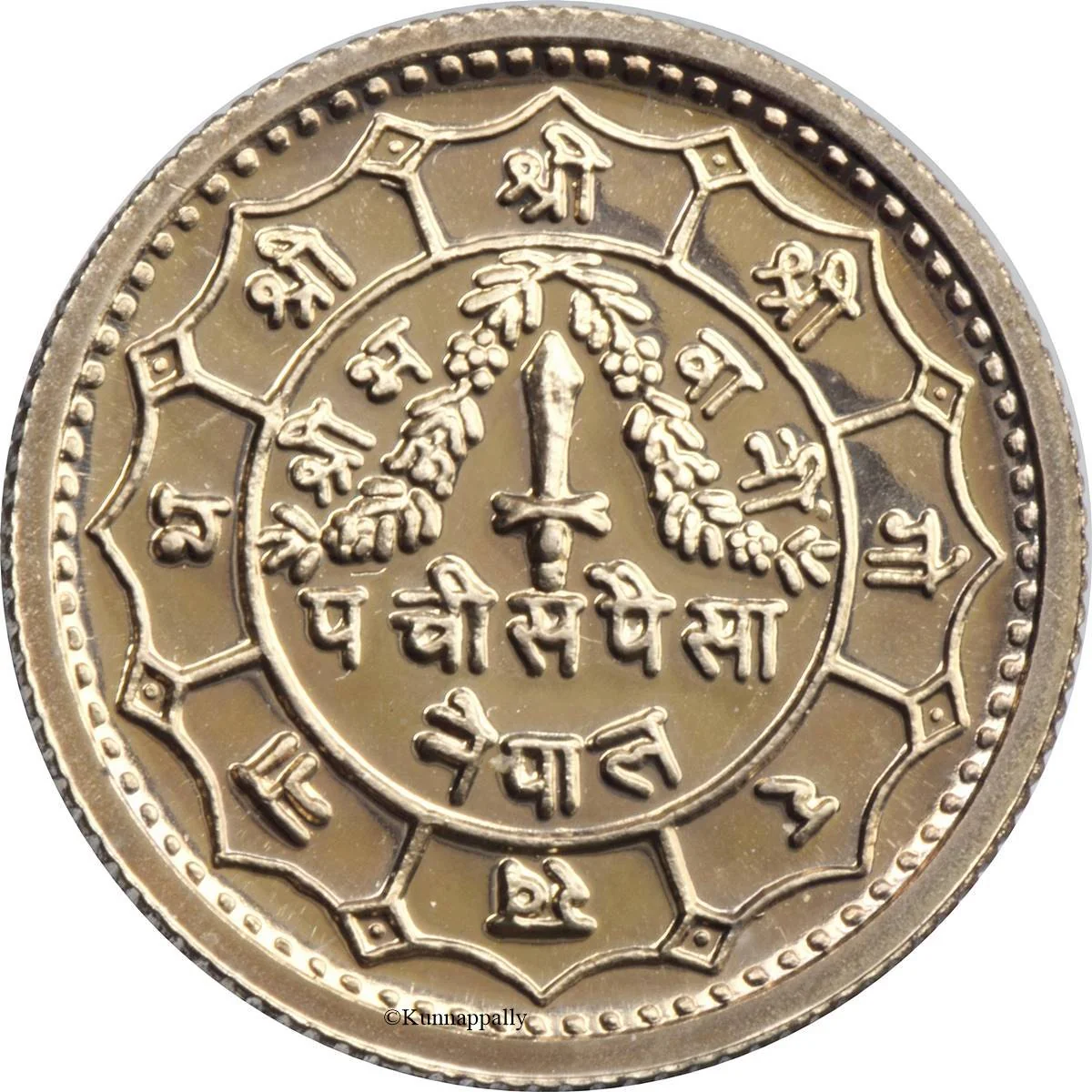
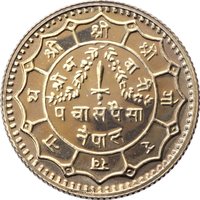
Reverse
Description:
Dagger between hanging garlands.
Inscription:
श्री श्री श्री गो र ख ना थ
श्री भवानी
पचीस पैसा
नेपाल
श्री भवानी
पचीस पैसा
नेपाल
Translation:
Shri Shri Shri Gorakhnath
Shri Bhavani
Twenty-Five Paisa
Nepal
Shri Bhavani
Twenty-Five Paisa
Nepal
Script: Devanagari
Edge
Reeded
Mints
| Name | Mark |
|---|---|
| United States Mint of San Francisco | — |
Mintings
| Year | Mint Mark | Mintage | Quality | Collection |
|---|---|---|---|---|
| 1967 | — | — | ||
| 1968 | — | — | ||
| 1969 | — | — | ||
| 1970 | — | — | ||
| 1970 | — | 2,187 | Proof | |
| 1971 | — | — | ||
| 1971 | — | 2,380 | Proof |
Historical background
In 1967, Nepal's currency situation was fundamentally defined by its fixed exchange rate system and close economic ties to India. The Nepalese rupee (NPR) was pegged to the Indian rupee (INR) at a par value of 1:1, a linkage formalized under the 1960 Nepal-India Trade and Transit Treaty. This arrangement facilitated extensive cross-border trade but also meant Nepal's monetary autonomy was significantly constrained, as its money supply and foreign reserves were heavily influenced by economic conditions and policies in India. The Nepal Rastra Bank, established in 1956, managed the currency but operated within this strict framework.
The economy was largely cash-based and agrarian, with limited financial intermediation. Currency in circulation was growing to meet the needs of a slowly modernizing economy, yet a significant portion of transactions, especially in rural areas, remained non-monetized. The issuance and stability of the Nepalese rupee were backed by foreign exchange reserves, predominantly held in Indian rupees and sterling. A notable feature was the continued legal tender status of Indian currency within Nepal, which circulated freely alongside domestic notes, further underscoring the dependent monetary relationship.
This period was one of relative stability but also of passive monetary policy. There were no major devaluations or crises in 1967 itself; the system functioned predictably under the peg. However, the setup was increasingly viewed by some Nepalese economists and nationalists as an impediment to independent economic planning. The fixed parity would persist for decades, but the inherent constraints of 1967 sowed the seeds for future policy debates that would eventually lead to a managed float and a more independent monetary policy in the early 1990s.
The economy was largely cash-based and agrarian, with limited financial intermediation. Currency in circulation was growing to meet the needs of a slowly modernizing economy, yet a significant portion of transactions, especially in rural areas, remained non-monetized. The issuance and stability of the Nepalese rupee were backed by foreign exchange reserves, predominantly held in Indian rupees and sterling. A notable feature was the continued legal tender status of Indian currency within Nepal, which circulated freely alongside domestic notes, further underscoring the dependent monetary relationship.
This period was one of relative stability but also of passive monetary policy. There were no major devaluations or crises in 1967 itself; the system functioned predictably under the peg. However, the setup was increasingly viewed by some Nepalese economists and nationalists as an impediment to independent economic planning. The fixed parity would persist for decades, but the inherent constraints of 1967 sowed the seeds for future policy debates that would eventually lead to a managed float and a more independent monetary policy in the early 1990s.

🌱 Fairly Common