

1 Colón – Costa Rica
Costa Rica
Context
Year: 1954
Issuer: Costa Rica 
Issuing organization: Central Bank of Costa Rica
Period:
(since 1948)
Currency:
(since 1896)
Demonetized: Yes
Total mintage: 987,000
Material
Diameter: 29 mm
Weight: 8.67 g
Shape: Round
Composition: Stainless steel
Technique: Milled
Alignment: Coin alignment
flip
References
KM: #Click to copy to clipboard186.1
Numista: #25115
Value
Exchange value: 1 CRC
Obverse
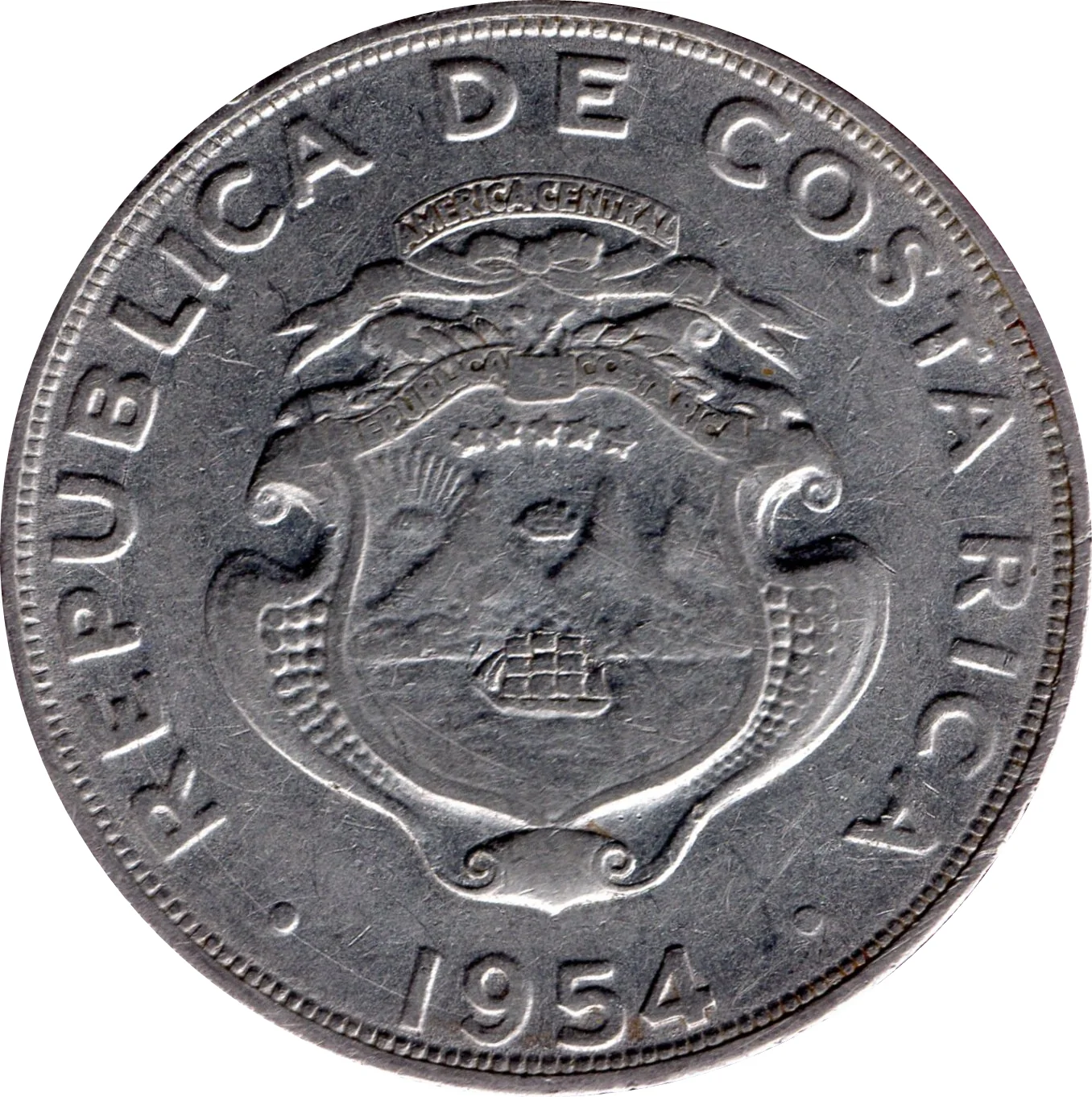
Description:
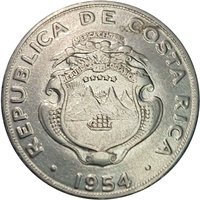
Costa Rica's coat of arms features five stars for its provinces, three volcanoes for its mountain ranges, two ships for its position between oceans, and a sunrise.
Inscription:
REPUBLICA DE COSTA RICA
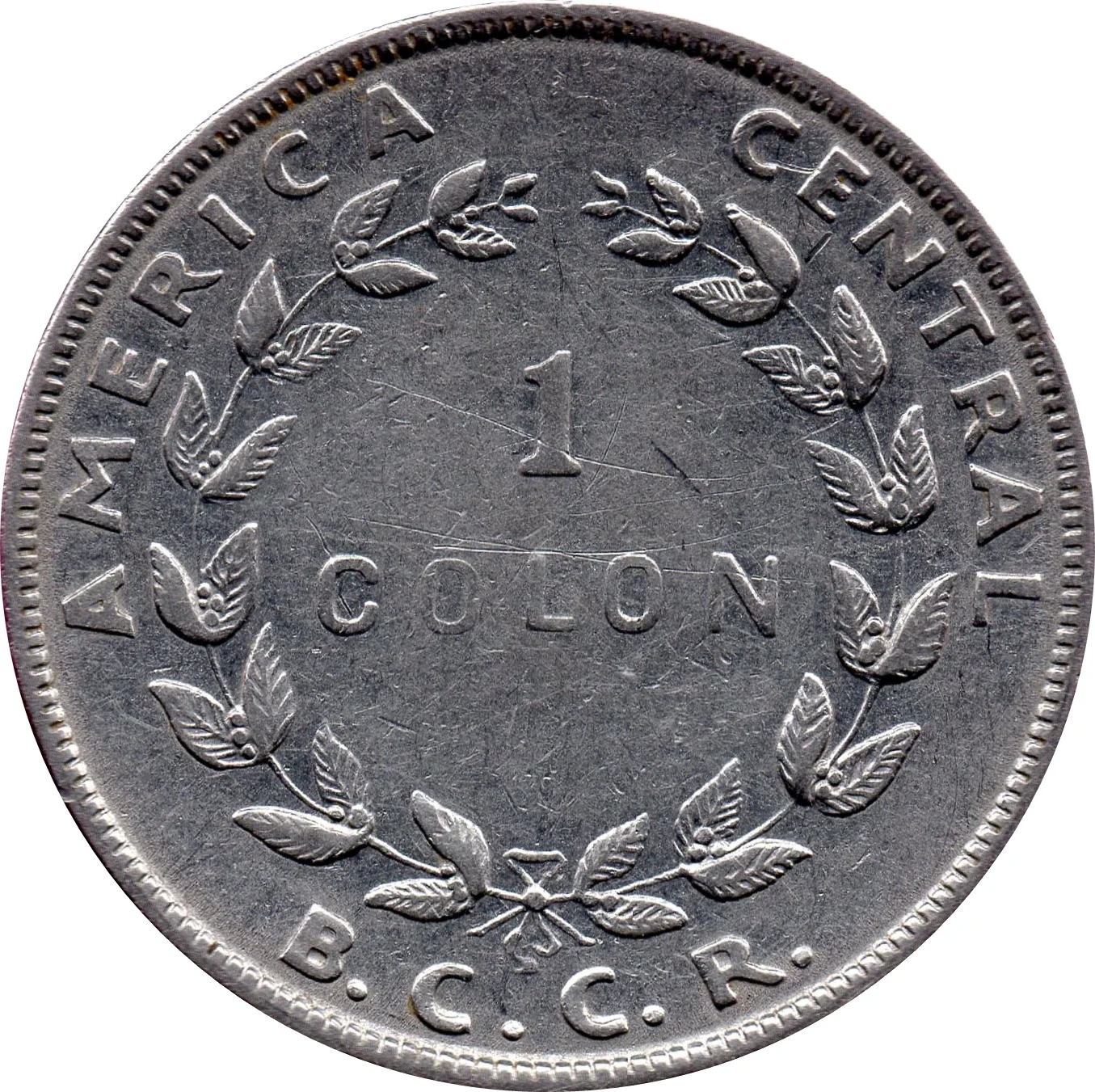
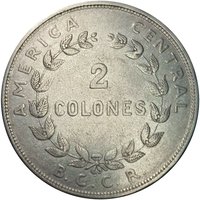
AMERICA CENTRAL
REPUBLICA DE COSTA RICA
1954
AMERICA CENTRAL
REPUBLICA DE COSTA RICA
1954
Translation:
REPUBLIC OF COSTA RICA
CENTRAL AMERICA
REPUBLIC OF COSTA RICA
1954
CENTRAL AMERICA
REPUBLIC OF COSTA RICA
1954
Script: Latin
Language: Spanish
Reverse
Edge
Categories
| Symbols> Coat of Arms |
| Symbol> Wreath |
Mints
| Name | Mark |
|---|---|
| United States Mint of Philadelphia | — |
Mintings
| Year | Mint Mark | Mintage | Quality | Collection |
|---|---|---|---|---|
| 1954 | — | 987,000 |
Historical background
In 1954, Costa Rica's currency situation was characterized by a complex and unstable system of multiple exchange rates, a legacy of the economic policies and disruptions of the 1940s. Following the 1948 Civil War and the subsequent abolition of the military, the new government under José Figueres Ferrer embarked on ambitious social and infrastructural spending. To manage foreign exchange for these priorities and control capital flight, the government maintained a system where the official colón was pegged to the U.S. dollar at a non-competitive rate (around 5.60 colones per dollar) for essential imports, while a less favorable "free" or parallel market existed for other transactions. This created a significant disparity and fostered a thriving black market for dollars.
The system led to persistent economic distortions. The overvalued official colón made Costa Rica's agricultural exports, primarily coffee and bananas, less competitive on the world market, hurting the vital export sector. Simultaneously, it artificially cheapened imports, draining foreign reserves. The government's continued deficit spending to fund social programs and the new National Institute for Housing and Urban Planning (INVU) further fueled inflationary pressures. By 1954, these contradictions were becoming unsustainable, with the parallel market rate reflecting the severe pressure on the currency.
Consequently, 1954 served as a pivotal year leading toward a major monetary reform. The tensions within the multi-tier system highlighted the need for a unified and realistic exchange rate to stabilize the economy. This mounting crisis set the stage for the significant financial reforms that would follow in 1955, including negotiations with the International Monetary Fund (IMF) and a substantial devaluation of the colón to unify the exchange rates and attempt to restore balance-of-payments equilibrium. Thus, the currency situation in 1954 was one of controlled but growing disequilibrium, prompting the critical reforms of the subsequent years.
The system led to persistent economic distortions. The overvalued official colón made Costa Rica's agricultural exports, primarily coffee and bananas, less competitive on the world market, hurting the vital export sector. Simultaneously, it artificially cheapened imports, draining foreign reserves. The government's continued deficit spending to fund social programs and the new National Institute for Housing and Urban Planning (INVU) further fueled inflationary pressures. By 1954, these contradictions were becoming unsustainable, with the parallel market rate reflecting the severe pressure on the currency.
Consequently, 1954 served as a pivotal year leading toward a major monetary reform. The tensions within the multi-tier system highlighted the need for a unified and realistic exchange rate to stabilize the economy. This mounting crisis set the stage for the significant financial reforms that would follow in 1955, including negotiations with the International Monetary Fund (IMF) and a substantial devaluation of the colón to unify the exchange rates and attempt to restore balance-of-payments equilibrium. Thus, the currency situation in 1954 was one of controlled but growing disequilibrium, prompting the critical reforms of the subsequent years.
🌱 Common