

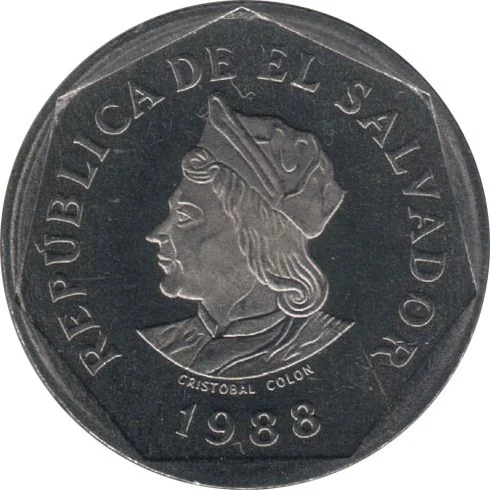
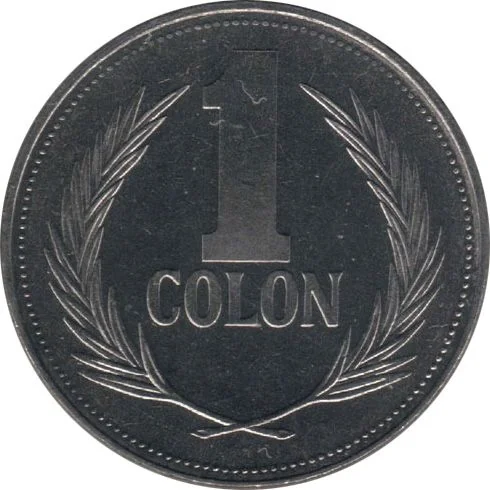
1 Colón – El Salvador
El Salvador
Context
Years: 1988–1999
Issuer: El Salvador 
Issuing organization: Central Reserve Bank of El Salvador
Period:
(since 1841)
Currency:
(since 1892)
Demonetization: 1 January 2001
Total mintage: 30,000,000
Material
Diameter: 25 mm
Weight: 5.95 g
Thickness: 1.7 mm
Shape: Round
Composition: Stainless steel
Technique: Milled
Alignment: Medal alignment
flip
References
KM: #Click to copy to clipboard156
Numista: #2505
Value
Exchange value: 1 SVC
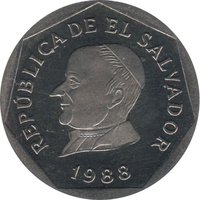
Obverse
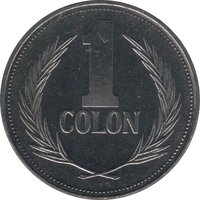
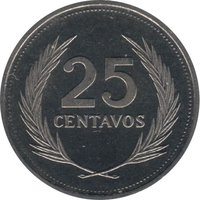
Reverse
Edge
Reeded
Mintings
| Year | Mint Mark | Mintage | Quality | Collection |
|---|---|---|---|---|
| 1988 | — | 30,000,000 | ||
| 1988 | — | — | Proof | |
| 1999 | — | — |
Historical background
In 1988, El Salvador was entrenched in a complex dual-currency system, a legacy of economic instability and civil war. The official currency was the Salvadoran colón, but the US dollar circulated widely and unofficially as a preferred medium for large transactions and a store of value. This dollarization was a pragmatic response to decades of high inflation, devaluation, and a lack of confidence in national institutions, exacerbated by the ongoing 12-year civil conflict that crippled the economy and fueled capital flight.
The government, under President José Napoleón Duarte, maintained a fixed exchange rate of 2.5 colónes to one US dollar, a rate established in 1986. However, this official rate was largely artificial and unsustainable. A thriving black market existed where the colón traded at a significant discount, often exceeding 5 colónes per dollar, revealing the stark gap between government policy and market reality. This parallel market was essential for many businesses and individuals, but it created economic distortions, encouraged corruption, and undermined official monetary policy.
This monetary duality reflected the broader economic crisis of the late 1980s. The economy was heavily dependent on foreign aid, primarily from the United States, to sustain both the government and the war effort against the FMLN guerrillas. With low export earnings, high debt, and rampant inflation, the reliance on the US dollar provided a fragile semblance of stability for those who could access it, while highlighting the profound weakness of the national currency and the Salvadoran state's limited capacity to manage its economy amidst profound political and social turmoil.
The government, under President José Napoleón Duarte, maintained a fixed exchange rate of 2.5 colónes to one US dollar, a rate established in 1986. However, this official rate was largely artificial and unsustainable. A thriving black market existed where the colón traded at a significant discount, often exceeding 5 colónes per dollar, revealing the stark gap between government policy and market reality. This parallel market was essential for many businesses and individuals, but it created economic distortions, encouraged corruption, and undermined official monetary policy.
This monetary duality reflected the broader economic crisis of the late 1980s. The economy was heavily dependent on foreign aid, primarily from the United States, to sustain both the government and the war effort against the FMLN guerrillas. With low export earnings, high debt, and rampant inflation, the reliance on the US dollar provided a fragile semblance of stability for those who could access it, while highlighting the profound weakness of the national currency and the Salvadoran state's limited capacity to manage its economy amidst profound political and social turmoil.
🌱 Common