

5 lire – Vatican City
Add to wishlist
Circulating commemorative coins
Commemoration: Sede Vacante
Vatican City
Context
Year: 1939
Issuer: Vatican City
Period:
Currency:
(1929—2001)
Demonetized: Yes
Total mintage: 40,000
Material
References
KM: #
Numista: #24975
Value
Exchange value: 5 VAL
Bullion value: $10.14
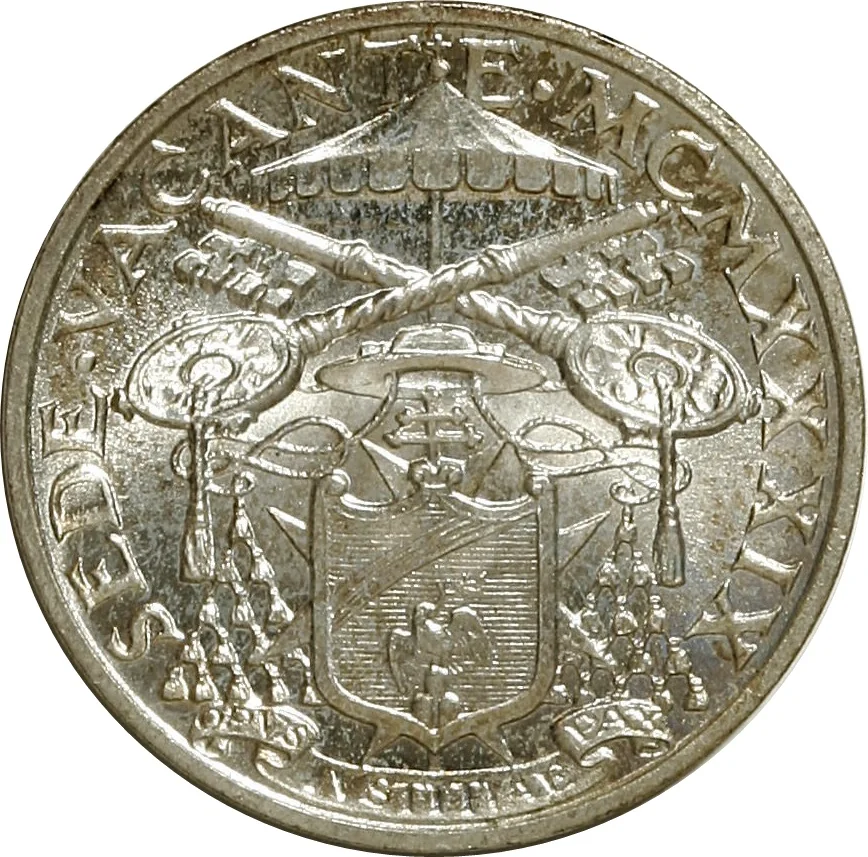
Obverse
Description:
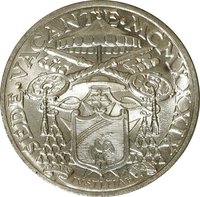
Arms of Cardinal Eugenio Pacelli
Inscription:
SEDE·VACANTE·MCMXXXIX
OPVS IVSTITIA PAX
OPVS IVSTITIA PAX
Script: Latin
Engraver: Aurelio Mistruzzi
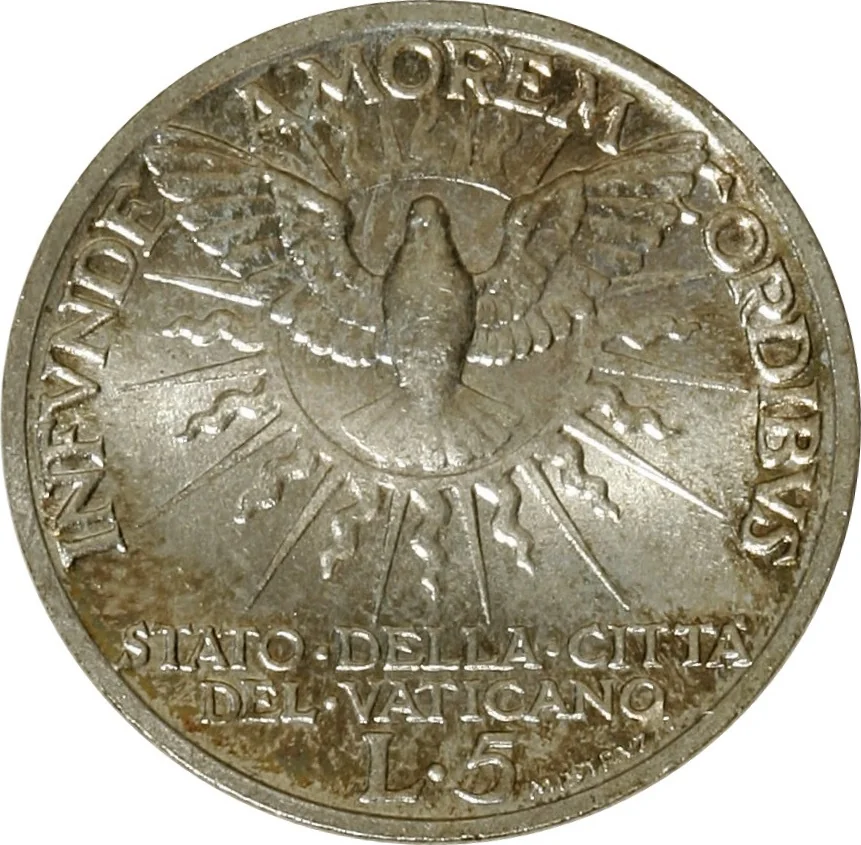
Reverse
Description:
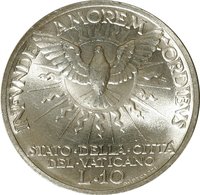
Sunlit dove.
Inscription:
INFVNDE AMOREM ORDIBVS
STATO·DELLA·CITTA
DEL·VATICANO
L·5
STATO·DELLA·CITTA
DEL·VATICANO
L·5
Script: Latin
Engraver: Aurelio Mistruzzi
Edge
Plain
Mintings
| Year | Mint Mark | Mintage | Quality | Collection |
|---|---|---|---|---|
| 1939 | — | 40,000 |
Historical background
In 1939, Vatican City’s currency situation was intrinsically tied to its unique status as a newly established sovereign entity and the broader monetary landscape of Italy. The Lateran Treaty of 1929, which created the Vatican City State, granted it the right to issue its own coinage. This was a key symbol of its political and financial sovereignty, separating it from the Kingdom of Italy. Consequently, the Vatican began minting its own lira in 1929, which was at parity and fully interchangeable with the Italian lira, forming a de facto monetary union. The Italian lira remained legal tender within the tiny city-state, and Vatican lire circulated without restriction in Italy.
The year 1939 fell within the period of the "Roman Question" being resolved, but also within the autarkic economic policies of Fascist Italy under Benito Mussolini. Italy had left the gold standard in the 1930s, and its currency was controlled and protected. Vatican coinage, minted in limited quantities primarily for collectors and commemorative purposes, adhered to the same metallic standards and denominations as Italian coins. Its practical economic function was minimal, as the state’s revenue came largely from investments and donations (like Peter’s Pence), and its day-to-day financial operations were heavily integrated with the Italian banking and currency system.
Pope Pius XII’s ascension in March 1939 occurred on the brink of World War II, a conflict that would soon profoundly disrupt European finance. Therefore, while the Vatican’s currency arrangement in 1939 was stable and governed by treaty, it was inherently vulnerable to the fortunes of the Italian lira and the impending war. The state’s financial independence was more juridical than practical, existing within the constraints of Mussolini’s controlled economy and on the eve of a period where border controls, inflation, and monetary instability would challenge the seamless interchangeability upon which the system relied.
The year 1939 fell within the period of the "Roman Question" being resolved, but also within the autarkic economic policies of Fascist Italy under Benito Mussolini. Italy had left the gold standard in the 1930s, and its currency was controlled and protected. Vatican coinage, minted in limited quantities primarily for collectors and commemorative purposes, adhered to the same metallic standards and denominations as Italian coins. Its practical economic function was minimal, as the state’s revenue came largely from investments and donations (like Peter’s Pence), and its day-to-day financial operations were heavily integrated with the Italian banking and currency system.
Pope Pius XII’s ascension in March 1939 occurred on the brink of World War II, a conflict that would soon profoundly disrupt European finance. Therefore, while the Vatican’s currency arrangement in 1939 was stable and governed by treaty, it was inherently vulnerable to the fortunes of the Italian lira and the impending war. The state’s financial independence was more juridical than practical, existing within the constraints of Mussolini’s controlled economy and on the eve of a period where border controls, inflation, and monetary instability would challenge the seamless interchangeability upon which the system relied.
🌟 Limited