

1 kuna (Kuna Currency) – Croatia
Add to wishlist
Circulating commemorative coins
Commemoration: 10th anniversary of Kuna Currency
Croatia
Obverse
Description:
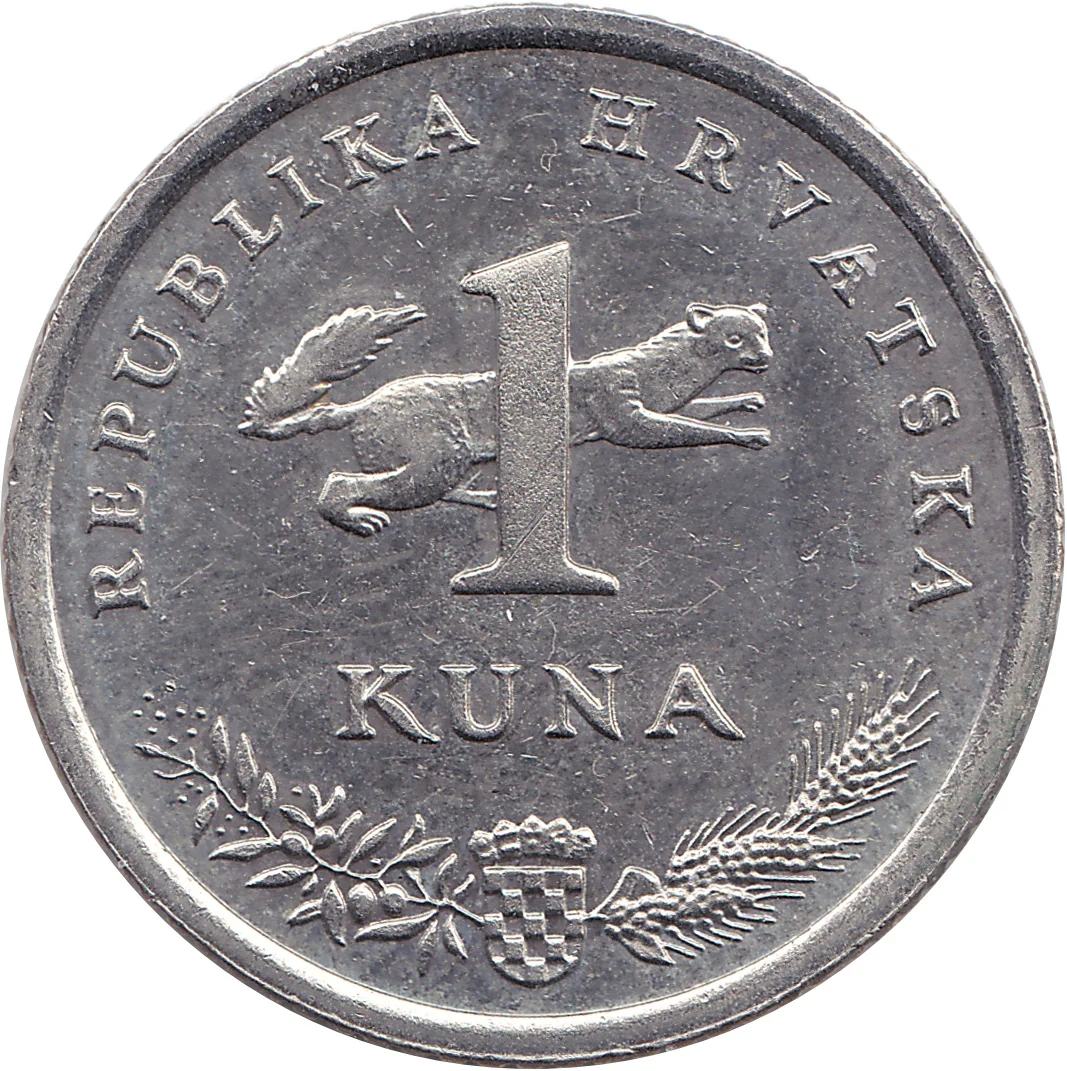
A marten runs right in the upper half-circle, with the numeral "1" and the word "KUNA" on its body. "REPUBLIKA HRVATSKA" arches above. Below, the central coat of arms is flanked by stylized wheat ears (right) and an olive branch (left).
Inscription:
REPUBLIKA HRVATSKA
1
KUNA
1
KUNA
Translation:
REPUBLIC OF CROATIA
1
Kuna
1
Kuna
Script: Latin
Language: Croatian
Engraver: Kuzma Kovačić
Reverse
Description:
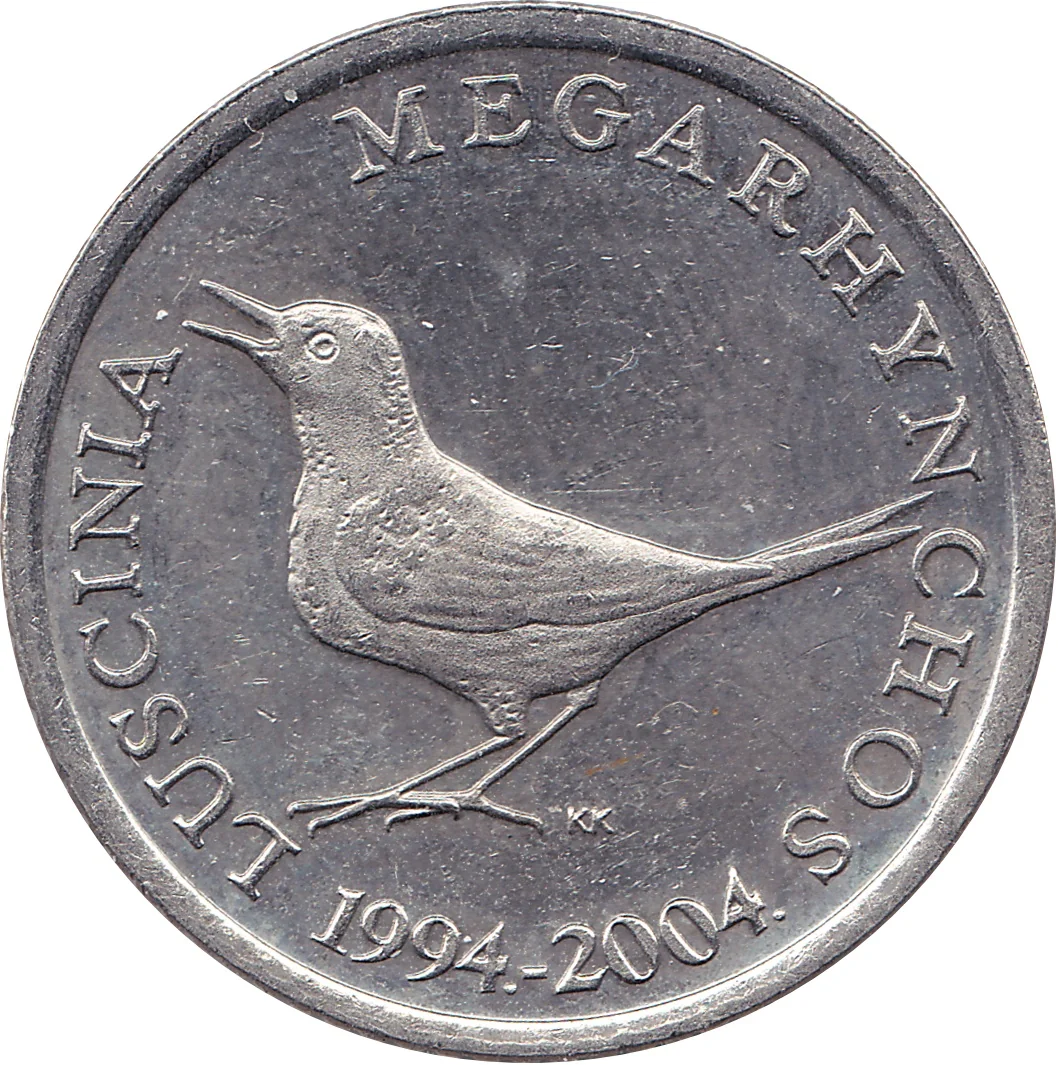
A left-facing nightingale is centrally depicted, encircled by its Latin name (LUSCINIA MEGARHYNCHOS). The years 1994-2004 are below, and the signature "KK" is near its foot.
Inscription:
LUSCINIA MEGARHYNCHOS
KK
1994.-2004.
KK
1994.-2004.
Script: Latin
Engraver: Kuzma Kovačić
Edge
Reeded (86 grooves)
Mints
| Name | Mark |
|---|---|
| Croatian Mint | — |
Mintings
| Year | Mint Mark | Mintage | Quality | Collection |
|---|---|---|---|---|
| 2004 | — | 2,000 | Proof | |
| 2004 | — | 4,000,000 |
Historical background
In 2004, Croatia's currency situation was defined by a managed floating exchange rate regime, with the Croatian kuna (HRK) as the national currency. The primary objective of the Croatian National Bank (CNB) was to maintain price and exchange rate stability, a challenging task given the country's high euroization, where a significant portion of savings and loans were denominated in foreign currencies, primarily the euro. This reliance created vulnerability to exchange rate fluctuations, making stability a key pillar of monetary policy.
The kuna was not pegged to the euro but was closely managed against it, with the CNB frequently intervening in the foreign exchange market to smooth out excessive volatility. This period followed a successful stabilization program from the 1990s, and by 2004, the kuna was relatively stable, fostering an environment conducive to economic growth and increasing foreign investment. However, the economy faced persistent challenges, including a large current account deficit and rising public debt, which placed underlying pressure on the currency framework.
This monetary policy approach was strategically aligned with Croatia's broader European integration goals. In 2004, the country was actively pursuing European Union membership, making the stability of the kuna and the reduction of inflation essential for meeting the Maastricht criteria in the future. Therefore, the currency management of 2004 was not only about immediate economic stability but also a deliberate step toward preparing for eventual Eurozone accession, a process that would culminate nearly two decades later with the adoption of the euro in 2023.
The kuna was not pegged to the euro but was closely managed against it, with the CNB frequently intervening in the foreign exchange market to smooth out excessive volatility. This period followed a successful stabilization program from the 1990s, and by 2004, the kuna was relatively stable, fostering an environment conducive to economic growth and increasing foreign investment. However, the economy faced persistent challenges, including a large current account deficit and rising public debt, which placed underlying pressure on the currency framework.
This monetary policy approach was strategically aligned with Croatia's broader European integration goals. In 2004, the country was actively pursuing European Union membership, making the stability of the kuna and the reduction of inflation essential for meeting the Maastricht criteria in the future. Therefore, the currency management of 2004 was not only about immediate economic stability but also a deliberate step toward preparing for eventual Eurozone accession, a process that would culminate nearly two decades later with the adoption of the euro in 2023.
🌱 Very Common