


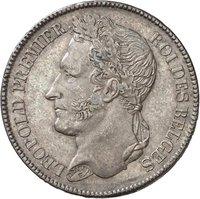
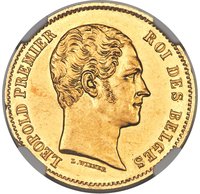
Obverse
Description:
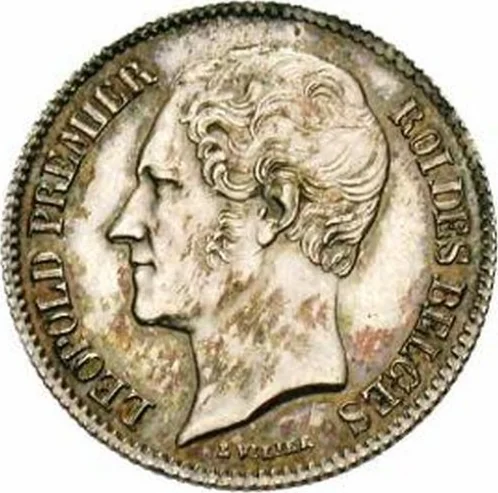
Leopold I of Belgium in left profile, French legend encircling. Designer below neck.
Inscription:
LEOPOLD PREMIER ROI DES BELGES
L.WIENER
L.WIENER
Translation:
Leopold the First King of the Belgians
L. Wiener
L. Wiener
Script: Latin
Language: French
Engraver: Léopold Wiener
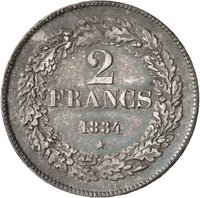
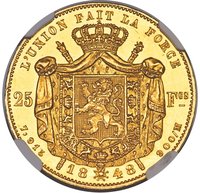
Reverse
Description:
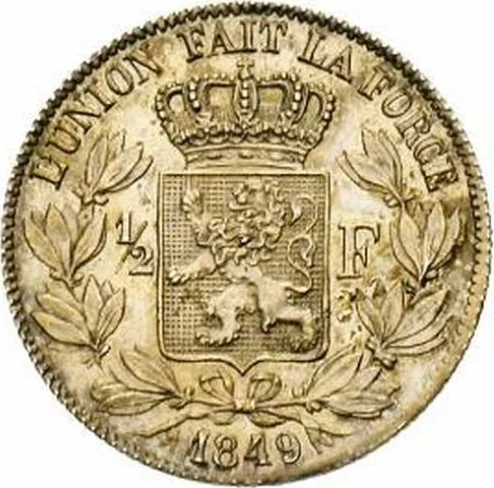
Coat of arms in wreath divides value. French motto above, year below.
Inscription:
L'UNION FAIT LA FORCE
1/2 F
1849
1/2 F
1849
Translation:
Union makes strength
1/2 F
1849
1/2 F
1849
Script: Latin
Language: French
Engraver: Léopold Wiener
Edge
Reeded
Mints
| Name | Mark |
|---|---|
| Royal Mint of Belgium | — |
Mintings
| Year | Mint Mark | Mintage | Quality | Collection |
|---|---|---|---|---|
| 1847 | — | — | ||
| 1849 | — | 209,571 | ||
| 1850 | — | — |
Historical background
In 1847, Belgium's currency situation was characterized by a complex and transitional monetary system, a direct legacy of its recent independence in 1830. The new nation had inherited a patchwork of coins from the previous Dutch, French, and Austrian regimes, alongside various banknotes. The official unit of account was the Belgian franc, pegged to the French franc under the Latin Monetary Union principles that were being formulated, but in practice, multiple foreign coins circulated freely alongside domestic issues. This lack of a uniform, trusted national currency created significant confusion for commerce and daily transactions, hindering economic cohesion.
The government, under the leadership of Prime Minister Charles Rogier, recognized that a stable and unified currency was essential for national sovereignty and economic development. The pivotal step came with the Monetary Law of June 5, 1847, which aimed to decisively reform the system. This law did not create an entirely new currency but sought to standardize and control the existing franc. It mandated the withdrawal of foreign gold and silver coins from circulation and centralized the minting of new, distinctly Belgian coinage at the national mint.
Therefore, 1847 stands as a watershed year, marking the deliberate move from a fragmented, post-colonial monetary landscape toward a modern, state-controlled currency system. The reforms of that year laid the essential legal and practical groundwork for Belgium's full integration into the Latin Monetary Union in 1865, finally providing the stable and uniform monetary foundation necessary for the country's rapid industrial expansion in the latter half of the 19th century.
The government, under the leadership of Prime Minister Charles Rogier, recognized that a stable and unified currency was essential for national sovereignty and economic development. The pivotal step came with the Monetary Law of June 5, 1847, which aimed to decisively reform the system. This law did not create an entirely new currency but sought to standardize and control the existing franc. It mandated the withdrawal of foreign gold and silver coins from circulation and centralized the minting of new, distinctly Belgian coinage at the national mint.
Therefore, 1847 stands as a watershed year, marking the deliberate move from a fragmented, post-colonial monetary landscape toward a modern, state-controlled currency system. The reforms of that year laid the essential legal and practical groundwork for Belgium's full integration into the Latin Monetary Union in 1865, finally providing the stable and uniform monetary foundation necessary for the country's rapid industrial expansion in the latter half of the 19th century.
💎 Extremely Rare