

20 reais – Brazil
Add to wishlist
Non-circulating coins
Commemoration: Ayrton Senna - Race Driver
Brazil
Context
Year: 1995
Issuer: Brazil
Issuing organization: Central Bank of Brazil
Period:
(since 1967)
Currency:
(since 1994)
Total mintage: 5,000
Material
References
KM: #
Numista: #24884
Value
Exchange value: 20 BRL
Bullion value: $1104.60
Inflation-adjusted value: 202.29 BRL
Obverse
Description:
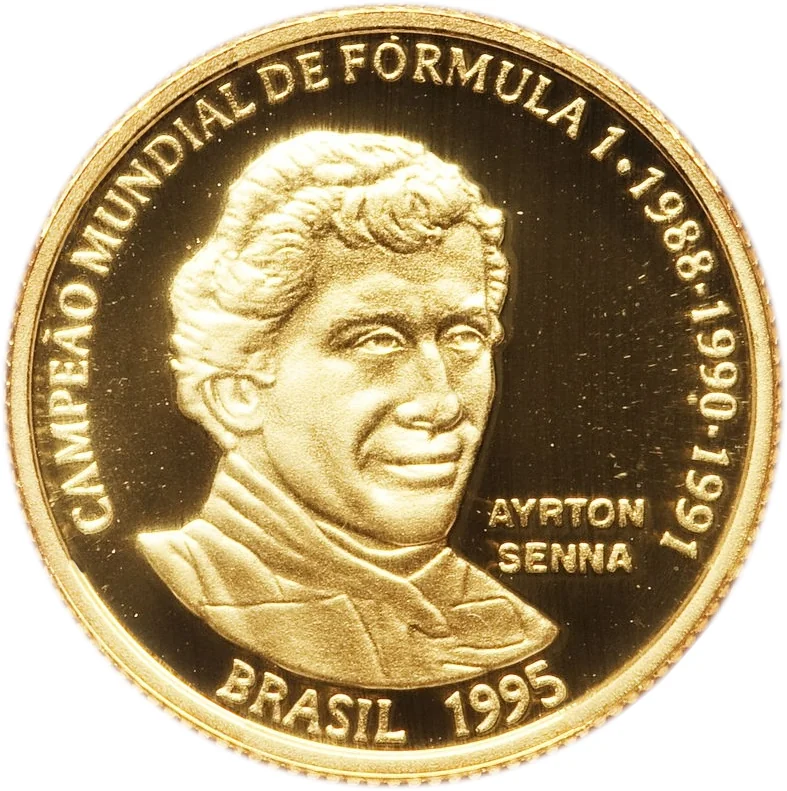
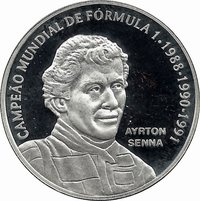
Ayrton Senna bust facing right over country and date.
Inscription:
CAMPEÃO MUNDIAL DE FÓRMULA 1·1988-1990-1991
AYRTON
SENNA
BRASIL 1995
AYRTON
SENNA
BRASIL 1995
Translation:
WORLD CHAMPION OF FORMULA 1·1988-1990-1991
AYRTON
SENNA
BRAZIL 1995
AYRTON
SENNA
BRAZIL 1995
Script: Latin
Language: Portuguese
Engraver: Glória Aparecida Ferreira Dias
Reverse
Inscription:
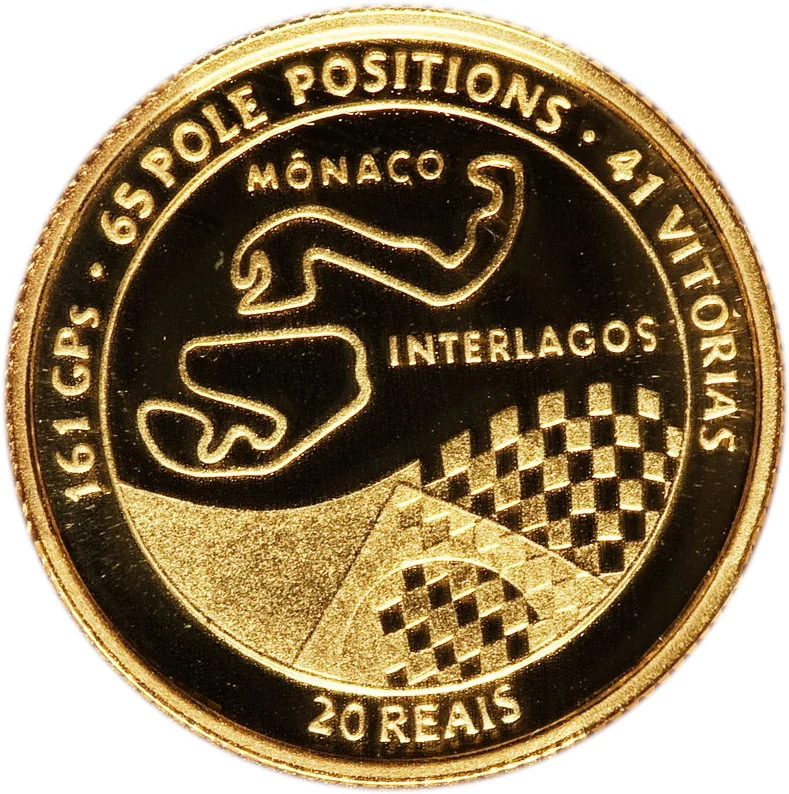
161 GPs · 65 POLE POSITIONS · 41 VITÓRIAS
MÔNACO
INTERLAGOS
20 REAIS
MÔNACO
INTERLAGOS
20 REAIS
Translation:
161 Grands Prix · 65 Pole Positions · 41 Victories
MONACO
INTERLAGOS
20 Reais
MONACO
INTERLAGOS
20 Reais
Script: Latin
Languages: English, Portuguese
Engraver: Glória Aparecida Ferreira Dias
Edge
Reeded
Categories
| Person> Sportsperson |
| Symbol> Flag |
| Sport> Motorsports |
Mints
| Name | Mark |
|---|---|
| Casa da Moeda do Brasil | — |
Mintings
| Year | Mint Mark | Mintage | Quality | Collection |
|---|---|---|---|---|
| 1995 | — | 5,000 | Proof |
Historical background
In 1995, Brazil's currency situation was defined by the Plano Real, a bold stabilization program launched in July 1994 under Finance Minister Fernando Henrique Cardoso. The plan's cornerstone was a new currency, the Real (R$), which was initially pegged to the US dollar through a semi-fixed "crawling peg" exchange rate band. This mechanism was crucial for breaking the inertial inflation that had plagued the country for decades, as it anchored prices and restored public confidence by providing a stable unit of account. The immediate success was dramatic, with annual inflation plummeting from over 2,000% in 1994 to just 22% in 1995.
However, the stability came at a significant cost. The strong, overvalued Real led to a surge in imports and a widening current account deficit, as Brazilian goods became more expensive abroad and foreign products became cheap domestically. To defend the currency peg and attract the foreign capital needed to finance this deficit, the Brazilian Central Bank was forced to maintain extremely high interest rates. While this succeeded in controlling inflation and stabilizing the currency in the short term, it also stifled economic growth and increased the government's debt servicing costs.
Consequently, 1995 was a year of fragile equilibrium. The government, now led by President Cardoso, was engaged in a difficult balancing act, using the currency anchor to consolidate the victory over hyperinflation while simultaneously implementing fiscal reforms to address the underlying structural deficits that the Plano Real had exposed. The situation highlighted the inherent tension of the exchange rate anchor: it was an effective tool for ending inflation but created vulnerabilities in external accounts and public debt that would pose severe challenges in the years to come, culminating in the 1999 currency crisis.
However, the stability came at a significant cost. The strong, overvalued Real led to a surge in imports and a widening current account deficit, as Brazilian goods became more expensive abroad and foreign products became cheap domestically. To defend the currency peg and attract the foreign capital needed to finance this deficit, the Brazilian Central Bank was forced to maintain extremely high interest rates. While this succeeded in controlling inflation and stabilizing the currency in the short term, it also stifled economic growth and increased the government's debt servicing costs.
Consequently, 1995 was a year of fragile equilibrium. The government, now led by President Cardoso, was engaged in a difficult balancing act, using the currency anchor to consolidate the victory over hyperinflation while simultaneously implementing fiscal reforms to address the underlying structural deficits that the Plano Real had exposed. The situation highlighted the inherent tension of the exchange rate anchor: it was an effective tool for ending inflation but created vulnerabilities in external accounts and public debt that would pose severe challenges in the years to come, culminating in the 1999 currency crisis.

💎 Extremely Rare