

5000 tolarjev (Bled) – Slovenia
Add to wishlist
Non-circulating coins
Commemoration: 1000th anniversary of the first written mention of Bled
Slovenia
Context
Material
References
KM: #
Numista: #24840
Value
Exchange value: 5000 SIT
Bullion value: $35.18
Inflation-adjusted value: 8594.45 SIT
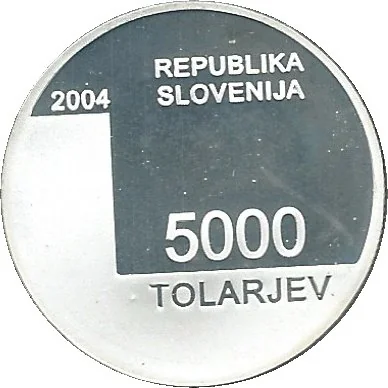
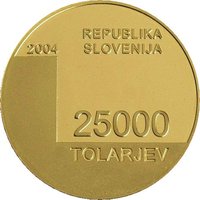
Obverse
Description:
Valuable
Inscription:
REPUBLIKA
SLOVENIJA
2004
5000
TOLARJEV
SLOVENIJA
2004
5000
TOLARJEV
Script: Latin
Designer: Boštjan Gabrovšek
Reverse
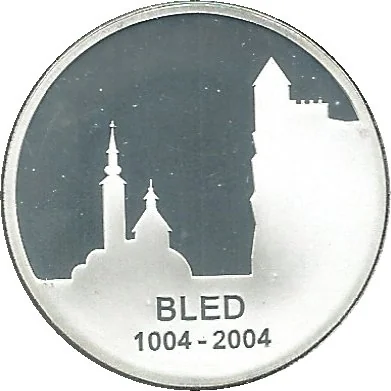
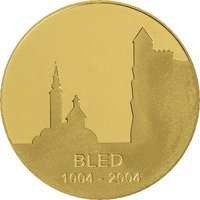
Description:
Castle and towers outlined.
Inscription:
BLED
1004 - 2004
1004 - 2004
Script: Latin
Designer: Boštjan Gabrovšek
Edge
160 reeds.
Categories
| Building> Castle or fortification |
| Building> Religious building |
Mints
| Name | Mark |
|---|---|
| Kremnica | — |
Mintings
| Year | Mint Mark | Mintage | Quality | Collection |
|---|---|---|---|---|
| 2004 | — | 2,500 | Proof |
Historical background
In 2004, Slovenia's currency situation was defined by a pivotal transition. The country, having successfully navigated the economic turbulence of its 1991 independence, was operating with its own national currency, the Slovenian tolar (SIT). The tolar had been introduced in 1991 and, following a period of high inflation in the early 1990s, was stabilized through prudent monetary policy by the Bank of Slovenia. By 2004, it was a stable and fully convertible currency, a key marker of the nation's economic maturity as it prepared for its most significant integration step since independence.
This year was crucial because Slovenia was on an accelerated path toward adopting the euro. Having joined the European Union in May 2004, the country immediately entered the EU's Exchange Rate Mechanism II (ERM II) in June, a mandatory two-year "waiting room" for euro adoption. Within this mechanism, the tolar's central rate was set at 239.64 tolars to the euro, and it was allowed to fluctuate within a ±15% band. The Bank of Slovenia successfully maintained exchange rate stability, keeping the tolar tightly pegged near its central rate, which was a key convergence criterion.
Therefore, the background of 2004 is one of confident preparation and final compliance. The government and central bank were diligently working to meet all the Maastricht criteria on inflation, interest rates, budget deficits, and public debt. The successful stability within ERM II, combined with meeting the other economic benchmarks, set the stage for the European Commission's positive convergence report in 2006. This ultimately led to Slovenia being the first of the 2004 EU entrants to adopt the euro, which it did on January 1, 2007, rendering the tolar a historical footnote.
This year was crucial because Slovenia was on an accelerated path toward adopting the euro. Having joined the European Union in May 2004, the country immediately entered the EU's Exchange Rate Mechanism II (ERM II) in June, a mandatory two-year "waiting room" for euro adoption. Within this mechanism, the tolar's central rate was set at 239.64 tolars to the euro, and it was allowed to fluctuate within a ±15% band. The Bank of Slovenia successfully maintained exchange rate stability, keeping the tolar tightly pegged near its central rate, which was a key convergence criterion.
Therefore, the background of 2004 is one of confident preparation and final compliance. The government and central bank were diligently working to meet all the Maastricht criteria on inflation, interest rates, budget deficits, and public debt. The successful stability within ERM II, combined with meeting the other economic benchmarks, set the stage for the European Commission's positive convergence report in 2006. This ultimately led to Slovenia being the first of the 2004 EU entrants to adopt the euro, which it did on January 1, 2007, rendering the tolar a historical footnote.
💎 Extremely Rare