

1 cent – South Africa
Add to wishlist
South Africa
Context
Years: 1997–2000
Issuer: South Africa
Period:
(since 1961)
Currency:
(since 1961)
Total mintage: 1,933,039,418
Material
References
KM: #
Numista: #2480
Value
Exchange value: 0.01 ZAR
Inflation-adjusted value: 0.04 ZAR
Obverse
Description:
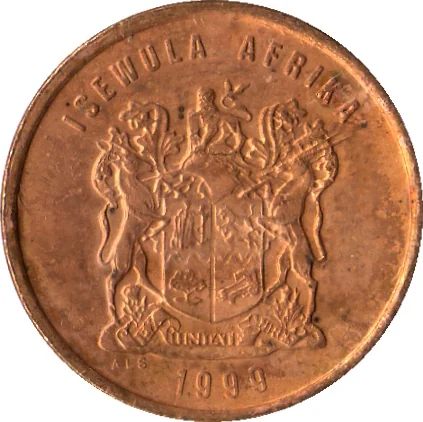
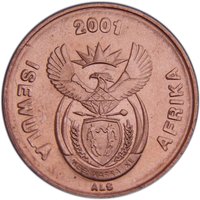
South Africa's coat of arms with the country name in Ndebele above.
Inscription:
ISEWULA AFRIKA 1999
EX UNITATE VIRES
ALS
EX UNITATE VIRES
ALS
Translation:
Strength from Unity
Script: Latin
Engraver: Arthur Sutherland
Reverse
Description:
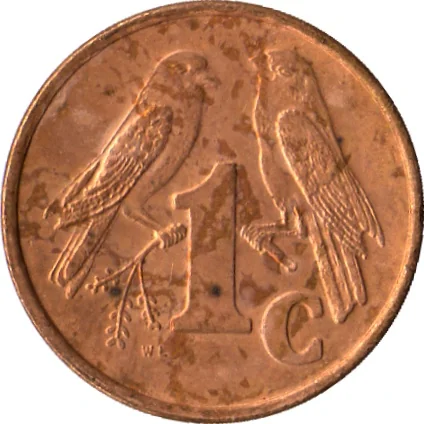
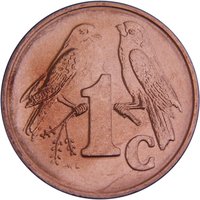
Cape Sparrows and lower denominations.
Inscription:
1c WL
Script: Latin
Engraver: William Lumley
Edge
Plain
Categories
| Animal> Bird |
| Symbols> Coat of Arms |
Mints
| Name | Mark |
|---|---|
| South African Mint | — |
Mintings
| Year | Mint Mark | Mintage | Quality | Collection |
|---|---|---|---|---|
| 1997 | — | 428,000,000 | ||
| 1997 | — | 7,515 | BU | |
| 1997 | — | 3,596 | Proof | |
| 1998 | — | 548,000,000 | ||
| 1998 | — | 4,487 | BU | |
| 1998 | — | 3,051 | Proof | |
| 1999 | — | 5,525 | BU | |
| 1999 | — | 3,774 | Proof | |
| 1999 | — | 370,000,000 | ||
| 2000 | — | 587,000,000 | ||
| 2000 | — | 7,767 | BU | |
| 2000 | — | 3,703 | Proof |
Historical background
In 1997, South Africa's currency, the rand, was navigating a complex period of transition and vulnerability. The country was still in the early years of post-apartheid democracy, with the government led by President Nelson Mandela focused on attracting foreign investment and implementing the Growth, Employment and Redistribution (GEAR) macroeconomic policy. While inflation was being brought under control by the South African Reserve Bank (SARB), the rand remained exposed to global market sentiment and domestic political uncertainties. Its value was influenced by high interest rates designed to curb inflation and the ongoing challenge of integrating the previously marginalized majority into the formal economy.
The year was marked by significant external pressure, most notably the spillover effects of the 1997 Asian Financial Crisis. As investors fled emerging markets globally, South Africa experienced substantial capital outflows, putting severe downward pressure on the rand. This highlighted the currency's sensitivity to international risk aversion, despite the country's improving fiscal fundamentals. Domestically, debates continued over the appropriate level of exchange control liberalization, balancing the desire for open capital markets with the need to maintain monetary stability.
By the end of 1997, the rand had depreciated considerably against major currencies like the US dollar, a trend that would intensify in the following years. This depreciation reflected both the contagion from emerging market crises and underlying concerns about South Africa's current account deficit and long-term economic prospects. The situation underscored the delicate task facing policymakers: managing a volatile currency while simultaneously trying to stimulate growth, reduce unemployment, and build international confidence in the new South Africa.
The year was marked by significant external pressure, most notably the spillover effects of the 1997 Asian Financial Crisis. As investors fled emerging markets globally, South Africa experienced substantial capital outflows, putting severe downward pressure on the rand. This highlighted the currency's sensitivity to international risk aversion, despite the country's improving fiscal fundamentals. Domestically, debates continued over the appropriate level of exchange control liberalization, balancing the desire for open capital markets with the need to maintain monetary stability.
By the end of 1997, the rand had depreciated considerably against major currencies like the US dollar, a trend that would intensify in the following years. This depreciation reflected both the contagion from emerging market crises and underlying concerns about South Africa's current account deficit and long-term economic prospects. The situation underscored the delicate task facing policymakers: managing a volatile currency while simultaneously trying to stimulate growth, reduce unemployment, and build international confidence in the new South Africa.
🌱 Very Common