

Obverse
Description:
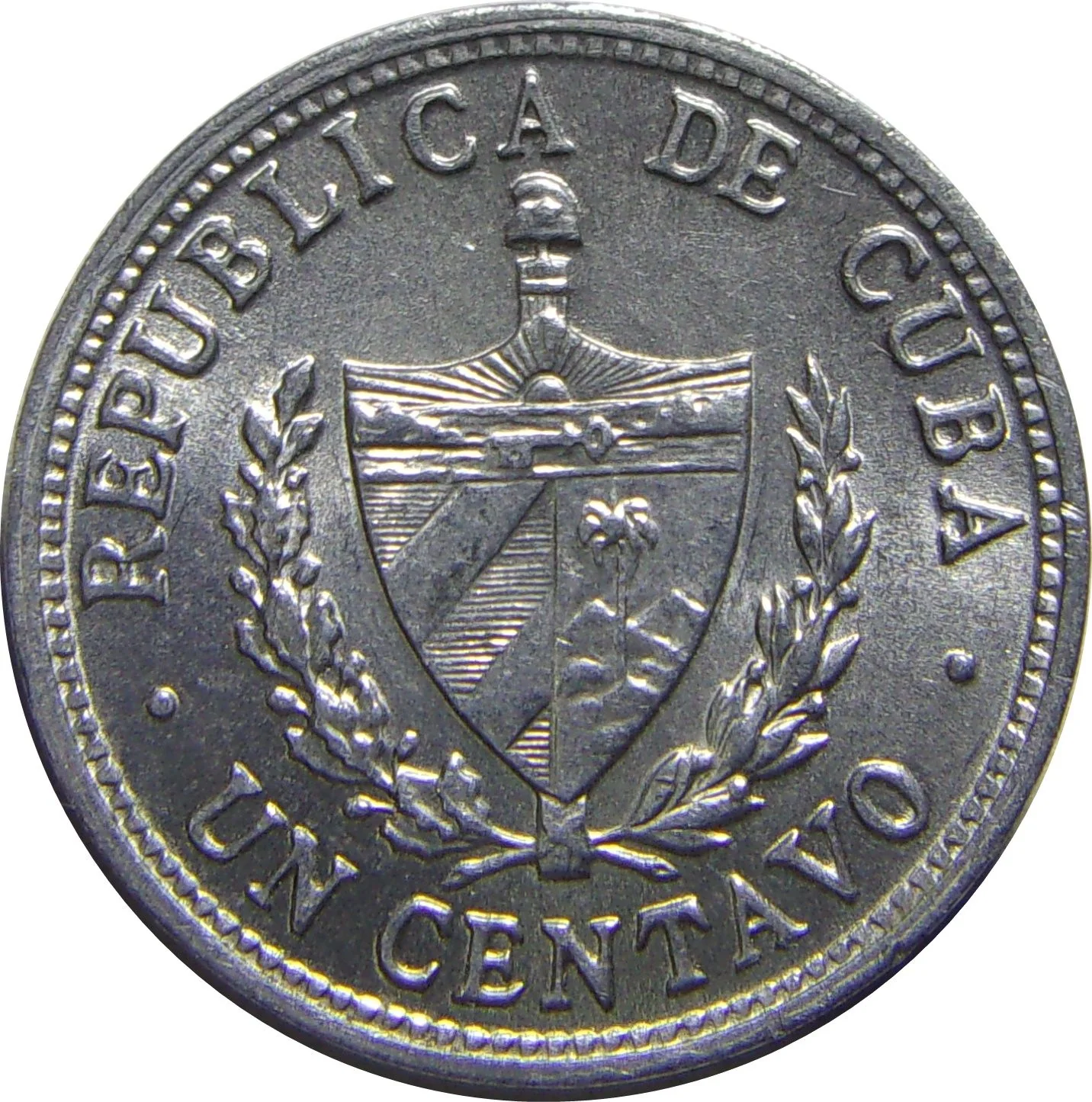
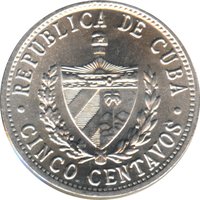
Cuban coat of arms. Top legend: country name. Bottom legend: face value in letters. Denticles near rim.
Inscription:
REPUBLICA DE CUBA
• UN CENTAVO •
• UN CENTAVO •
Translation:
REPUBLIC OF CUBA
• ONE CENT •
• ONE CENT •
Script: Latin
Language: Spanish
Engraver: Charles Edward Barber
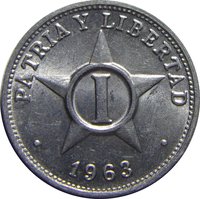
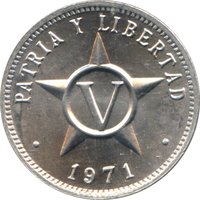
Reverse
Description:
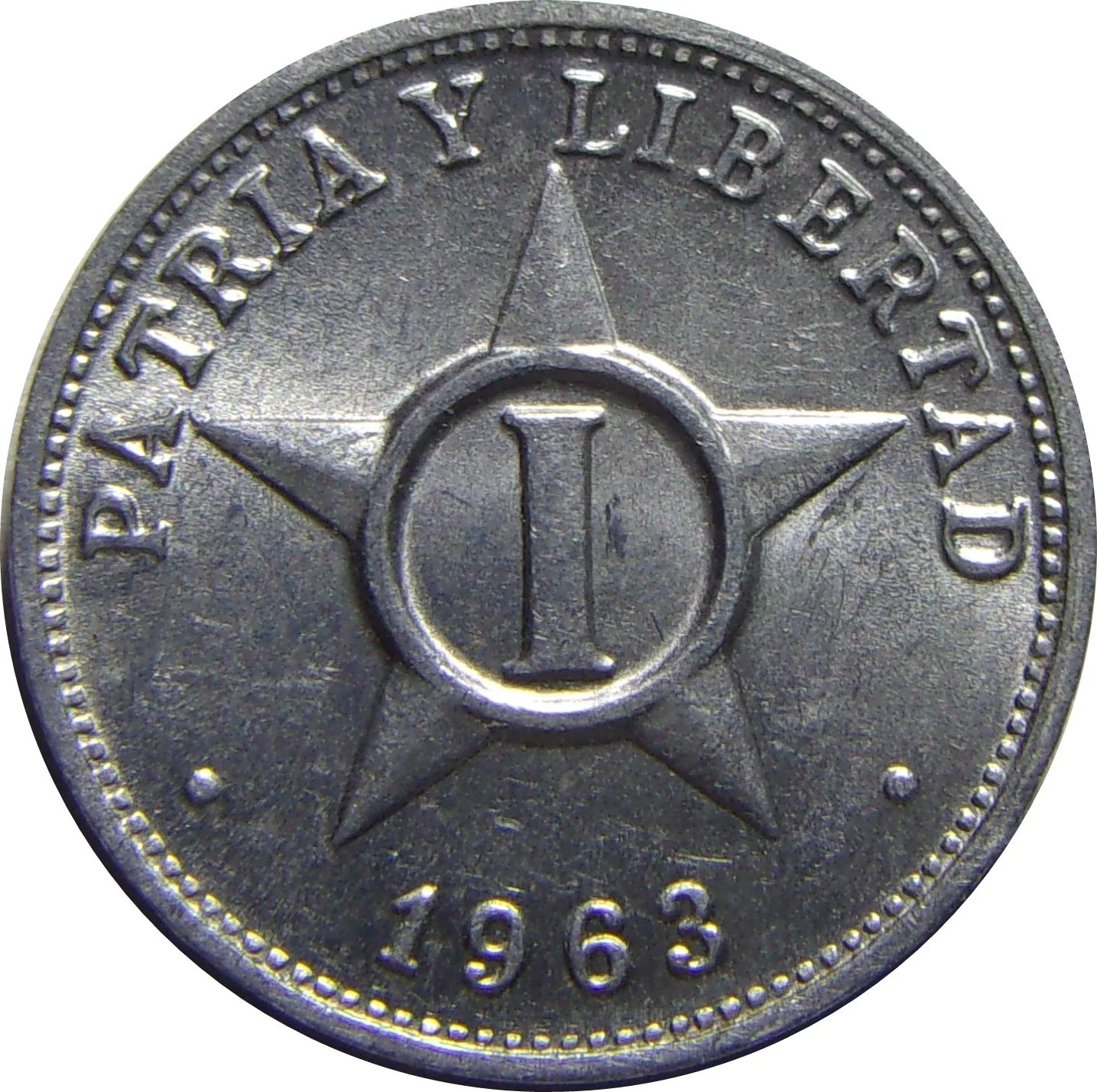
Roman numeral in circled star. Top legend, date below. Denticles near rim.
Inscription:
PATRIA Y LIBERTAD
I
• 1963 •
I
• 1963 •
Translation:
Country and Liberty
I
• 1963 •
I
• 1963 •
Script: Latin
Language: Spanish
Engraver: Charles Edward Barber
Edge
Plain
Categories
| Symbols> Coat of Arms |
Mints
| Name | Mark |
|---|---|
| Saint Petersburg | — |
Mintings
| Year | Mint Mark | Mintage | Quality | Collection |
|---|---|---|---|---|
| 1963 | — | 200,020,000 | ||
| 1966 | — | 50,000,000 | ||
| 1969 | — | 50,000,000 | ||
| 1970 | — | 50,000,000 | ||
| 1971 | — | 49,960,000 | ||
| 1972 | — | 100,000,000 | ||
| 1978 | — | 50,000,000 | ||
| 1979 | — | 100,000,000 | ||
| 1981 | — | 100,000,000 | ||
| 1982 | — | 50,000,000 |
Historical background
In 1963, Cuba's currency situation was defined by the revolutionary government's sweeping economic restructuring and the deepening confrontation with the United States. Following the 1959 Revolution and the subsequent U.S. embargo, Cuba realigned its economy with the Soviet bloc, moving toward a centrally planned model. A critical step was the nationalization of nearly all private industry and banking, which placed control of the monetary system firmly in the hands of the state. This period saw the elimination of the old peso's convertibility with the U.S. dollar and the establishment of a government monopoly on foreign exchange, isolating Cuba from the Western financial system.
The year was marked by the official launch of two distinct currency systems, a structure that would define Cuban economics for decades. While both were called the "peso," they operated in separate spheres: the Cuban Peso (CUP) for domestic wages and most goods for Cuban citizens, and the Cuban Convertible Peso (CUC), which was pegged to the Soviet ruble and later other hard currencies, and used in foreign trade and tourism. This dual system, though not fully formalized until later, began to take shape as a means to capture scarce foreign currency while shielding the domestic economy. It created an early, stark divide between those with access to convertible currency and those reliant solely on national pesos.
Furthermore, 1963 was a year of significant inflationary pressure and scarcity. The shift away from sugar-centric exports and rapid industrialization efforts, combined with the loss of the U.S. market and the need to reorient trade over great distances, led to widespread shortages of consumer goods. The government responded with a comprehensive rationing system (the libreta) for basic necessities, effectively suppressing open inflation but creating a parallel economy. Thus, the currency situation was not merely a financial policy but a core component of Cuba's new socialist society, characterized by state control, isolation from the dollar zone, and the emergence of a dual monetary reality that separated the domestic population from the international economy.
The year was marked by the official launch of two distinct currency systems, a structure that would define Cuban economics for decades. While both were called the "peso," they operated in separate spheres: the Cuban Peso (CUP) for domestic wages and most goods for Cuban citizens, and the Cuban Convertible Peso (CUC), which was pegged to the Soviet ruble and later other hard currencies, and used in foreign trade and tourism. This dual system, though not fully formalized until later, began to take shape as a means to capture scarce foreign currency while shielding the domestic economy. It created an early, stark divide between those with access to convertible currency and those reliant solely on national pesos.
Furthermore, 1963 was a year of significant inflationary pressure and scarcity. The shift away from sugar-centric exports and rapid industrialization efforts, combined with the loss of the U.S. market and the need to reorient trade over great distances, led to widespread shortages of consumer goods. The government responded with a comprehensive rationing system (the libreta) for basic necessities, effectively suppressing open inflation but creating a parallel economy. Thus, the currency situation was not merely a financial policy but a core component of Cuba's new socialist society, characterized by state control, isolation from the dollar zone, and the emergence of a dual monetary reality that separated the domestic population from the international economy.
🌱 Very Common