

5 Francs – Belgium
Belgium
Context
Years: 1865–1868
Issuer: Belgium 
Ruler: Leopold II
Currency:
(1832—2001)
Demonetization: 30 July 1932
Material
References
KM: #Click to copy to clipboard25
Numista: #24661
Value
Exchange value: 5 BEF
Bullion value: $64.19
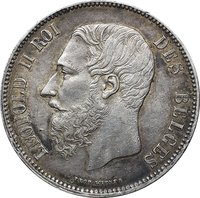
Obverse
Description:
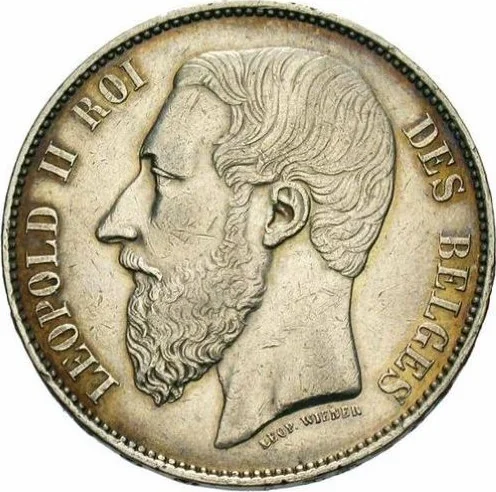
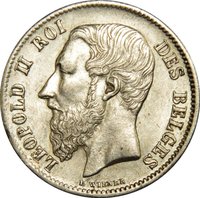
Head of Leopold II left, French legend around, designer below.
Inscription:
LEOPOLD II ROI DES BELGES
LEOP. WIENER
LEOP. WIENER
Translation:
Leopold II King of the Belgians
Leopold Wiener
Leopold Wiener
Script: Latin
Language: French
Engraver: Léopold Wiener
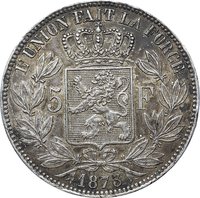
Reverse
Description:
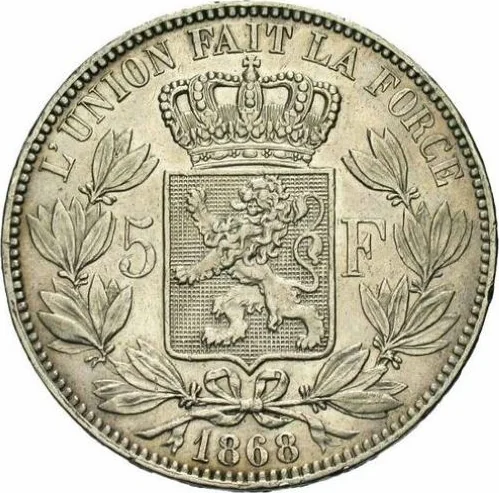
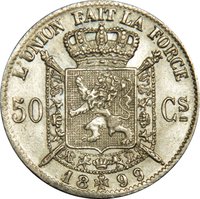
Coat of arms in wreath divides value, French motto above, year below.
Inscription:
L'UNION FAIT LA FORCE
5 F
1868
5 F
1868
Translation:
Union makes strength
5 Francs
1868
5 Francs
1868
Script: Latin
Language: French
Engraver: Léopold Wiener
Edge
Plain with raised lettering
Legend:
DIEU PROTÈGE LA BELGIQUE ***
Translation:
God Protects Belgium ***
Language: French
Mints
| Name | Mark |
|---|---|
| Royal Mint of Belgium | — |
Mintings
| Year | Mint Mark | Mintage | Quality | Collection |
|---|---|---|---|---|
| 1865 | — | — | ||
| 1866 | — | — | ||
| 1867 | — | — | ||
| 1868 | — | — |
Historical background
In 1865, Belgium's currency situation was defined by its pivotal role in the formation of the Latin Monetary Union (LMU). Following its independence in 1830, Belgium had initially adopted a monetary system closely aligned with that of France, based on a bimetallic standard of gold and silver. However, the mid-19th century saw significant instability in the relative values of these two metals, causing disruptive arbitrage and threatening the stability of national coinages across Europe. Belgium, alongside France, Italy, and Switzerland, sought a multilateral solution to this problem.
Consequently, on December 23, 1865, the four nations signed the treaty that established the Latin Monetary Union. This agreement created a standardized, bimetallic currency bloc where each member's coins—the Belgian franc, French franc, Italian lira, and Swiss franc—were defined by identical weights of gold and silver (4.5 grams of fine silver or 0.290322 grams of fine gold for a franc) and were granted legal tender status across all member states. For Belgium, this formalized and strengthened its existing monetary ties with France, ensuring the free circulation of its currency with its major economic partners and stabilizing exchange rates.
The immediate background in 1865 was thus one of proactive international cooperation to overcome the flaws of bimetallism. The LMU aimed to facilitate trade and travel by eliminating exchange risk within Western Europe. While successful in the short term, the Union would later face strains from members over-issuing silver token coins and the global shift toward a gold standard. Nevertheless, in 1865, Belgium's currency was at the forefront of a pioneering, albeit ultimately unsustainable, experiment in European monetary integration.
Consequently, on December 23, 1865, the four nations signed the treaty that established the Latin Monetary Union. This agreement created a standardized, bimetallic currency bloc where each member's coins—the Belgian franc, French franc, Italian lira, and Swiss franc—were defined by identical weights of gold and silver (4.5 grams of fine silver or 0.290322 grams of fine gold for a franc) and were granted legal tender status across all member states. For Belgium, this formalized and strengthened its existing monetary ties with France, ensuring the free circulation of its currency with its major economic partners and stabilizing exchange rates.
The immediate background in 1865 was thus one of proactive international cooperation to overcome the flaws of bimetallism. The LMU aimed to facilitate trade and travel by eliminating exchange risk within Western Europe. While successful in the short term, the Union would later face strains from members over-issuing silver token coins and the global shift toward a gold standard. Nevertheless, in 1865, Belgium's currency was at the forefront of a pioneering, albeit ultimately unsustainable, experiment in European monetary integration.
⭐ Somewhat Rare