

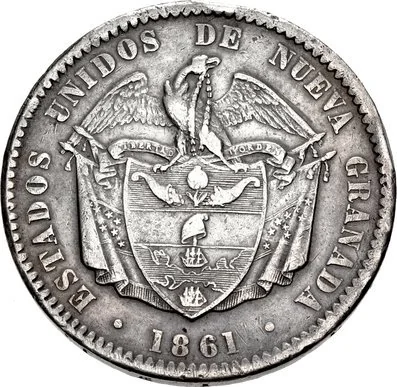
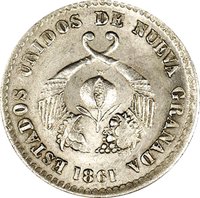
Obverse
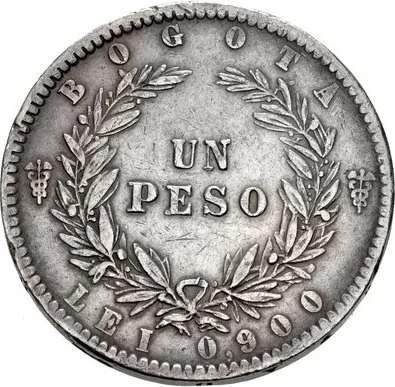
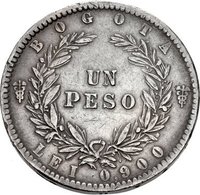
Reverse
Description:
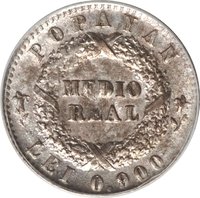
Mint above. Denomination in wreath, caduceus on each side. Fineness below.
Inscription:
BOGOTA
UN
PESO
LEI 0,900
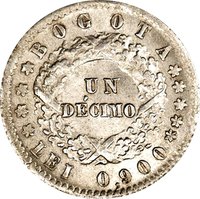
UN
PESO
LEI 0,900
Script: Latin
Edge
Mints
| Name | Mark |
|---|---|
| Bogota Mint | BOGOTA |
Mintings
| Year | Mint Mark | Mintage | Quality | Collection |
|---|---|---|---|---|
| 1861 | — | — |
Historical background
In 1861, Colombia was embroiled in the chaotic period known as the "Radical Olympus" following a liberal revolution led by General Tomás Cipriano de Mosquera. The nation, then called the Granadine Confederation, was fractured by civil war between centralist and federalist forces, and its currency system reflected this profound instability. The government, facing immense war expenses and a crippling lack of credit, resorted to the rampant issuance of paper money without metallic backing. This led to severe inflation and a dramatic loss of public confidence, as the value of these banknotes plummeted and they circulated at a steep discount to gold and silver coin.
The monetary landscape was further complicated by the legacy of earlier, decentralized minting. Prior to the 1860s, various sovereign states within the confederation, such as Antioquia and Cauca, issued their own gold and silver coinage, leading to a circulation of heterogeneous coins of varying weight and purity. While the 1861 "Medellín Mint Law" attempted to centralize coinage under the new federal government, the ongoing conflict and the overwhelming flood of paper money made this reform largely ineffective. The result was a dual system where scarce, trusted precious metal coins were hoarded for significant transactions and foreign trade, while devalued paper notes were used for daily, local commerce.
Consequently, the currency situation in 1861 was one of profound disorder, characterized by hyperinflation of fiat paper, a retreat to commodity money where available, and a complete lack of uniform national monetary authority. This financial crisis was both a cause and a symptom of the broader political disintegration, severely hampering economic activity and trade. It set the stage for the monetary reforms that would later be attempted by the subsequent United States of Colombia, which grappled with the consequences of this period for decades.
The monetary landscape was further complicated by the legacy of earlier, decentralized minting. Prior to the 1860s, various sovereign states within the confederation, such as Antioquia and Cauca, issued their own gold and silver coinage, leading to a circulation of heterogeneous coins of varying weight and purity. While the 1861 "Medellín Mint Law" attempted to centralize coinage under the new federal government, the ongoing conflict and the overwhelming flood of paper money made this reform largely ineffective. The result was a dual system where scarce, trusted precious metal coins were hoarded for significant transactions and foreign trade, while devalued paper notes were used for daily, local commerce.
Consequently, the currency situation in 1861 was one of profound disorder, characterized by hyperinflation of fiat paper, a retreat to commodity money where available, and a complete lack of uniform national monetary authority. This financial crisis was both a cause and a symptom of the broader political disintegration, severely hampering economic activity and trade. It set the stage for the monetary reforms that would later be attempted by the subsequent United States of Colombia, which grappled with the consequences of this period for decades.
✨ Legendary