

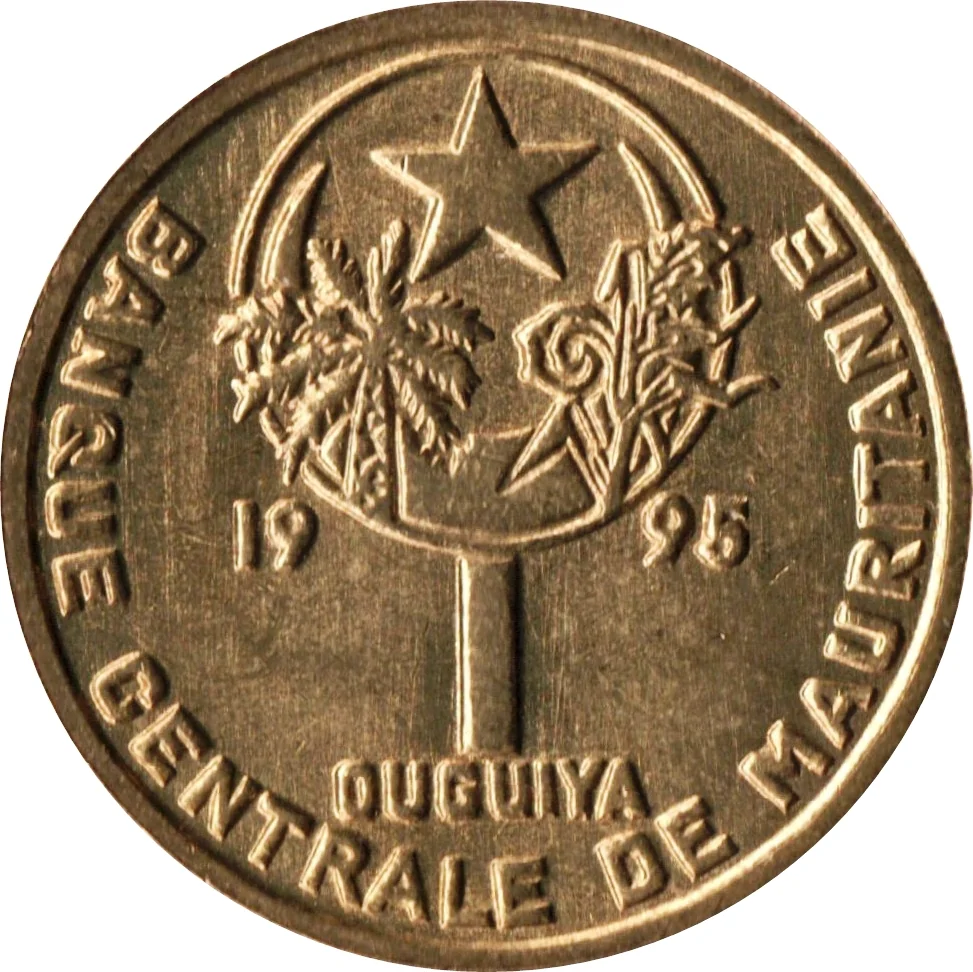
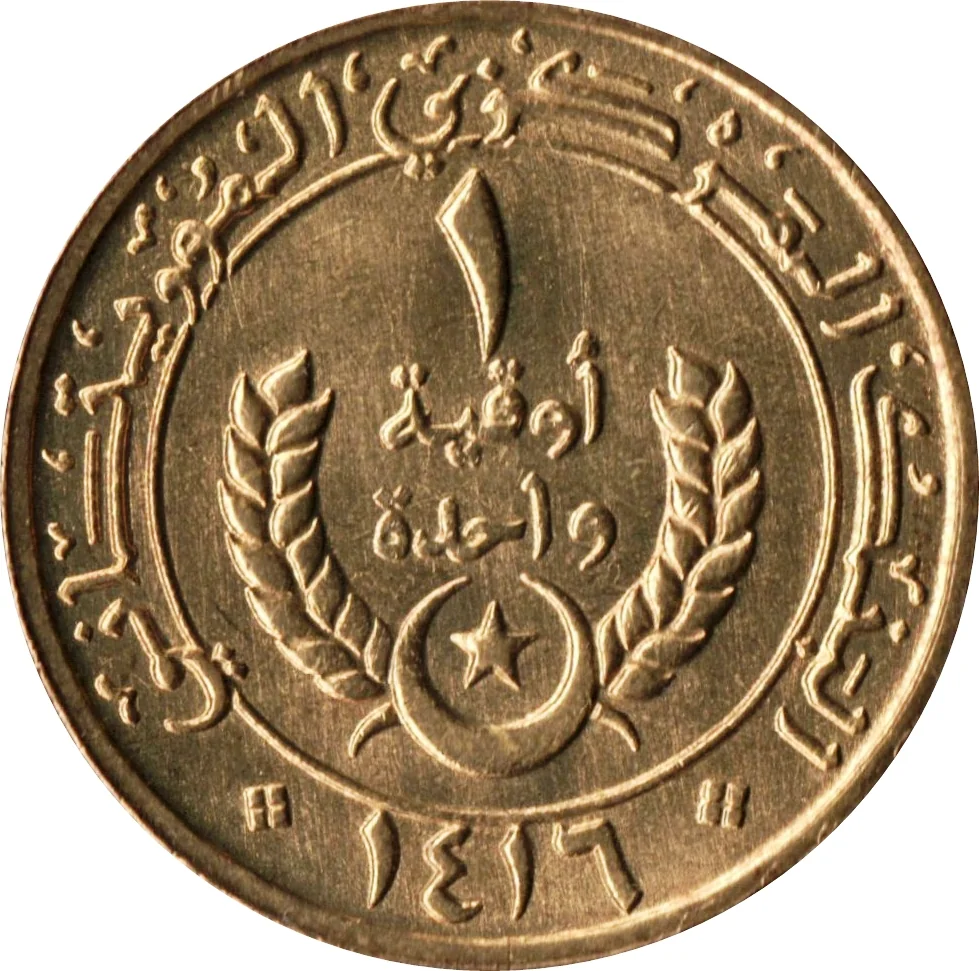
1 ouguiya – Mauritania
Add to wishlist
Mauritania
Context
Years: 1974–2003
Issuer: Mauritania
Issuing organization: Central Bank of Mauritania
Period:
(since 1960)
Currency:
(1973—2018)
Demonetization: 30 June 2018
Material
Diameter: 21 mm
Weight: 3.6 g
Thickness: 1.53 mm
Shape: Round
Composition: Aluminium bronze
Magnetic: No
Technique: Milled
Alignment: Coin alignment
flip
References
KM: #
Numista: #2458
Value
Exchange value: 1 MRO
Obverse
Reverse
Edge
Reeded
Mints
| Name | Mark |
|---|---|
| Kremnica | — |
Mintings
| Year | Mint Mark | Mintage | Quality | Collection |
|---|---|---|---|---|
| 1974 | — | — | ||
| 1981 | — | — | ||
| 1983 | — | — | ||
| 1986 | — | — | ||
| 1987 | — | — | ||
| 1990 | — | — | ||
| 1993 | — | — | ||
| 1995 | — | — | ||
| 2003 | — | — |
Historical background
In 1974, Mauritania was navigating a complex monetary transition rooted in its recent independence and regional economic ties. Since 1960, the country had used the CFA franc, a colonial-era currency guaranteed by France and shared across much of French-speaking West Africa. This arrangement provided stability but limited national monetary sovereignty, a point of growing contention as Mauritania sought to assert its economic independence, particularly following the nationalization of its key iron ore mining sector in 1974.
This drive for greater control culminated in the government's decisive move to leave the West African Monetary Union (UMOA) and introduce a national currency. On June 29, 1974, Mauritania launched the ouguiya (MRO), replacing the CFA franc at a rate of 1 ouguiya = 5 CFA francs. The change was symbolic of a broader post-independence shift, aligning with President Moktar Ould Daddah's policies of "Mauritanization" and distancing from former colonial structures.
The transition, however, occurred amidst significant economic challenges. The early 1970s brought severe drought to the Sahel, crippling the agricultural sector, while global economic shocks strained public finances. The introduction of the ouguiya was thus a bold assertion of sovereignty during a period of vulnerability, placing full responsibility for currency management and stability onto the nascent Mauritanian state without the former French guarantee, setting the stage for future economic challenges and adjustments.
This drive for greater control culminated in the government's decisive move to leave the West African Monetary Union (UMOA) and introduce a national currency. On June 29, 1974, Mauritania launched the ouguiya (MRO), replacing the CFA franc at a rate of 1 ouguiya = 5 CFA francs. The change was symbolic of a broader post-independence shift, aligning with President Moktar Ould Daddah's policies of "Mauritanization" and distancing from former colonial structures.
The transition, however, occurred amidst significant economic challenges. The early 1970s brought severe drought to the Sahel, crippling the agricultural sector, while global economic shocks strained public finances. The introduction of the ouguiya was thus a bold assertion of sovereignty during a period of vulnerability, placing full responsibility for currency management and stability onto the nascent Mauritanian state without the former French guarantee, setting the stage for future economic challenges and adjustments.
🌱 Common