Logo Title
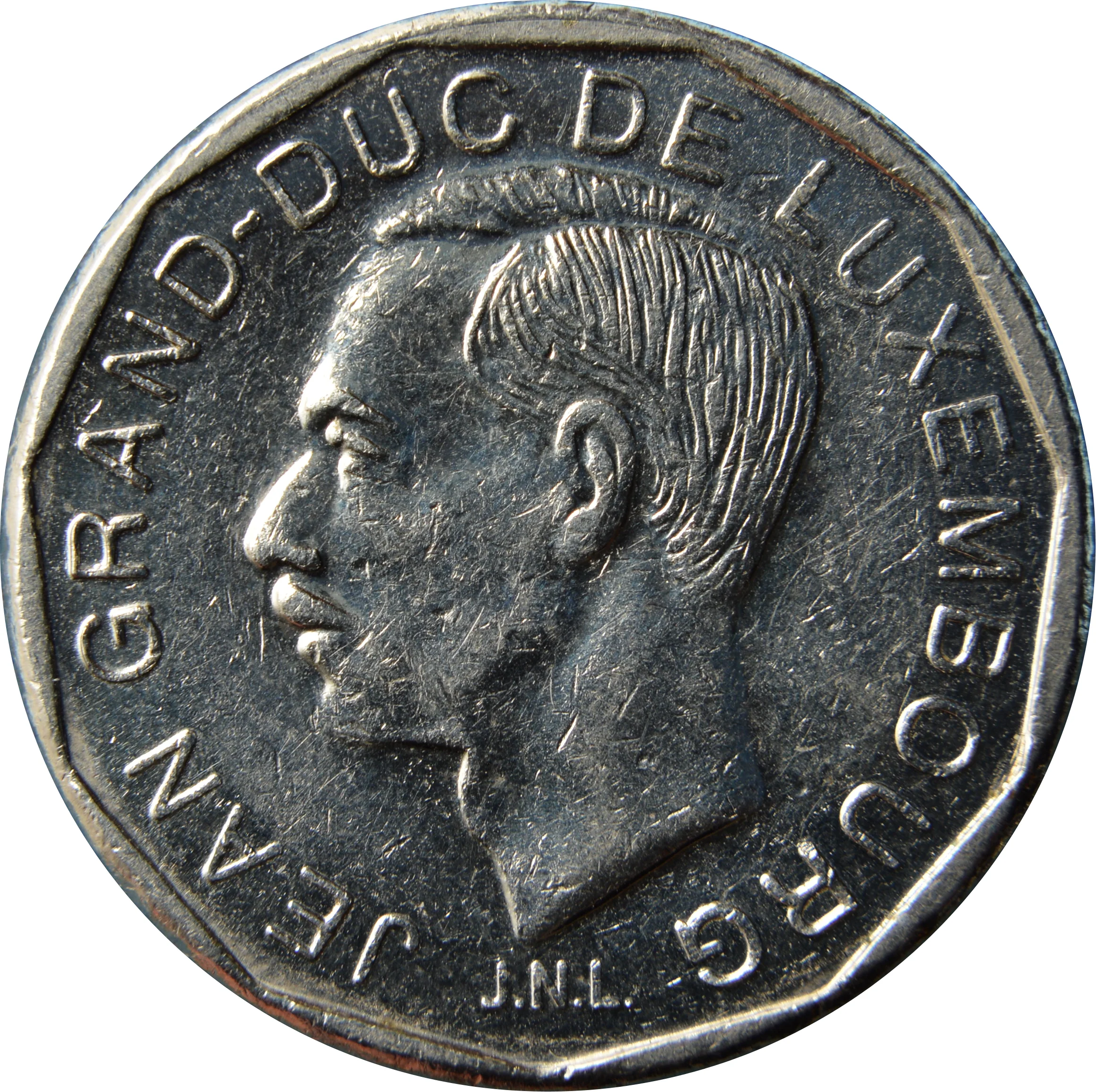
obverse
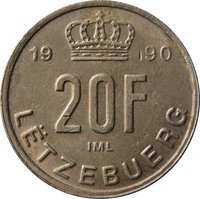
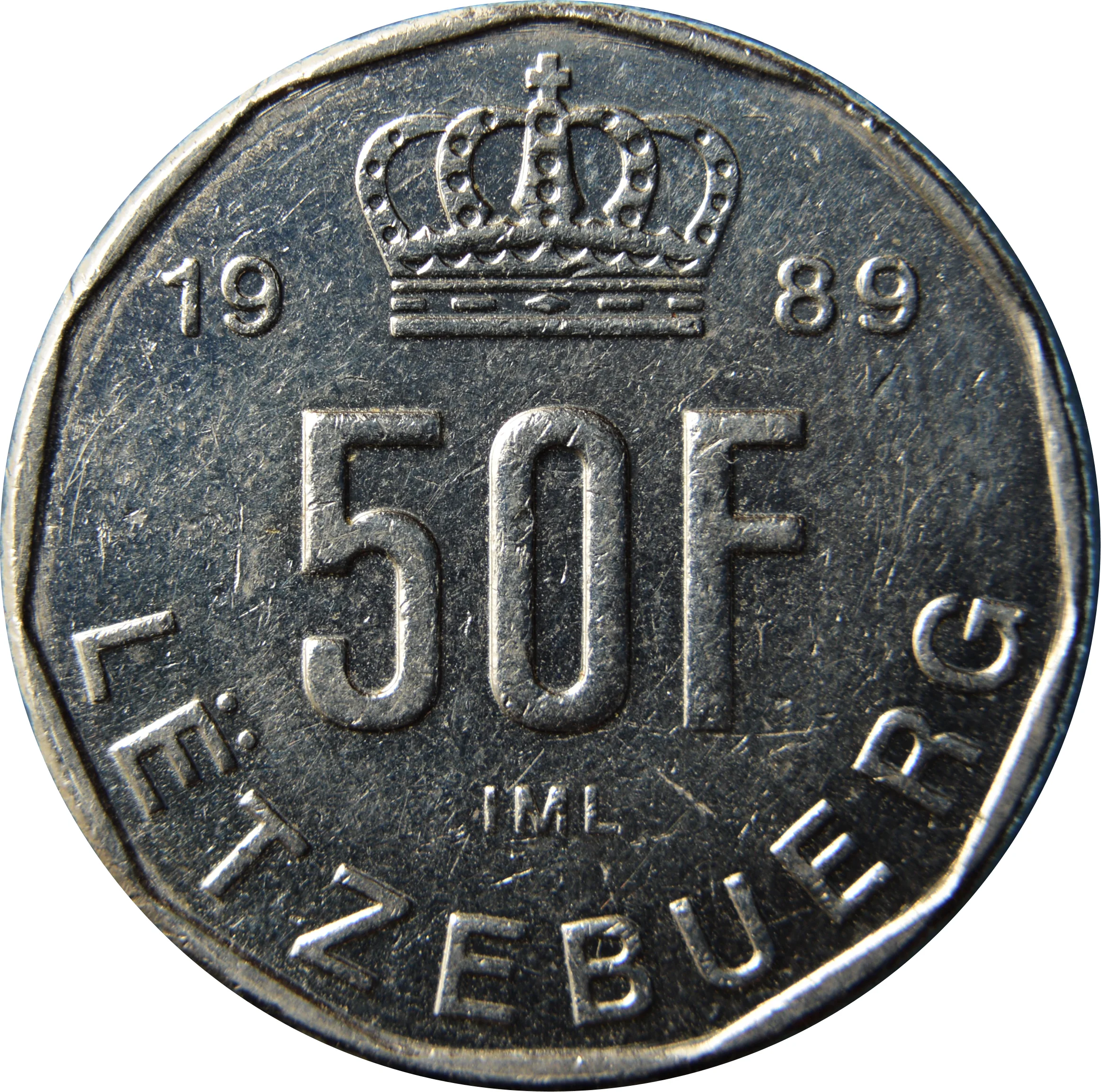
reverse
smy77 CC BY-NC-SA

50 Francs – Grand Duchy of Luxembourg

Luxembourg
Context
Years: 1989–1995
Country: Luxembourg Country flag
Ruler: Jean
Currency:
(1854—2001)
Demonetization: 28 February 2002
Total mintage: 4,060,000
Material
Diameter: 22.75 mm
Weight: 7 g
Shape: 2.3 round
Composition: Nickel
Magnetic: Yes
Technique: Milled
Alignment: Coin alignment
Obverse
OBVERSE ↑
flip
Reverse
REVERSE ↓
References
KM: #Click to copy to clipboard66
Numista: #245
Value
Exchange value: 50 LUF
Inflation-adjusted value: 113.63 LUF

Obverse

Description:
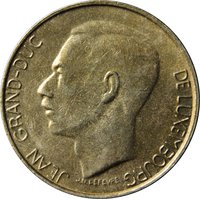
Portrait left of Jean (1921-), Grand Duke of Luxembourg (1964–2000). Legend surrounds image. Signature "J.N.L." below neck.
Inscription:
JEAN GRAND-DUC DE LUXEMBOURG

J.N.L.
Translation:
John, Grand Duke of Luxembourg
Script: Latin
Language: French

Reverse

Description:
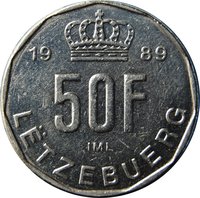
Above "IML" and "LËTZEBUERG," the Grand-Ducal crown and date flank the face value.
Inscription:
19 89

50F

IML

LËTZEBUERG
Translation:
nineteen eighty-nine

fifty francs

Luxembourg
Script: Latin
Languages: French, Luxembourgish

Edge

Coarsely reeded

Categories

Person> Monarch
Symbol> Crown

Mintings

YearMint MarkMintageQualityCollection
19892,000,000
19902,010,000
199110,000In sets
199210,000In sets
199310,000In sets
199410,000In sets
199510,000In sets

Historical background

In 1989, the Grand Duchy of Luxembourg was a fully integrated participant in the European Monetary System (EMS), established a decade earlier. Its currency, the Luxembourg franc (LUF), was permanently and irrevocably fixed at a 1:1 parity with the Belgian franc (BEF) through the Belgium-Luxembourg Economic Union (BLEU), a partnership dating back to 1922. This meant that while Luxembourg issued its own coins and banknotes, they circulated interchangeably with Belgian francs in both countries, with the Belgian central bank effectively guaranteeing the convertibility. Monetary policy for the franc zone was thus set primarily by Belgium's National Bank, albeit with Luxembourgish representation.

The domestic currency situation was exceptionally stable but lacked independent monetary tools. Luxembourg's economy, heavily focused on banking, steel, and emerging EU institutions, benefited from the fixed exchange rate which eliminated transaction costs and currency risk with its largest trading partner. However, this arrangement also meant Luxembourg had to align its interest rates and follow Belgium's lead on monetary matters, a trade-off for deep economic integration. The system functioned smoothly in 1989, providing a solid foundation for Luxembourg's thriving financial centre.

Crucially, 1989 was a pivotal year within the broader European context, setting the stage for profound change. The Delors Report, published in April, outlined a three-stage plan for achieving Economic and Monetary Union (EMU). As a founding and enthusiastic member of the European Community, Luxembourg was a committed advocate for this deeper integration. Therefore, while the franc zone provided stability in the short term, Luxembourg's financial and political authorities were already looking toward the future replacement of the Luxembourg franc with a single European currency—a process that would culminate a decade later with the introduction of the euro.
🌱 Very Common