

1 Pound – South African Republic
South Africa
Context
Year: 1874
Country: South Africa 
Issuer: South African Republic
Period:
(1874—1902)
Currency:
(1874—1902)
Demonetized: Yes
Total mintage: 142
Material
References
KM: #Click to copy to clipboard1.1
Numista: #24472
Value
Bullion value: $1213.66
Obverse
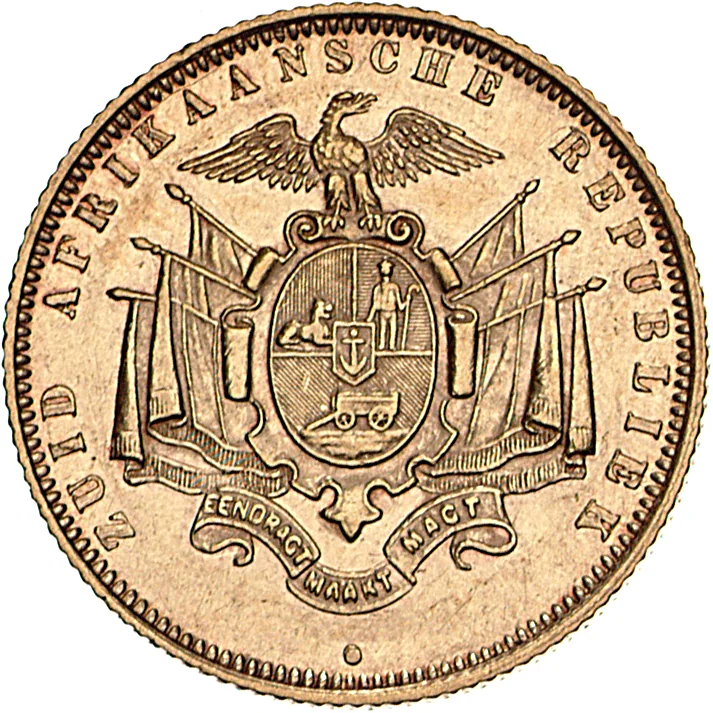
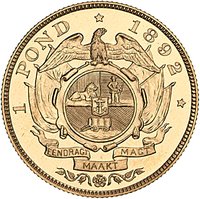
Description:
Eagle above a shield and banner, encircled by legend.
Inscription:
ZUID AFRIKAANSCHE REPUBLIEK
Translation:
SOUTH AFRICAN REPUBLIC
Script: Latin
Language: Dutch
Engraver: Leonard Charles Wyon
Reverse
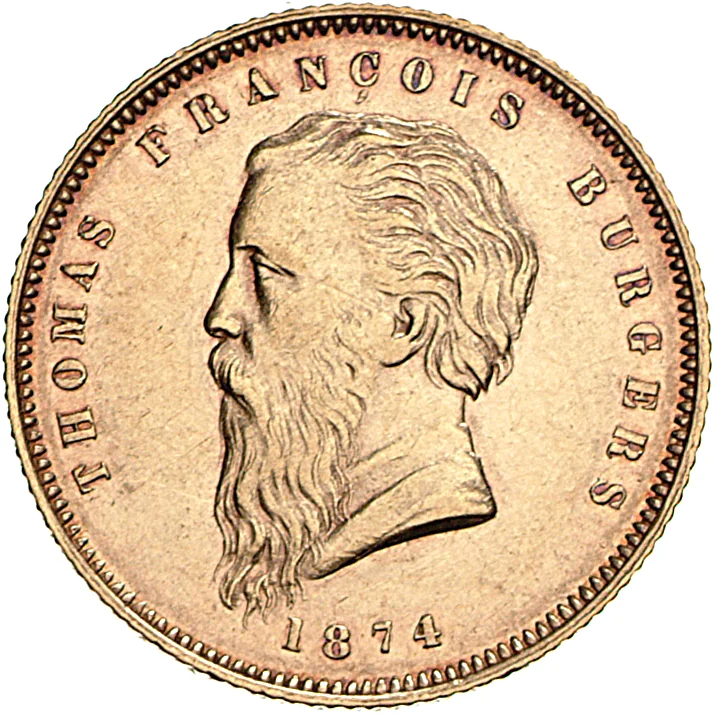
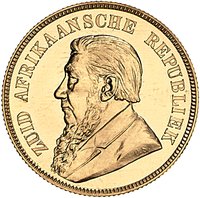
Description:
Bust of President Thomas Burgers left, date below. Coarse and fine beard varieties exist.
Inscription:
THOMAS FRANÇOIS BURGERS
1874
1874
Translation:
THOMAS FRANÇOIS BURGERS
1874
1874
Script: Latin
Engraver: Leonard Charles Wyon
Edge
Reeded
Categories
| Animal> Bird |
| Person> Politician |
| Symbol> Flag |
| Mustache/Beard |
| Symbols> Coat of Arms |
Mints
| Name | Mark |
|---|---|
| Heaton and Sons / The Mint Birmingham | — |
Mintings
| Year | Mint Mark | Mintage | Quality | Collection |
|---|---|---|---|---|
| 1874 | — | 142 |
Historical background
In 1874, the South African Republic (ZAR), also known as the Transvaal, faced a persistent and debilitating currency crisis that directly threatened its economic stability and governance. As a fledgling Boer republic with limited recognition and resources, it lacked the capacity to mint its own official coinage. Consequently, the economy operated on a chaotic mixture of foreign currencies, primarily British sterling, Portuguese gold and silver coins, and a variety of older Dutch guilders. This lack of a unified, state-backed monetary system created chronic uncertainty for merchants and citizens, hampered tax collection, and stifled internal trade and investment.
The core of the problem was a severe shortage of specie (hard coin), particularly gold, which flowed out of the republic to pay for essential imported goods. To address this, the government had previously authorized the issue of paper notes, known as Staatskasbiljetten (State Treasury Notes), but these were not backed by sufficient gold reserves. By 1874, public confidence in this paper money had collapsed, leading to widespread discounting and refusal to accept it at face value. The notes traded at a significant and fluctuating discount against harder currencies, effectively creating a two-tier economy that undermined government finances and fueled inflation.
President Thomas François Burgers, who took office in 1872, was acutely aware that this monetary anarchy weakened the republic's sovereignty and economic prospects. His administration's efforts to restore confidence, including a failed attempt to demonetize the devalued paper notes and introduce new currency in 1874, were largely ineffective without the financial strength to guarantee them. This ongoing crisis highlighted the ZAR's fiscal fragility and was a key factor driving Burgers' later, and ultimately disastrous, pursuit of a national railway and loan from the Cape Colony—a policy that would exacerbate the republic's debt and contribute to its annexation by Britain in 1877.
The core of the problem was a severe shortage of specie (hard coin), particularly gold, which flowed out of the republic to pay for essential imported goods. To address this, the government had previously authorized the issue of paper notes, known as Staatskasbiljetten (State Treasury Notes), but these were not backed by sufficient gold reserves. By 1874, public confidence in this paper money had collapsed, leading to widespread discounting and refusal to accept it at face value. The notes traded at a significant and fluctuating discount against harder currencies, effectively creating a two-tier economy that undermined government finances and fueled inflation.
President Thomas François Burgers, who took office in 1872, was acutely aware that this monetary anarchy weakened the republic's sovereignty and economic prospects. His administration's efforts to restore confidence, including a failed attempt to demonetize the devalued paper notes and introduce new currency in 1874, were largely ineffective without the financial strength to guarantee them. This ongoing crisis highlighted the ZAR's fiscal fragility and was a key factor driving Burgers' later, and ultimately disastrous, pursuit of a national railway and loan from the Cape Colony—a policy that would exacerbate the republic's debt and contribute to its annexation by Britain in 1877.
✨ Legendary