

250 Won (Korea) – South Korea
Non-circulating coins
Commemoration: 5000th Anniversary of Korea
South Korea
Context
Year: 1970
Korean - Dangun Year: 4303
Issuer: South Korea 
Period:
(since 1948)
Currency:
(since 1962)
Total mintage: 4,100
Material
References
KM: #Click to copy to clipboard11
Numista: #24399
Value
Exchange value: 250 KRW = $0.18
Bullion value: $40.65
Inflation-adjusted value: 7222.80 KRW
Obverse
Description:
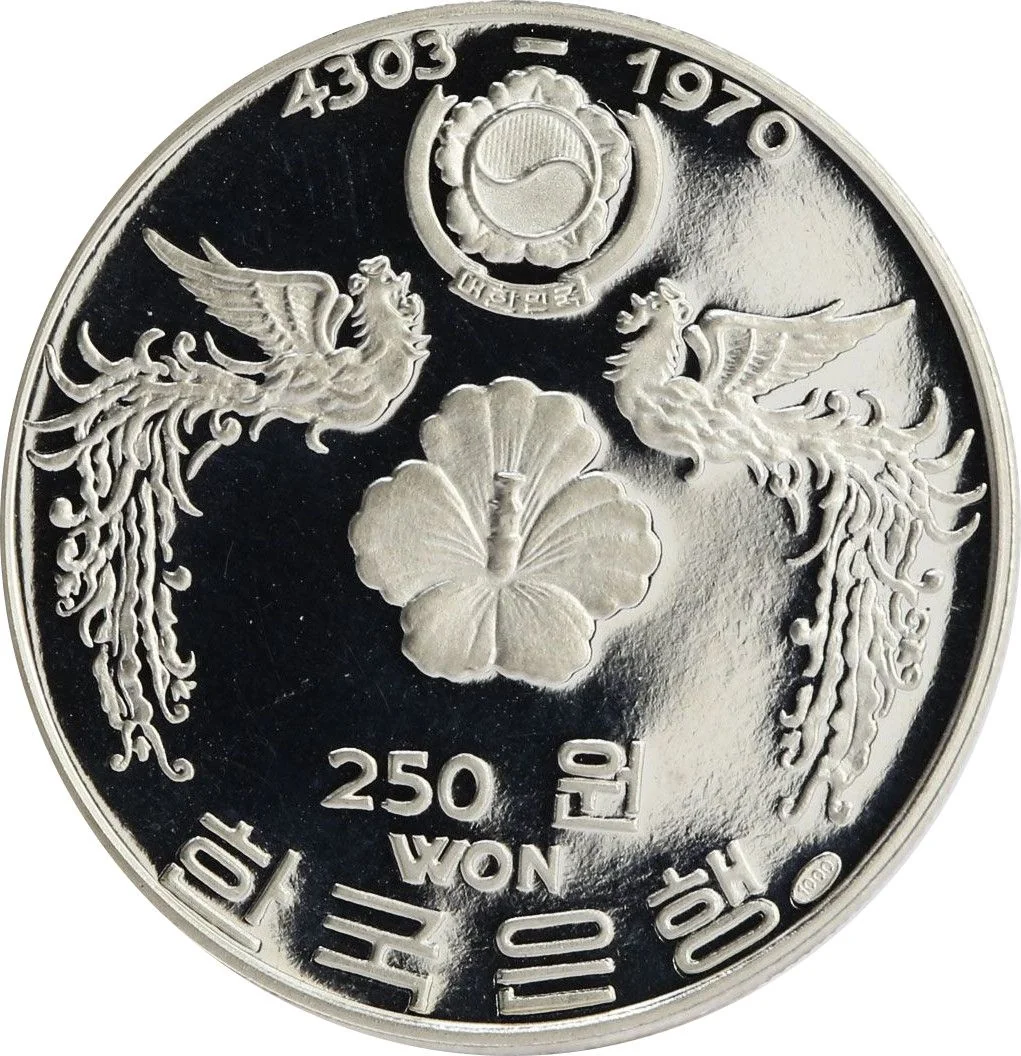
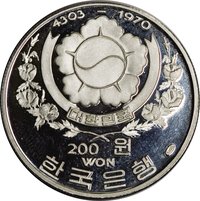
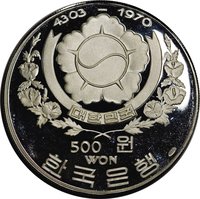
Phoenix-flanked floral arms
Inscription:
4303 - 1970
대한민국
250 원
WON
한국은행
대한민국
250 원
WON
한국은행
Translation:
Republic of Korea
250 Won
WON
Bank of Korea
250 Won
WON
Bank of Korea
Engraver: Jo Byung-soo
Reverse
Description:
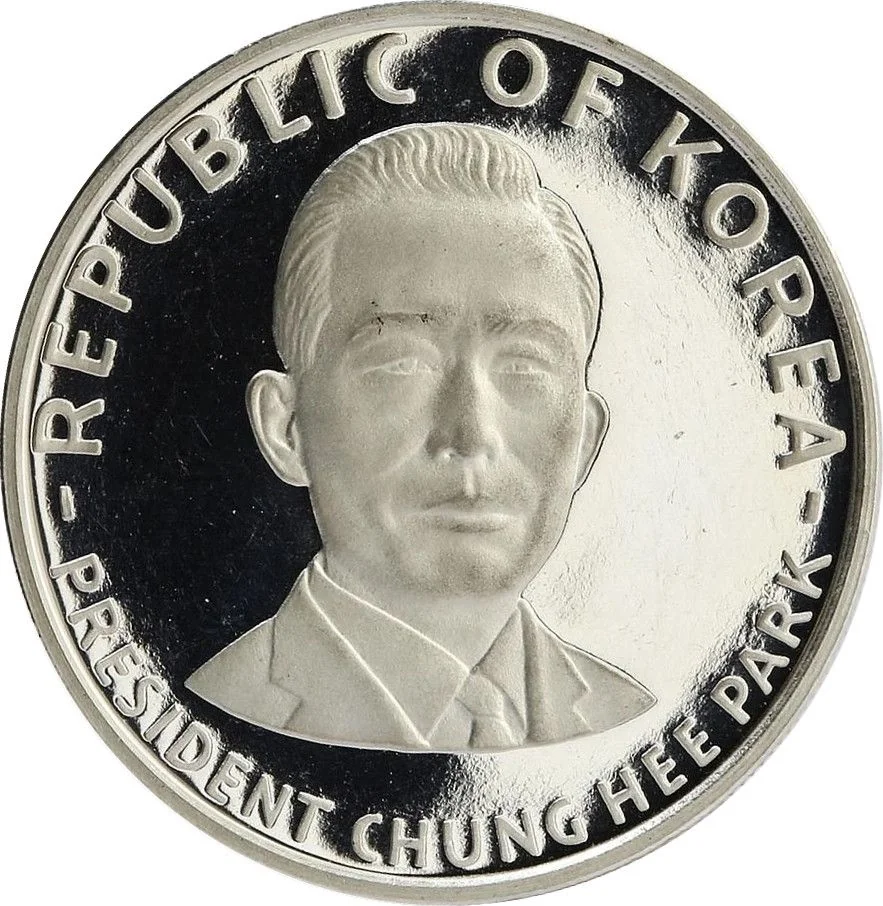
Bust portrait
Inscription:
REPUBLIC OF KOREA
- PRESIDENT CHUNG HEE PARK -
- PRESIDENT CHUNG HEE PARK -
Engraver: Jo Byung-soo
Edge
Categories
| Animal> Bird |
| Mythology> Fantastic animal |
| Person> Politician |
| Plants> Flower |
Mintings
| Year | Mint Mark | Mintage | Quality | Collection |
|---|---|---|---|---|
| 1970 | — | 4,100 | Proof |
Historical background
In the early 1970s, South Korea's currency situation was fundamentally shaped by the country's rapid, state-led industrialization under President Park Chung-hee. The official currency, the won, was tightly managed through a fixed exchange rate system, pegged to the U.S. dollar at a rate of 310 won per dollar since 1964. This fixed rate was a cornerstone of the government's export-oriented economic strategy, providing stability and predictability for the chaebols (large family-owned conglomerates) that were driving the nation's "Miracle on the Han River." By keeping the won undervalued, South Korean exports remained competitively priced on the global market, fueling extraordinary growth in sectors like textiles, light manufacturing, and heavy industry.
However, this system masked significant underlying pressures. The aggressive push for industrialization, funded by heavy foreign borrowing, led to persistent trade deficits and mounting external debt. Inflation was a chronic problem, eroding the won's domestic purchasing power even as its international value was held artificially steady. Furthermore, the government maintained strict capital controls and a complex web of regulations, including multiple exchange rates for different transaction types. This created a thriving black market for foreign currency, where the U.S. dollar traded at a significant premium, highlighting the disparity between the official rate and market forces.
The inherent strains of this system culminated in a major devaluation in December 1974, when the won was sharply devalued to 480 per dollar. This move, though painful, was a recognition that the rigid peg was unsustainable. It marked the beginning of a slow transition toward a more flexible exchange rate regime in the following decades, as South Korea gradually liberalized its financial system in response to both internal economic maturation and external pressures from international trade partners.
However, this system masked significant underlying pressures. The aggressive push for industrialization, funded by heavy foreign borrowing, led to persistent trade deficits and mounting external debt. Inflation was a chronic problem, eroding the won's domestic purchasing power even as its international value was held artificially steady. Furthermore, the government maintained strict capital controls and a complex web of regulations, including multiple exchange rates for different transaction types. This created a thriving black market for foreign currency, where the U.S. dollar traded at a significant premium, highlighting the disparity between the official rate and market forces.
The inherent strains of this system culminated in a major devaluation in December 1974, when the won was sharply devalued to 480 per dollar. This move, though painful, was a recognition that the rigid peg was unsustainable. It marked the beginning of a slow transition toward a more flexible exchange rate regime in the following decades, as South Korea gradually liberalized its financial system in response to both internal economic maturation and external pressures from international trade partners.


✨ Legendary