

10000 forint (World War I) – Hungary
Add to wishlist
Non-circulating coins
Commemoration: 100th Anniversary of the End of World War I
Hungary
Context
Material
References
Numista: #242774
Value
Exchange value: 10000 HUF
Bullion value: $55.35
Inflation-adjusted value: 16539.30 HUF
Obverse
Description:
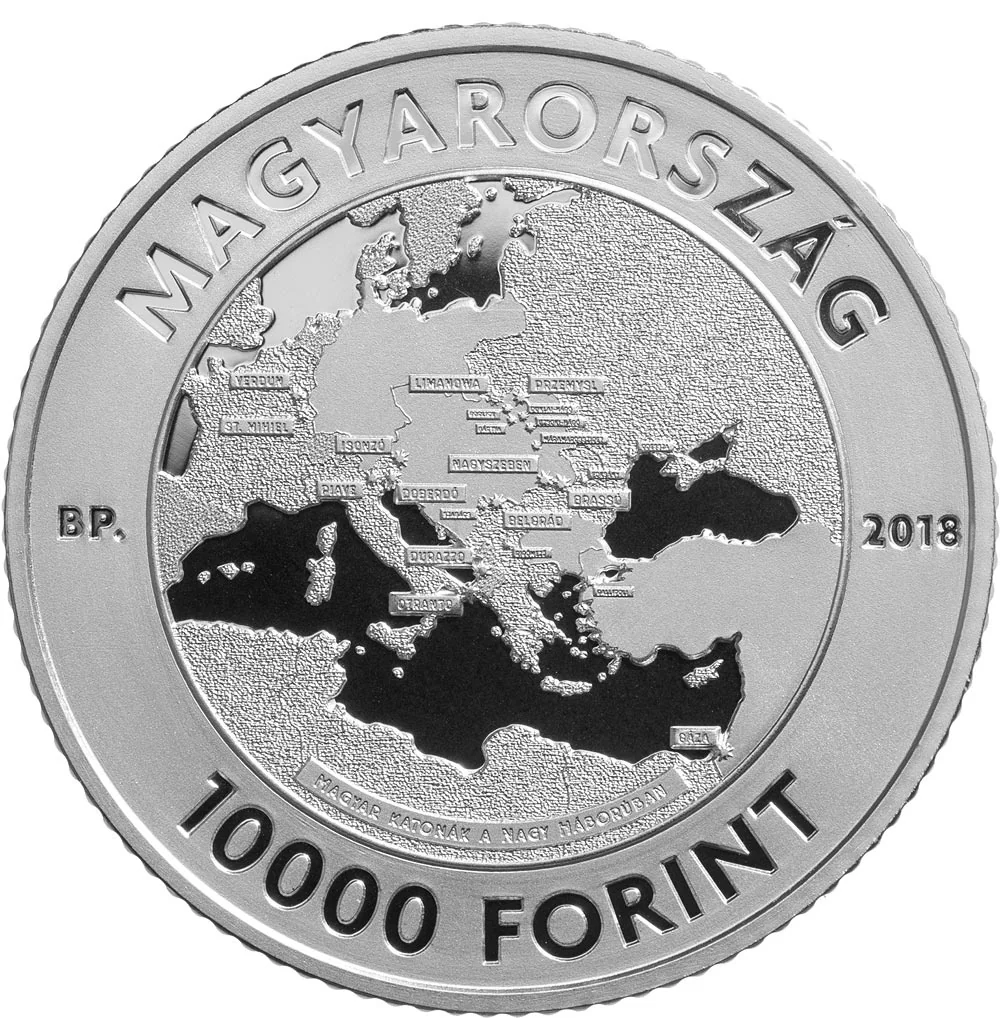
The obverse features a Europe-centered world map, marking key First World War battles involving Hungarian soldiers with stars and named settlements.
Inscription:
MAGYARORSZÁG
BP.
2018
MAGYAR KATONÁK A NAGY HÁBORUBAN
10000 FORINT
BP.
2018
MAGYAR KATONÁK A NAGY HÁBORUBAN
10000 FORINT
Translation:
HUNGARY
BP.
2018
HUNGARIAN SOLDIERS IN THE GREAT WAR
10000 FORINT
BP.
2018
HUNGARIAN SOLDIERS IN THE GREAT WAR
10000 FORINT
Script: Latin
Language: Hungarian
Designer: Balázs Bitó
Reverse
Description:
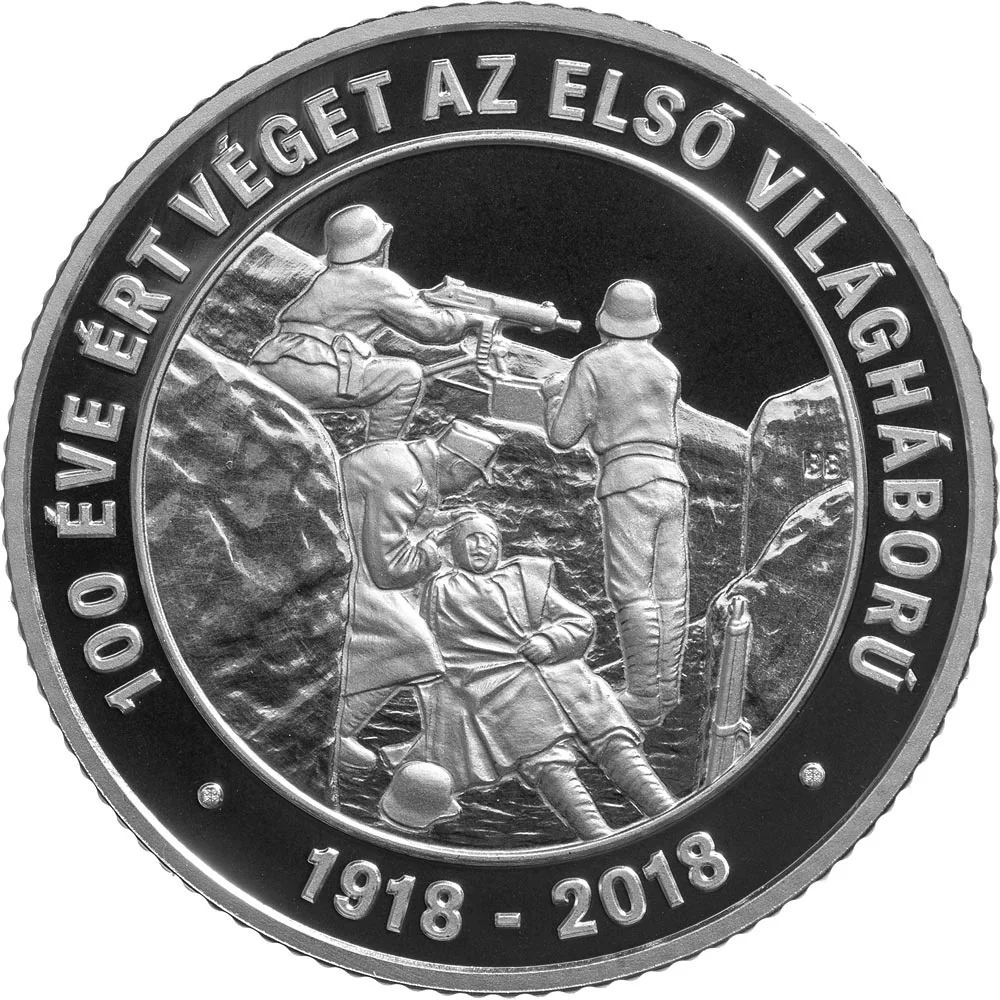
The reverse's central motif is a trench warfare scene, honoring the tragedy, heroism, and comradeship of the First World War.
Inscription:
100 ÉVE ÉRT VÉGET AZ ELSŐ VILÁGHÁBORÚ
BB
1918-2018
BB
1918-2018
Translation:
100 Years Since the End of the First World War
BB
1918-2018
BB
1918-2018
Script: Latin
Language: Hungarian
Designer: Balázs Bitó
Edge
Reeded
Mints
| Name | Mark |
|---|---|
| Hungarian mint | BP. |
Mintings
| Year | Mint Mark | Mintage | Quality | Collection |
|---|---|---|---|---|
| 2018 | BP | 3,000 | Proof |
Historical background
In 2018, Hungary's currency situation was characterized by a period of deliberate weakening and historic lows for the Hungarian forint (HUF), driven primarily by the monetary policy of the National Bank of Hungary (MNB). Under the leadership of Governor György Matolcsy, the MNB maintained an ultra-loose policy with record-low base rates and a unique system of "quantitative easing" using unconventional tools like interest rate swaps and funding for growth. The explicit goal was to keep borrowing costs cheap for the government and businesses, stimulate lending, and maintain export competitiveness through a weaker currency. This policy succeeded in keeping the forint soft, with the EUR/HUF rate consistently trading above 310 and reaching historic lows near 330 in the second half of the year.
This weak-forint strategy, however, created significant tensions and trade-offs. While it supported economic growth (which exceeded 4% in 2018) and helped the government finance its debt cheaply, it imported inflation and increased the burden of foreign-currency-denominated household loans (mostly in Swiss francs, a legacy from before 2010). Rising global oil prices and domestic wage growth further fueled inflation, which hovered around the MNB's 3% target but showed upward pressure. Consequently, the central bank faced growing criticism for prioritizing growth over price stability and for the increased vulnerability of Hungarian households and the economy to sudden shifts in currency markets.
By the end of 2018, pressures were mounting for a policy shift. As the US Federal Reserve raised rates and global monetary conditions tightened, the forint came under sporadic selling pressure, highlighting its vulnerability. The widening interest rate differential between Hungary and its main trading partners in the Eurozone began to strain the MNB's strategy. This set the stage for a pivotal change in 2019, when the central bank began to slowly unwind its unconventional tools and signal a move toward monetary tightening, marking the beginning of the end for the prolonged period of deliberate forint weakness.
This weak-forint strategy, however, created significant tensions and trade-offs. While it supported economic growth (which exceeded 4% in 2018) and helped the government finance its debt cheaply, it imported inflation and increased the burden of foreign-currency-denominated household loans (mostly in Swiss francs, a legacy from before 2010). Rising global oil prices and domestic wage growth further fueled inflation, which hovered around the MNB's 3% target but showed upward pressure. Consequently, the central bank faced growing criticism for prioritizing growth over price stability and for the increased vulnerability of Hungarian households and the economy to sudden shifts in currency markets.
By the end of 2018, pressures were mounting for a policy shift. As the US Federal Reserve raised rates and global monetary conditions tightened, the forint came under sporadic selling pressure, highlighting its vulnerability. The widening interest rate differential between Hungary and its main trading partners in the Eurozone began to strain the MNB's strategy. This set the stage for a pivotal change in 2019, when the central bank began to slowly unwind its unconventional tools and signal a move toward monetary tightening, marking the beginning of the end for the prolonged period of deliberate forint weakness.

✨ Legendary