

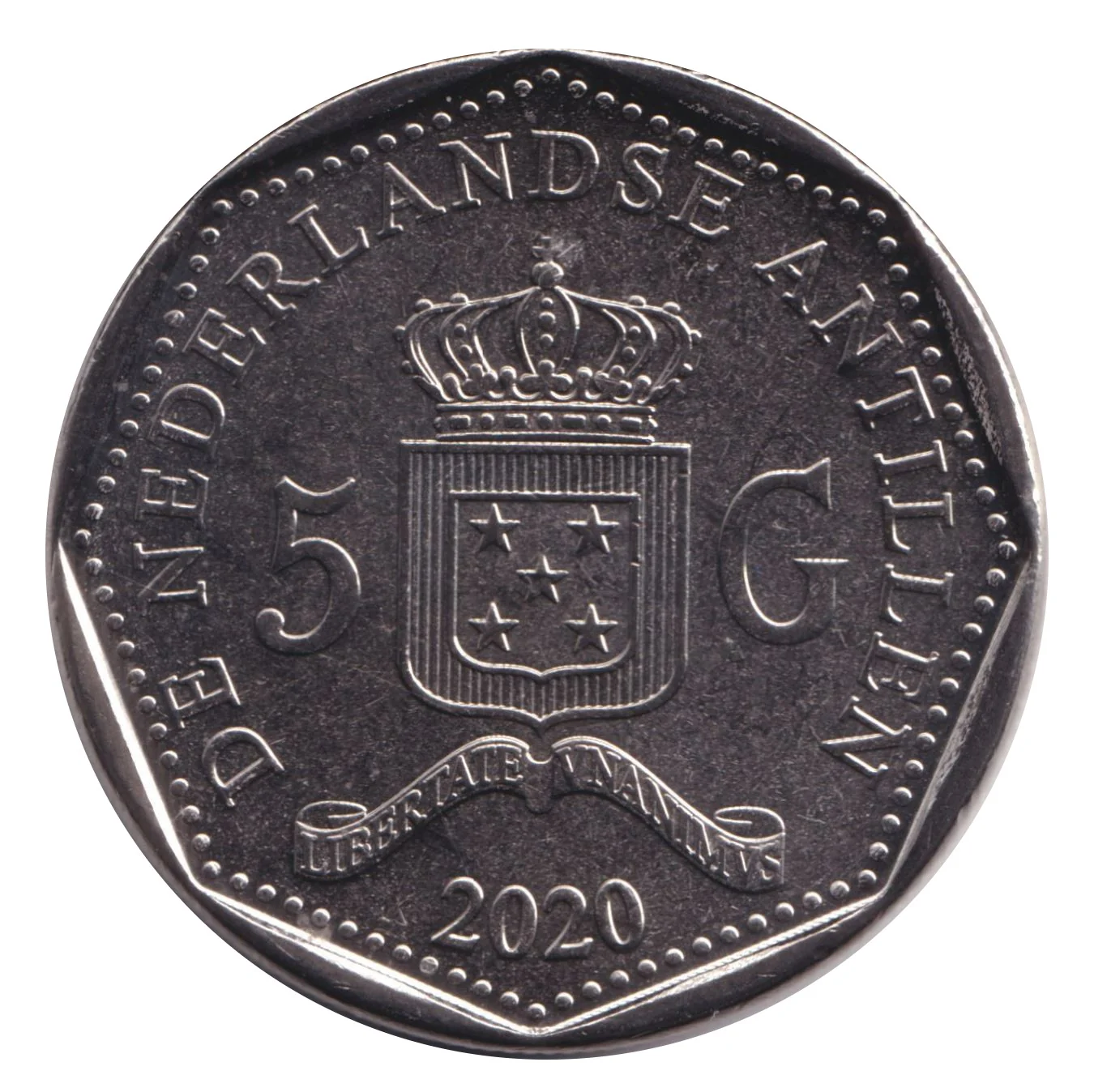
5 gulden (Structural reforms) – Netherlands Antilles
Add to wishlist
Circulating commemorative coins
Commemoration: 10 years of structural reforms
Netherlands
Context
Year: 2020
Country: Netherlands
Issuer: Netherlands Antilles
Ruler: Willem-Alexander
Currency:
(since 1828)
Demonetization: 31 March 2025
Total mintage: 100,000
Material
References
KM: #
Numista: #242031
Value
Exchange value: 5 ANG
Inflation-adjusted value: 6.08 ANG
Obverse
Description:
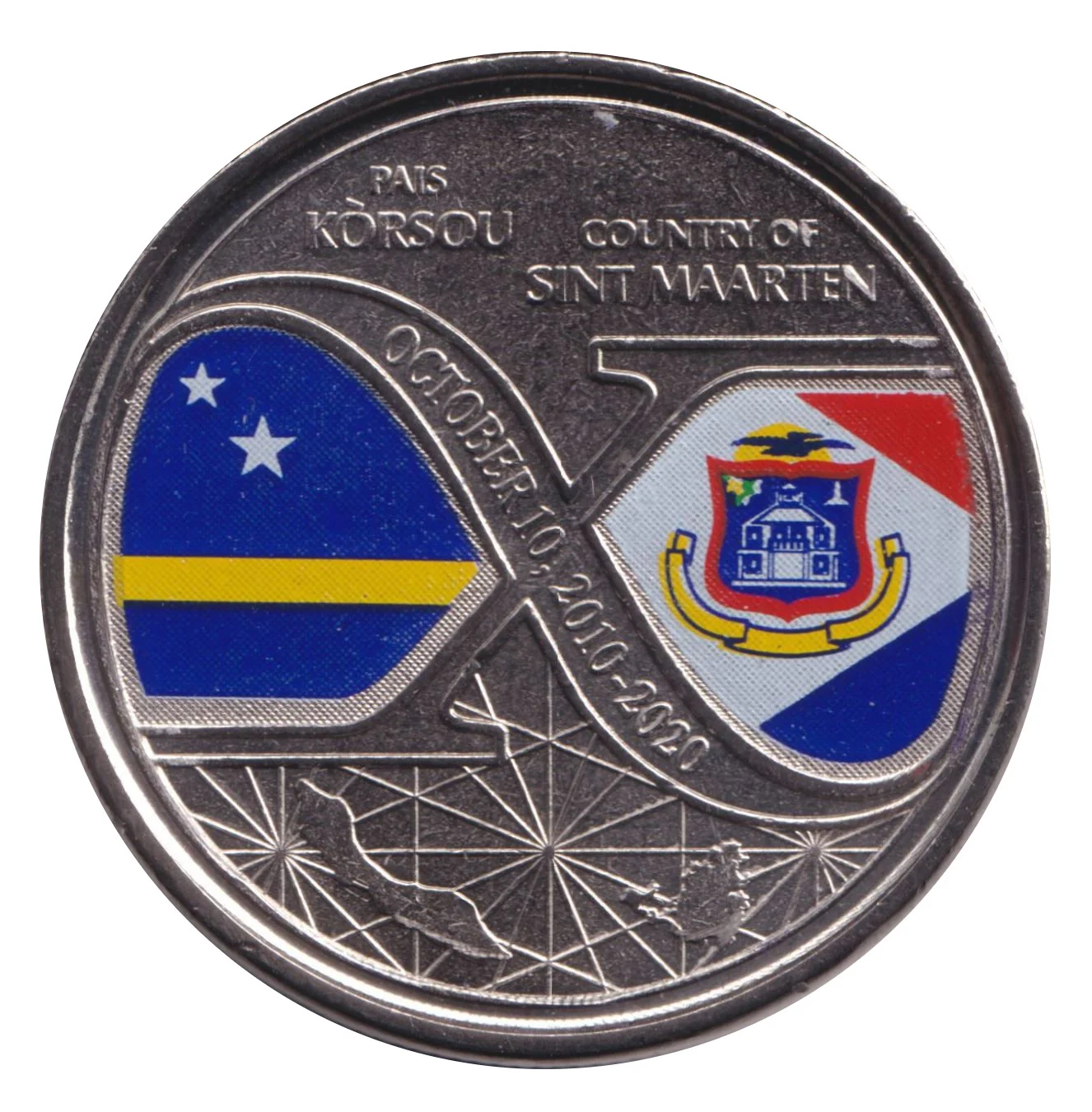
This NAf 5 coin's obverse features a Roman numeral "X" containing "October 10, 2010-2020." The colored flags of Curaçao and Sint Maarten flank the X. Above are the texts "PAIS KÒRSOU" and "COUNTRY OF SINT MAARTEN," with their national silhouettes below.
Inscription:
PAIS KÒRSOU
COUNTRY OF SINT MAARTEN
X
October 10, 2010-2020
COUNTRY OF SINT MAARTEN
X
October 10, 2010-2020
Translation:
Country of Curaçao
Country of Sint Maarten
X
October 10, 2010-2020
Country of Sint Maarten
X
October 10, 2010-2020
Script: Latin
Languages: English, Papiamento
Reverse
Edge
Plain
Categories
| Symbols> Coat of Arms |
Mints
| Name | Mark |
|---|---|
| Royal Canadian Mint of Winnipeg | — |
Mintings
| Year | Mint Mark | Mintage | Quality | Collection |
|---|---|---|---|---|
| 2020 | — | 100,000 |
Historical background
In 2020, the currency situation in the Netherlands Antilles was one of transition and unresolved legacy. Although the political entity known as the Netherlands Antilles was dissolved in 2010, its common currency, the Netherlands Antillean guilder (ANG), remained in use in two of its successor constituent countries: Curaçao and Sint Maarten. These two autonomous countries within the Kingdom of the Netherlands continued to operate under a joint central bank, the Centrale Bank van Curaçao en Sint Maarten (CBCS), which managed the currency peg that had been long-established at 1.79 ANG to 1 US dollar.
The year 2020 intensified existing economic pressures on the currency union. The COVID-19 pandemic caused a catastrophic collapse in tourism, the economic lifeblood of both islands, leading to severe recessions, soaring public debt, and strained government finances. This crisis exposed and amplified underlying fiscal vulnerabilities and longstanding disagreements between Curaçao and Sint Maarten, particularly regarding debt sharing and fiscal discipline. The CBCS faced the dual challenge of maintaining the fixed peg while navigating a sharp decline in foreign exchange reserves, prompting urgent liquidity support and negotiations for financial assistance from the Netherlands.
Consequently, 2020 became a pivotal year that accelerated discussions about the currency's future. The Dutch government, as a condition for vital pandemic-related liquidity loans, pushed for deeper economic reforms and raised the possibility of replacing the guilder with the US dollar to ensure stability and reduce exchange rate risk. While the formal decision to dollarize would come later, the turmoil of 2020 made it clear that the status quo was unsustainable, setting the stage for the historic announcement in 2023 that Curaçao and Sint Maarten would adopt the US dollar.
The year 2020 intensified existing economic pressures on the currency union. The COVID-19 pandemic caused a catastrophic collapse in tourism, the economic lifeblood of both islands, leading to severe recessions, soaring public debt, and strained government finances. This crisis exposed and amplified underlying fiscal vulnerabilities and longstanding disagreements between Curaçao and Sint Maarten, particularly regarding debt sharing and fiscal discipline. The CBCS faced the dual challenge of maintaining the fixed peg while navigating a sharp decline in foreign exchange reserves, prompting urgent liquidity support and negotiations for financial assistance from the Netherlands.
Consequently, 2020 became a pivotal year that accelerated discussions about the currency's future. The Dutch government, as a condition for vital pandemic-related liquidity loans, pushed for deeper economic reforms and raised the possibility of replacing the guilder with the US dollar to ensure stability and reduce exchange rate risk. While the formal decision to dollarize would come later, the turmoil of 2020 made it clear that the status quo was unsustainable, setting the stage for the historic announcement in 2023 that Curaçao and Sint Maarten would adopt the US dollar.
🌟 Uncommon