

1000 rupees – Nepal
Add to wishlist
Non-circulating coins
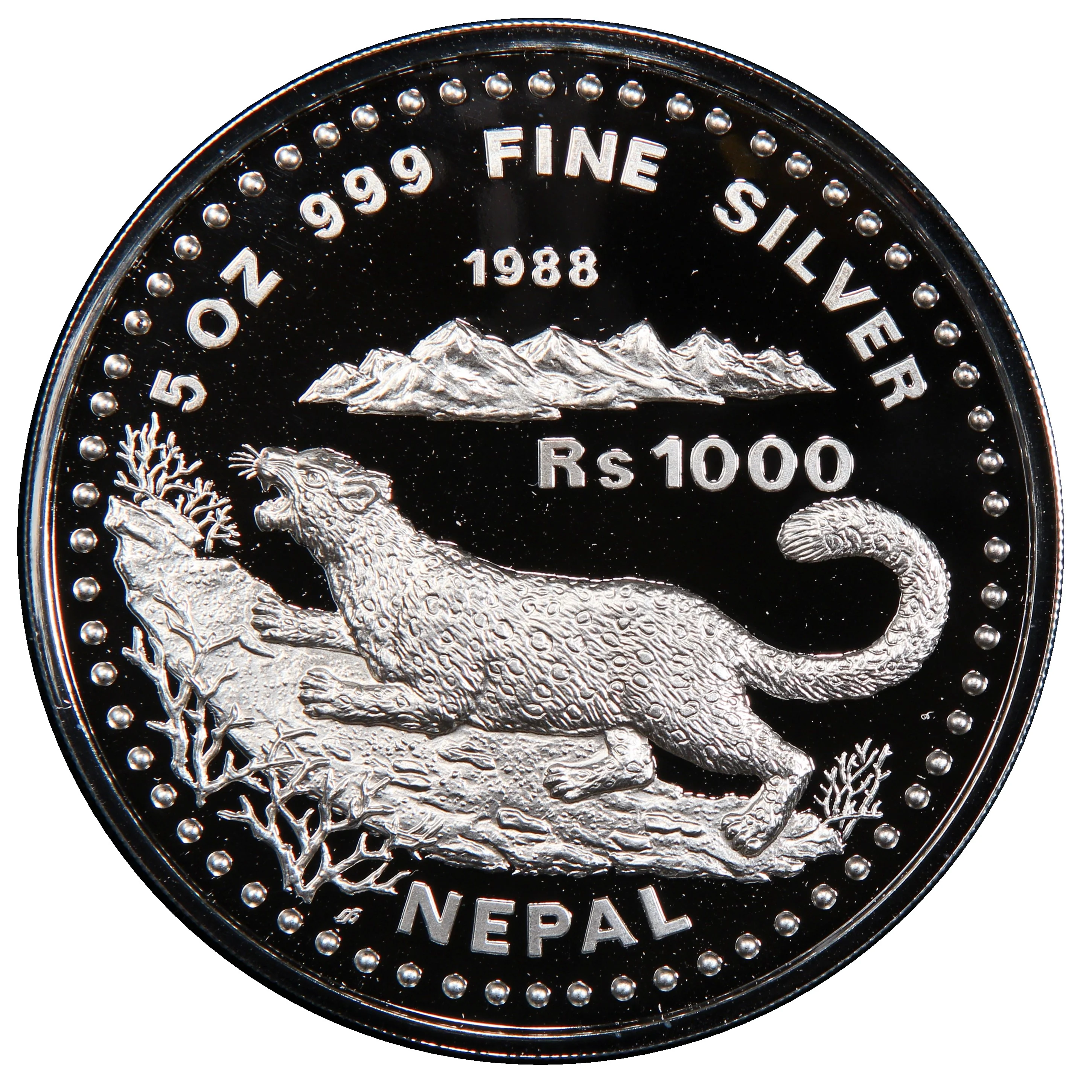
Commemoration: Snow Leopard
Nepal
Context
Year: 1988
Vikram Samvat Year:: 2045
Issuer: Nepal
Ruler: Birendra Bir Bikram Shah
Currency:
(since 1932)
Total mintage: 5,000
Material
Diameter: 65 mm
Weight: 155.52 g
Silver Weight:: 155.36 g
Shape: Round
Composition: 99.9% Silver
Standard: Silver 5 ounces
Magnetic: No
Technique: Milled
Alignment: Medal alignment
flip
References
KM: #
Numista: #241590
Value
Exchange value: 1000 NPR
Bullion value: $387.75
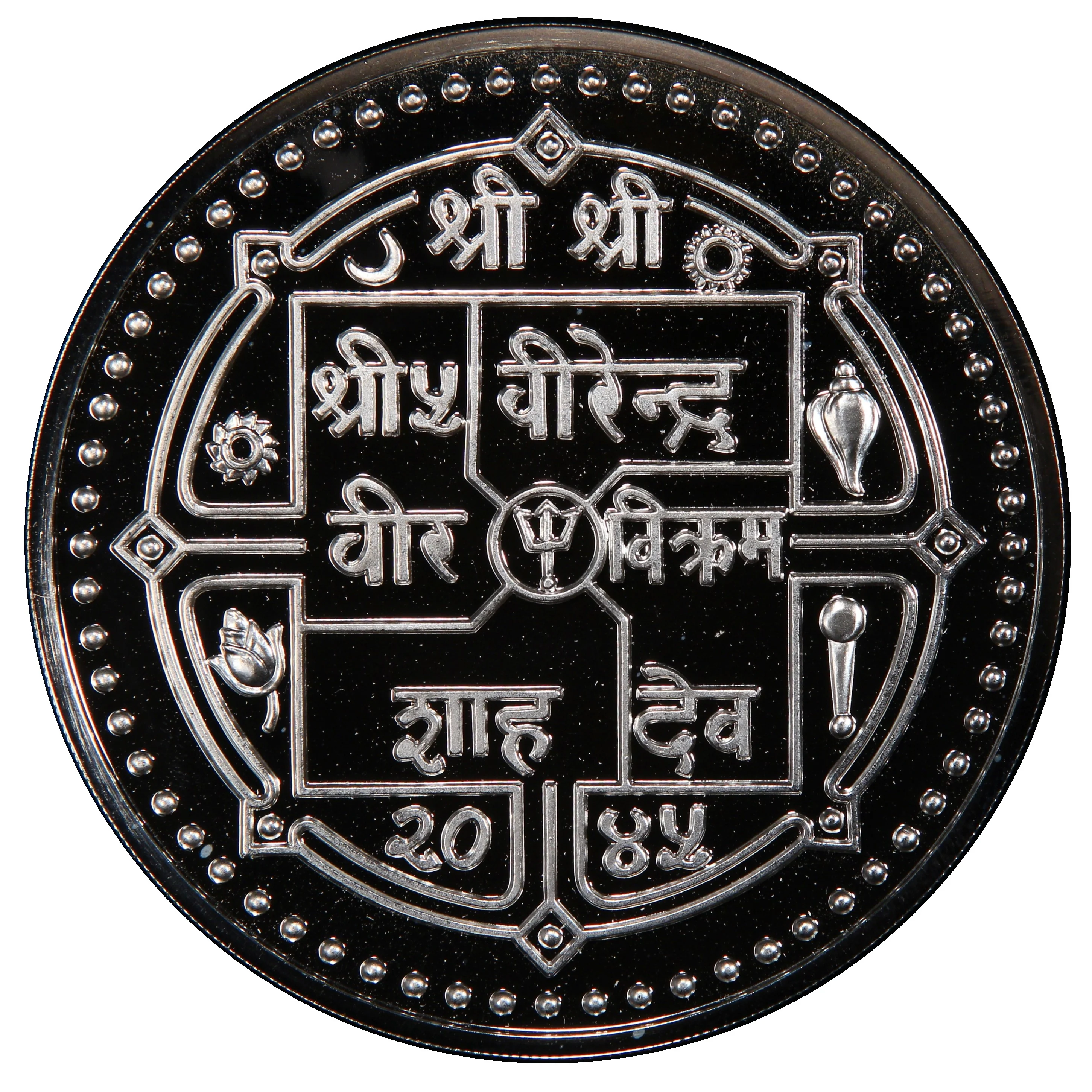
Obverse
Description:
Classic style
Script: Devanagari
Reverse
Description:
Elusive high-altitude big cat
Inscription:
5 OZ FINE SILVER
1988
Rs 1000
NEPAL
1988
Rs 1000
NEPAL
Script: Latin
Edge
Mints
| Name | Mark |
|---|---|
| Singapore Mint | — |
Mintings
| Year | Mint Mark | Mintage | Quality | Collection |
|---|---|---|---|---|
| 1988 | — | 5,000 | Proof |
Historical background
In 1988, Nepal's currency situation was dominated by its complex and strained economic relationship with India, its largest trading partner. Since 1960, the Nepalese rupee (NRs) had been pegged to the Indian rupee (INR) at a fixed rate of 1:1.25 (1 INR = 1.25 NRs), facilitating open-border trade. However, this arrangement made Nepal's economy highly vulnerable to India's monetary policy and trade decisions. A significant point of tension was the widespread use of Indian currency notes within Nepal's territory, which, while practical for cross-border commerce, limited Nepal's own monetary sovereignty and control over its money supply.
The situation reached a critical juncture in 1988 when a major trade and transit dispute erupted between the two countries. India, citing security concerns, unilaterally closed multiple border crossing points and imposed what was effectively an economic blockade. This severe disruption choked off essential supplies, including fuel and medicine, and triggered a sharp depreciation of the Nepalese rupee in the unofficial market. With trade crippled, confidence in the Nepalese currency plummeted, and the fixed peg came under immense practical strain, exposing the fragility of Nepal's dependent monetary framework.
Consequently, 1988 became a watershed year that forced a fundamental rethink of Nepal's monetary policy. The crisis starkly revealed the dangers of excessive dependence on a single foreign currency and a rigid exchange rate peg. The economic hardship and currency instability of this period provided the direct impetus for Nepal to pursue greater monetary independence, which would culminate in the landmark Nepal Rastra Bank Act of 2002 and the Foreign Exchange Regulation Act of 2003. These later reforms aimed to establish a more flexible and managed floating exchange rate system, reducing the overwhelming influence of the Indian rupee and strengthening the central bank's control over the national currency.
The situation reached a critical juncture in 1988 when a major trade and transit dispute erupted between the two countries. India, citing security concerns, unilaterally closed multiple border crossing points and imposed what was effectively an economic blockade. This severe disruption choked off essential supplies, including fuel and medicine, and triggered a sharp depreciation of the Nepalese rupee in the unofficial market. With trade crippled, confidence in the Nepalese currency plummeted, and the fixed peg came under immense practical strain, exposing the fragility of Nepal's dependent monetary framework.
Consequently, 1988 became a watershed year that forced a fundamental rethink of Nepal's monetary policy. The crisis starkly revealed the dangers of excessive dependence on a single foreign currency and a rigid exchange rate peg. The economic hardship and currency instability of this period provided the direct impetus for Nepal to pursue greater monetary independence, which would culminate in the landmark Nepal Rastra Bank Act of 2002 and the Foreign Exchange Regulation Act of 2003. These later reforms aimed to establish a more flexible and managed floating exchange rate system, reducing the overwhelming influence of the Indian rupee and strengthening the central bank's control over the national currency.
✨ Legendary