

350 Rupees – Nepal
Non-circulating coins
Commemoration: Dipendra
Nepal
Context
Year: 1987
Vikram Samvat Year: 2044
Issuer: Nepal 
Ruler: Birendra Bir Bikram Shah
Currency:
(since 1932)
Material

References
KM: #Click to copy to clipboard1032
Numista: #240984
Value
Exchange value: 350 NPR
Bullion value: $66.06
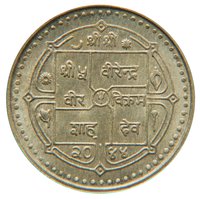
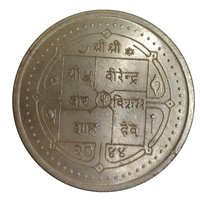
Obverse
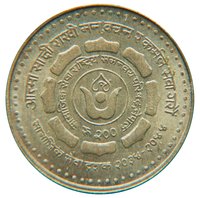
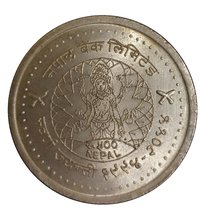
Reverse
Edge
Mintings
| Year | Mint Mark | Mintage | Quality | Collection |
|---|---|---|---|---|
| 1987 | — | — |
Historical background
In 1987, Nepal's currency situation was characterized by a tightly controlled and dual exchange rate system, heavily influenced by its economic and geopolitical relationship with India. As a landlocked nation with over 90% of its trade linked to India, the Nepalese rupee (NPR) was pegged to the Indian rupee (INR) at a fixed rate of 1.45 NPR to 1 INR for official transactions. This formal parity, established under the 1960 Treaty of Trade and Transit, facilitated crucial cross-border commerce but also made Nepal's monetary policy largely dependent on India's economic decisions. The country maintained strict capital controls, and the possession of foreign currency by individuals was heavily regulated by the Nepal Rastra Bank, the central bank.
Alongside the official rate, a active black market for foreign exchange, particularly for US dollars and Indian rupees, operated due to the restrictive policies. This parallel market emerged because the fixed peg did not always reflect market realities, and access to foreign currency for imports outside the India-trade sphere was limited and required cumbersome bureaucratic approval. The disparity between the official and black-market rates created distortions, incentivizing smuggling and under-invoicing of exports, which eroded the state's foreign exchange reserves and tax revenue.
The year 1987 fell within a period of growing economic strain that would lead to significant reform. The fixed peg, while providing stability, was increasingly seen as inflexible amidst differing inflation rates between the two countries. Pressure was building from international donors and within Nepal's own business community for liberalization. This mounting pressure would culminate just a few years later in a major economic overhaul, with the landmark 1991 economic reforms introducing a partial convertibility of the rupee and moving towards a more market-oriented exchange rate mechanism, effectively ending the rigid system of 1987.
Alongside the official rate, a active black market for foreign exchange, particularly for US dollars and Indian rupees, operated due to the restrictive policies. This parallel market emerged because the fixed peg did not always reflect market realities, and access to foreign currency for imports outside the India-trade sphere was limited and required cumbersome bureaucratic approval. The disparity between the official and black-market rates created distortions, incentivizing smuggling and under-invoicing of exports, which eroded the state's foreign exchange reserves and tax revenue.
The year 1987 fell within a period of growing economic strain that would lead to significant reform. The fixed peg, while providing stability, was increasingly seen as inflexible amidst differing inflation rates between the two countries. Pressure was building from international donors and within Nepal's own business community for liberalization. This mounting pressure would culminate just a few years later in a major economic overhaul, with the landmark 1991 economic reforms introducing a partial convertibility of the rupee and moving towards a more market-oriented exchange rate mechanism, effectively ending the rigid system of 1987.
✨ Legendary