

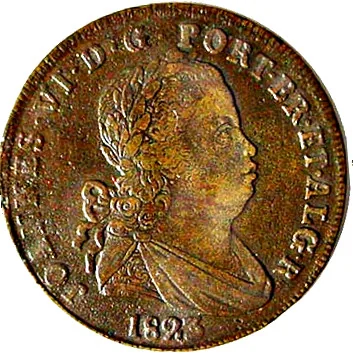

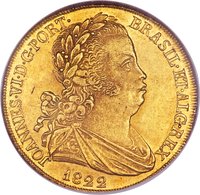
Obverse
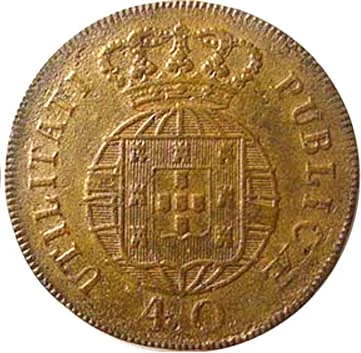
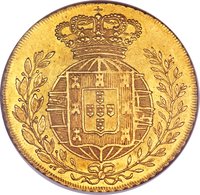
Reverse
Edge
Plain
Mints
| Name | Mark |
|---|---|
| Imprensa Nacional - Casa da Moeda | — |
Mintings
| Year | Mint Mark | Mintage | Quality | Collection |
|---|---|---|---|---|
| 1819 | — | — | ||
| 1820 | — | — | ||
| 1821 | — | — | ||
| 1822 | — | — | ||
| 1823 | — | — | ||
| 1824 | — | — | ||
| 1825 | — | — |
Historical background
In 1819, Portugal's currency situation was complex and unstable, deeply entangled with the political and economic turmoil following the Napoleonic Wars and the Peninsular War (1807-1814). The country was operating under a bimetallic system of gold and silver, but the standard coin was the real (plural: réis), with values often expressed in the higher unit of the milréis (1,000 réis). However, decades of war had severely depleted state coffers, leading to chronic budget deficits. To finance conflicts and the royal court's exile in Brazil (1808-1821), the government had resorted to extensive minting of debased coinage and issuing paper money, which eroded public trust and caused significant inflation.
A critical factor was the unique status of Brazil, then still a kingdom united with Portugal under the monarchy. The 1808 opening of Brazilian ports had shifted much of Portugal's economic gravity and gold reserves to its colony. Furthermore, the Bank of Lisbon (Banco de Lisboa), founded in 1821 but planned in this period, was being established precisely to address the monetary chaos by consolidating paper note issuance. In 1819, the circulating medium was a confused mix of older Portuguese coins, newer debased issues, and even foreign currency, particularly British, all circulating at fluctuating values.
Consequently, Portugal in 1819 was on the brink of a monetary crisis. The value of currency was unreliable, hampering trade and economic recovery. This precarious financial background set the stage for the major reforms of the 1820s and 1830s, including the formal creation of the real as the national currency and later the introduction of the escudo in the early 20th century. The period thus represents a late phase of the Ancien Régime monetary system, struggling under the weight of war debt and the impending loss of its primary source of wealth, Brazil, which would declare independence in 1822.
A critical factor was the unique status of Brazil, then still a kingdom united with Portugal under the monarchy. The 1808 opening of Brazilian ports had shifted much of Portugal's economic gravity and gold reserves to its colony. Furthermore, the Bank of Lisbon (Banco de Lisboa), founded in 1821 but planned in this period, was being established precisely to address the monetary chaos by consolidating paper note issuance. In 1819, the circulating medium was a confused mix of older Portuguese coins, newer debased issues, and even foreign currency, particularly British, all circulating at fluctuating values.
Consequently, Portugal in 1819 was on the brink of a monetary crisis. The value of currency was unreliable, hampering trade and economic recovery. This precarious financial background set the stage for the major reforms of the 1820s and 1830s, including the formal creation of the real as the national currency and later the introduction of the escudo in the early 20th century. The period thus represents a late phase of the Ancien Régime monetary system, struggling under the weight of war debt and the impending loss of its primary source of wealth, Brazil, which would declare independence in 1822.
🌱 Common