

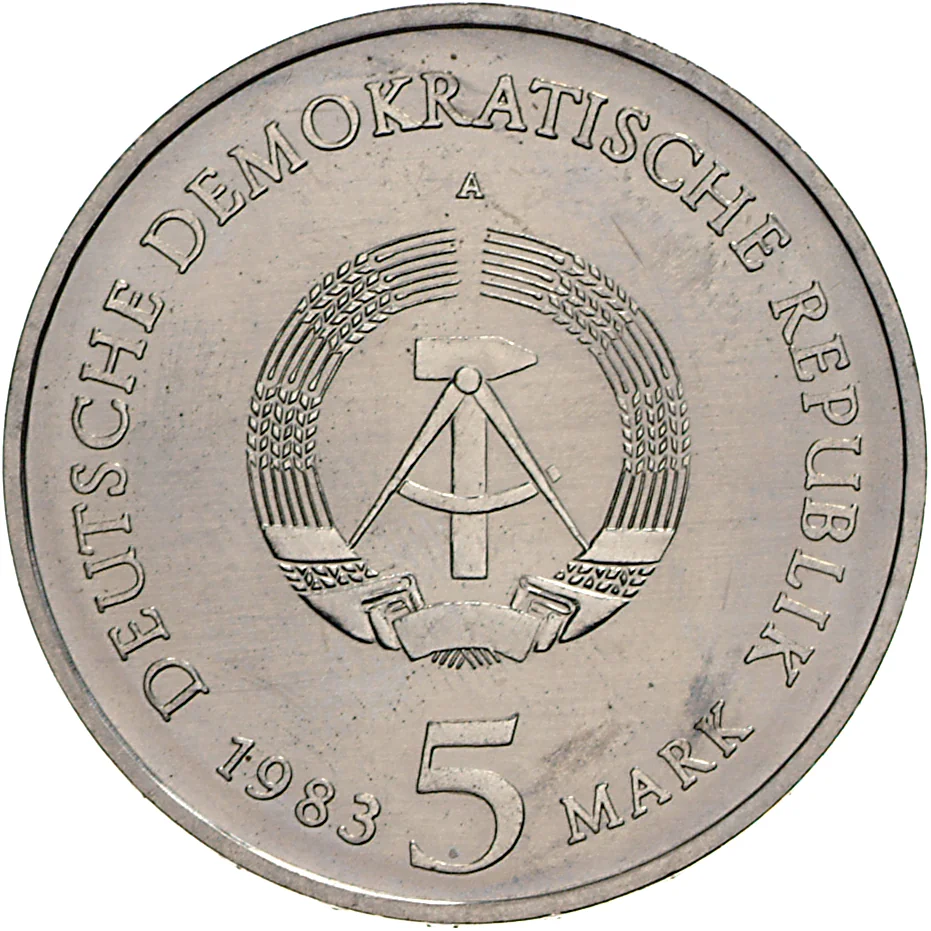
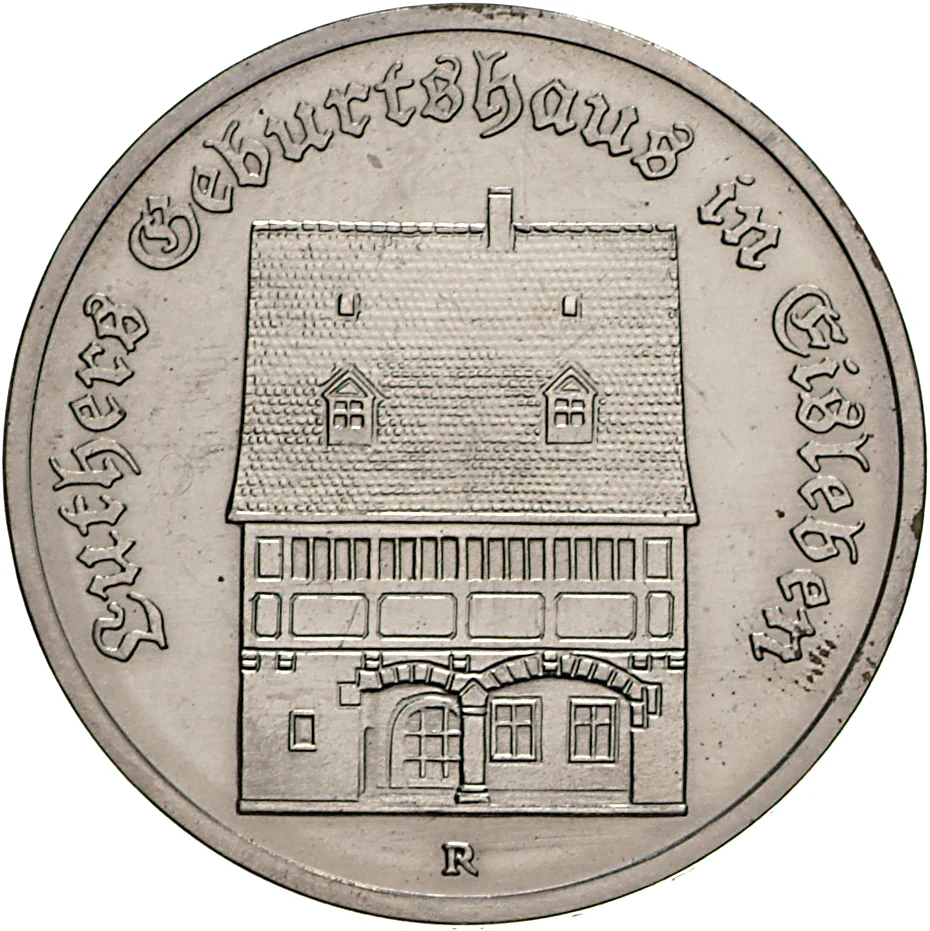
5 mark (Martin Luther's birth) – German Democratic Republic
Add to wishlist
Non-circulating coins
Commemoration: 500th anniversary of Martin Luther's birth in his birthplace.
Germany
Context
Year: 1983
Country: Germany
Issuer: German Democratic Republic
Period:
(1949—1990)
Currency:
(1948—1990)
Demonetization: 30 June 1990
Total mintage: 271,180
Material
Diameter: 29 mm
Weight: 9.7 g
Shape: Round
Composition: Copper-nickel
Technique: Milled
Alignment: Medal alignment
flip
References
KM: #
Numista: #24026
Value
Exchange value: 5 DDM
Inflation-adjusted value: 11.78 DDM
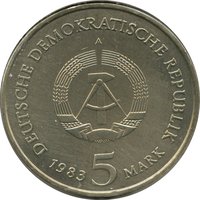
Obverse
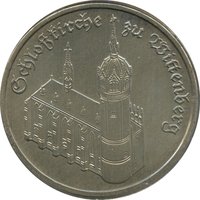
Reverse
Description:
Luther’s Eisleben birthplace
Inscription:
Luthers Geburtshaus in Eisleben
R
R
Script: Latin
Engraver: H. Rodewald
Edge
Script:Latin
Legend:
5 MARK * 5 MARK * 5 MARK * 5 MARK *
Categories
| Event> Birth anniversary |
Mints
| Name | Mark |
|---|---|
| Berlin | A |
Historical background
In 1983, the German Democratic Republic (GDR) operated under a strict dual-currency system that starkly mirrored the country's political and economic division from the West. The official state currency was the GDR Mark (Mark der DDR), often called the "Ostmark." It was a non-convertible "soft currency," meaning it could not be legally exchanged for Western currencies and had no value outside the GDR's closed economy. Its value was artificially maintained by the state, but it masked chronic shortages, a lack of quality consumer goods, and declining productivity in the planned economy. Wages and domestic prices were set in Ostmarks, but the currency's purchasing power was limited to the constrained supply within the state-run network of shops (HO and Intershop).
Alongside this, a parallel economy existed, driven by the freely convertible Deutsche Mark (DM) from West Germany. The GDR state actively coveted this "hard currency" to pay for critical imports and service its massive foreign debt. To capture DM from its own citizens and visitors, the government created a network of Intershop stores. These shops, accessible initially only to foreigners but later to East Germans with Western money, offered a tantalizing array of high-quality goods, from coffee and fruit to electronics and fashion, which were unavailable for Ostmarks. This created a deeply humiliating two-tiered society where access to a basic quality of life depended on access to Western currency, often sent by relatives in the FRG.
The currency situation in 1983 thus highlighted the GDR's profound economic weaknesses and ideological contradictions. The state's dependence on the very capitalist symbol it denounced undermined its socialist claims. While the Ostmark represented the failing planned economy, the pervasive presence of the Deutsche Mark within its borders demonstrated the powerful pull of West German prosperity and foreshadowed the internal pressures that would contribute to the state's eventual collapse. The regime, led by Erich Honecker, maintained this precarious system through strict laws against unauthorized currency possession, but it could not resolve the fundamental disparity it represented.
Alongside this, a parallel economy existed, driven by the freely convertible Deutsche Mark (DM) from West Germany. The GDR state actively coveted this "hard currency" to pay for critical imports and service its massive foreign debt. To capture DM from its own citizens and visitors, the government created a network of Intershop stores. These shops, accessible initially only to foreigners but later to East Germans with Western money, offered a tantalizing array of high-quality goods, from coffee and fruit to electronics and fashion, which were unavailable for Ostmarks. This created a deeply humiliating two-tiered society where access to a basic quality of life depended on access to Western currency, often sent by relatives in the FRG.
The currency situation in 1983 thus highlighted the GDR's profound economic weaknesses and ideological contradictions. The state's dependence on the very capitalist symbol it denounced undermined its socialist claims. While the Ostmark represented the failing planned economy, the pervasive presence of the Deutsche Mark within its borders demonstrated the powerful pull of West German prosperity and foreshadowed the internal pressures that would contribute to the state's eventual collapse. The regime, led by Erich Honecker, maintained this precarious system through strict laws against unauthorized currency possession, but it could not resolve the fundamental disparity it represented.
🌟 Uncommon