

1000 lire – Vatican City
Add to wishlist
Non-circulating coins
Commemoration: Peace and Solidarity
Vatican City
Context
Year: 1998
Issuer: Vatican City
Ruler: John Paul II
Currency:
(1929—2001)
Demonetization: 1 January 2002
Total mintage: 28,500
Material
References
KM: #
Numista: #24007
Value
Exchange value: 1000 VAL
Bullion value: $31.15
Obverse
Description:
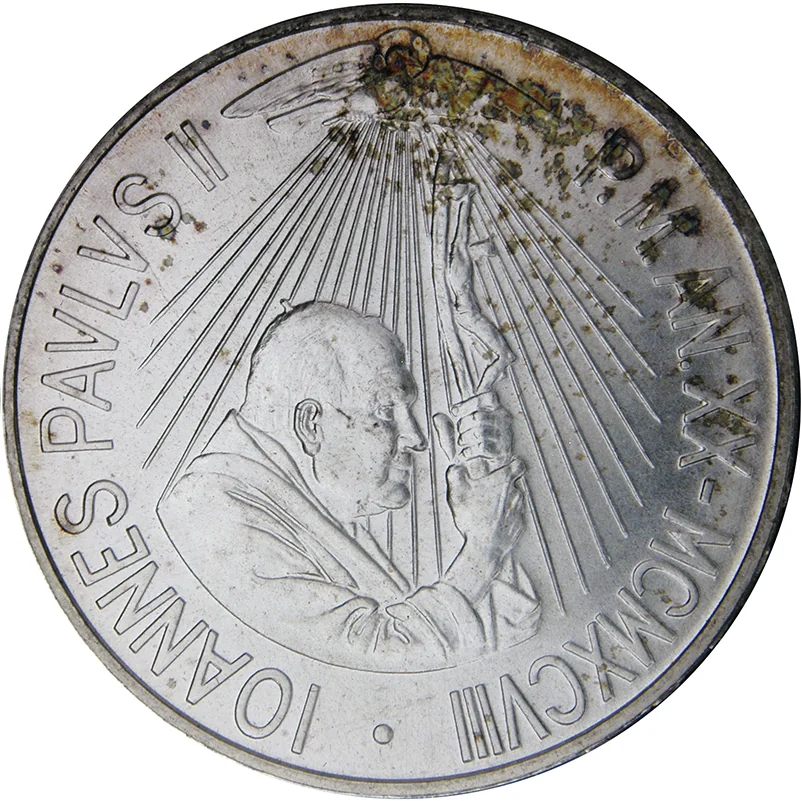
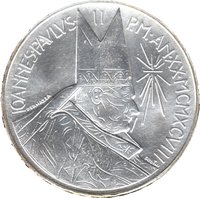
Pope holding staff in sunlight.
Inscription:
IOANNES PAVLVS II P.M. AN. XX-MCMXCVIII ·
Translation:
JOHN PAUL II SUPREME PONTIFF YEAR 20-1998
Script: Latin
Language: Latin
Engraver: Paolo Borghi
Reverse
Description:
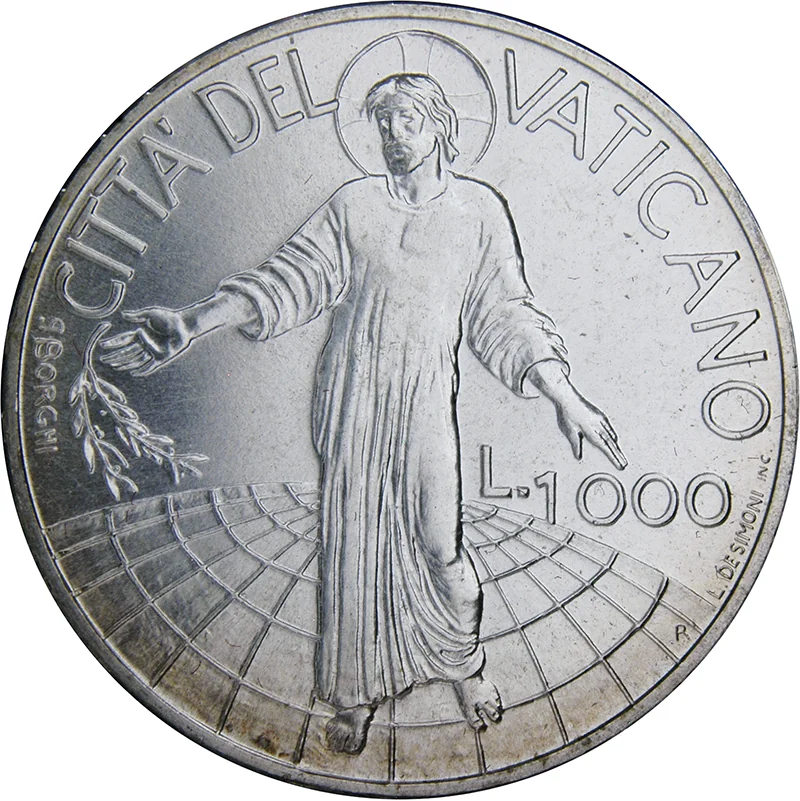
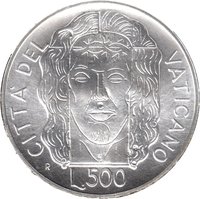
Jesus descending, offering an olive branch to Earth.
Inscription:
CITTA' DEL VATICANO
R L. 1000
R L. 1000
Translation:
Vatican City
1000 Lire
1000 Lire
Script: Latin
Language: Italian
Engraver: Paolo Borghi
Edge
Embossed Script
Legend:
TOTVS TVVS +++ MCMXCVIII +++
Mints
| Name | Mark |
|---|---|
| Rome | R |
Mintings
| Year | Mint Mark | Mintage | Quality | Collection |
|---|---|---|---|---|
| 1998 | R | 28,500 |
Historical background
In 1998, the currency situation in Vatican City was defined by its unique status as a sovereign entity with a minuscule domestic economy, entirely reliant on the Italian lira for its practical, everyday monetary life. Although the Holy See had the right to mint its own coinage (the Vatican lira) under the terms of the 1929 Lateran Treaty, these coins were not a standalone currency but were legally pegged at par with the Italian lira and circulated interchangeably within Italy and the Vatican. Consequently, the Italian lira served as the de facto currency for all commercial transactions, salaries, and operational expenses, while Vatican-minted coins and commemorative issues were primarily sought by collectors and tourists rather than used in routine commerce.
This period was one of significant transition, as 1998 was a crucial preparatory year for the launch of the euro on January 1, 1999. As a member of a monetary union with Italy, Vatican City’s monetary fate was tied to Italian decisions. The Holy See negotiated a special agreement with the European Union (formalized in December 1998) that allowed it to adopt the euro as its official currency, with the right to mint a limited quantity of its own euro coins bearing Vatican designs. This ensured its continued monetary sovereignty in a symbolic form within the new European framework.
Therefore, the background of 1998 captures the Vatican at a monetary crossroads: it was the final full year of the lira era, a system that had functioned seamlessly for decades. The authorities were actively engaged in complex diplomatic and technical preparations to ensure a smooth transition, securing its place within the coming Eurozone while preserving its tradition of issuing distinctive, non-commercial coinage. The year ended with the legal framework set for the Vatican lira to be replaced by the Vatican euro at the same fixed conversion rate as the Italian lira.
This period was one of significant transition, as 1998 was a crucial preparatory year for the launch of the euro on January 1, 1999. As a member of a monetary union with Italy, Vatican City’s monetary fate was tied to Italian decisions. The Holy See negotiated a special agreement with the European Union (formalized in December 1998) that allowed it to adopt the euro as its official currency, with the right to mint a limited quantity of its own euro coins bearing Vatican designs. This ensured its continued monetary sovereignty in a symbolic form within the new European framework.
Therefore, the background of 1998 captures the Vatican at a monetary crossroads: it was the final full year of the lira era, a system that had functioned seamlessly for decades. The authorities were actively engaged in complex diplomatic and technical preparations to ensure a smooth transition, securing its place within the coming Eurozone while preserving its tradition of issuing distinctive, non-commercial coinage. The year ended with the legal framework set for the Vatican lira to be replaced by the Vatican euro at the same fixed conversion rate as the Italian lira.
⭐ Somewhat Rare