

5 francs (French Franc Decimal System) – France
Add to wishlist
Circulating commemorative coins
Commemoration: 200th Anniversary of the French Franc - Decimal System
France
Context
Year: 1996
Issuer: France
Period:
(since 1958)
Currency:
(1960—2001)
Demonetization: 17 February 2002
Total mintage: 4,978,743
Material
References
KM: #
Numista: #24
Value
Exchange value: 5 FRF
Inflation-adjusted value: 8.18 FRF
Obverse
Description:
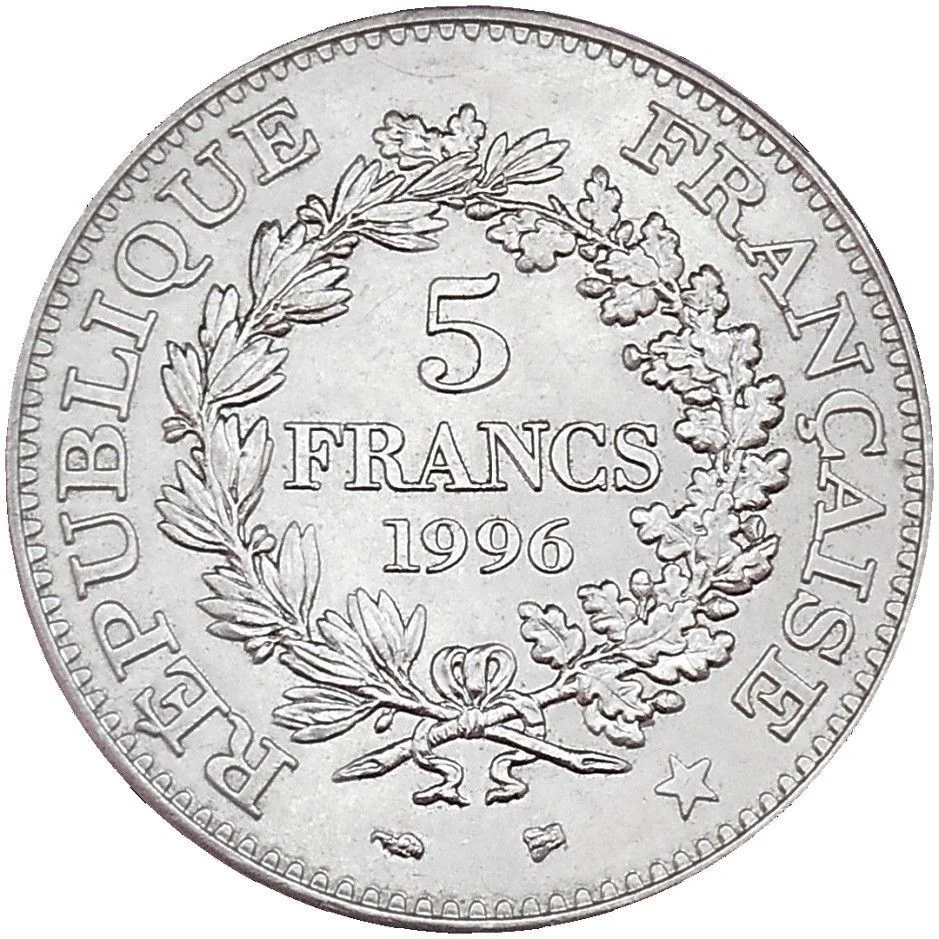
The face value, encircled by laurel and oak branches, is surrounded by "RÉPUBLIQUE FRANÇAISE" and a star.
Inscription:
RÉPUBLIQUE FRANÇAISE *
5
FRANCS
1996
5
FRANCS
1996
Translation:
FRENCH REPUBLIC *
5
FRANCS
1996
5
FRANCS
1996
Script: Latin
Language: French
Engravers: Augustin Dupré, Atelier de Gravure (A.G.M.M.)
Reverse
Description:
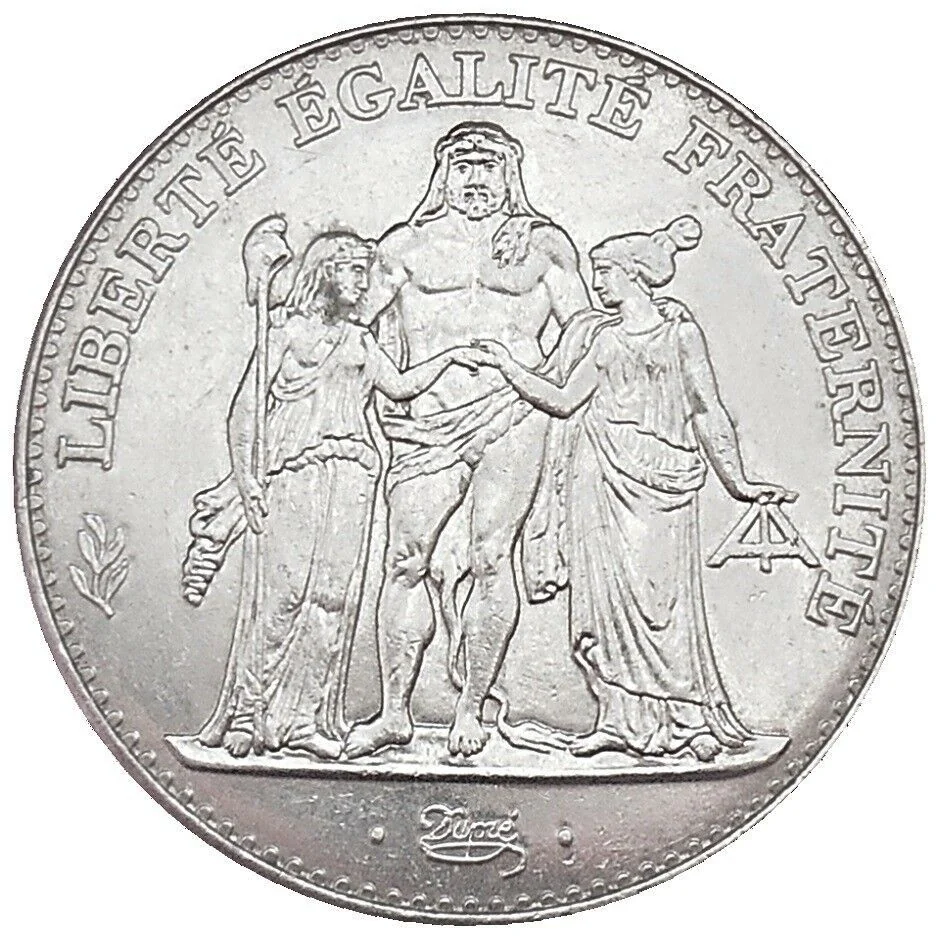
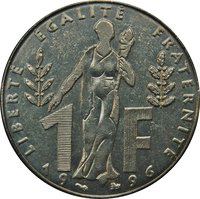
Hercules, nude and wearing a lion skin, stands between Liberté (holding a pike with a Phrygian cap) and Égalité (holding a level), framed by the motto "LIBERTÉ ÉGALITÉ FRATERNITÉ".
Inscription:
LIBERTÉ ÉGALITÉ FRATERNITÉ
Dupré
Dupré
Translation:
Liberty Equality Fraternity
Dupré
Dupré
Script: Latin
Language: French
Engravers: Atelier de Gravure (A.G.M.M.), Augustin Dupré
Edge
Reeded
Mints
| Name | Mark |
|---|---|
| Monnaie de Paris | — |
Mintings
| Year | Mint Mark | Mintage | Quality | Collection |
|---|---|---|---|---|
| 1996 | — | 4,978,743 |
Historical background
In 1996, France was in the final, confident phase of its long-standing commitment to European monetary integration, operating within the strict framework of the European Monetary System (EMS). The French franc was a core and stable member of the Exchange Rate Mechanism (ERM), its value pegged tightly to the Deutsche Mark within narrow fluctuation bands. This stability was hard-won, following the severe crises of 1992-1993 that had forced a widening of the bands, and was a testament to the French policy of the franc fort (strong franc). This policy prioritized low inflation and exchange rate stability over domestic monetary flexibility, aligning closely with German Bundesbank policies to build credibility for the coming single currency.
The primary national focus was not on managing an independent currency but on meticulously fulfilling the Maastricht Treaty convergence criteria to qualify for the European Economic and Monetary Union (EMU). France was actively preparing to cede its monetary sovereignty to the future European Central Bank. Key efforts involved stringent austerity measures to reduce the budget deficit to the required 3% of GDP threshold and to control public debt, sparking significant domestic political debate and social unrest over cuts to public spending and welfare.
Thus, the currency situation was one of transition and anticipation. The franc itself was effectively in a holding pattern, its fate already decided. The real economic drama centered on the government's struggle to meet the Maastricht targets on time, against a backdrop of high unemployment, while the financial markets and institutions were increasingly planning for a post-franc future. The year 1996 was less about the franc's standalone performance and more about France's final preparations to irrevocably lock its exchange rate and adopt the euro, which was then scheduled for introduction in virtual form on January 1, 1999.
The primary national focus was not on managing an independent currency but on meticulously fulfilling the Maastricht Treaty convergence criteria to qualify for the European Economic and Monetary Union (EMU). France was actively preparing to cede its monetary sovereignty to the future European Central Bank. Key efforts involved stringent austerity measures to reduce the budget deficit to the required 3% of GDP threshold and to control public debt, sparking significant domestic political debate and social unrest over cuts to public spending and welfare.
Thus, the currency situation was one of transition and anticipation. The franc itself was effectively in a holding pattern, its fate already decided. The real economic drama centered on the government's struggle to meet the Maastricht targets on time, against a backdrop of high unemployment, while the financial markets and institutions were increasingly planning for a post-franc future. The year 1996 was less about the franc's standalone performance and more about France's final preparations to irrevocably lock its exchange rate and adopt the euro, which was then scheduled for introduction in virtual form on January 1, 1999.
🌱 Very Common