

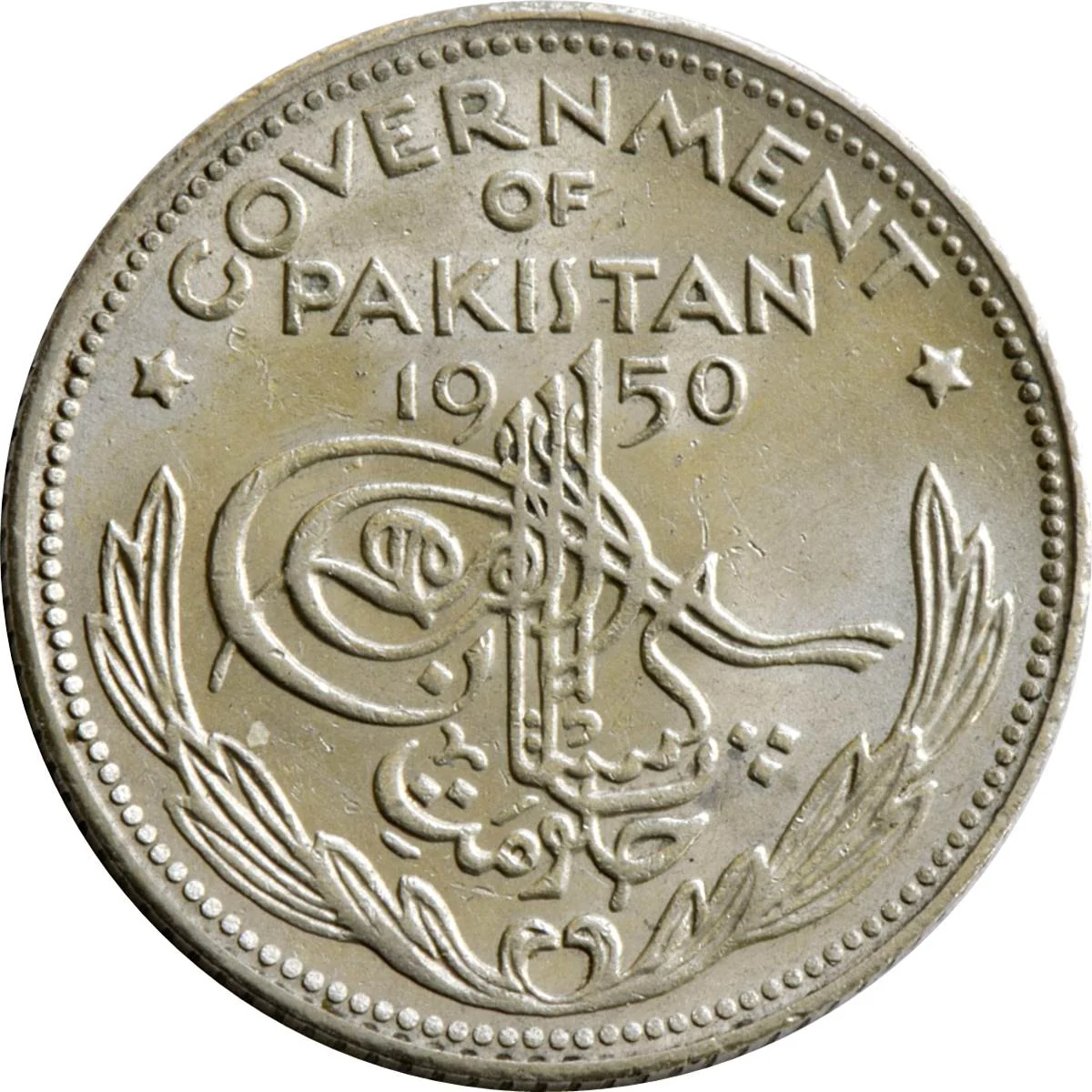
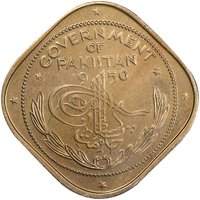
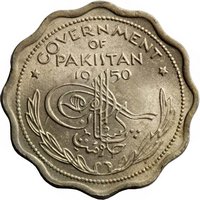
Obverse
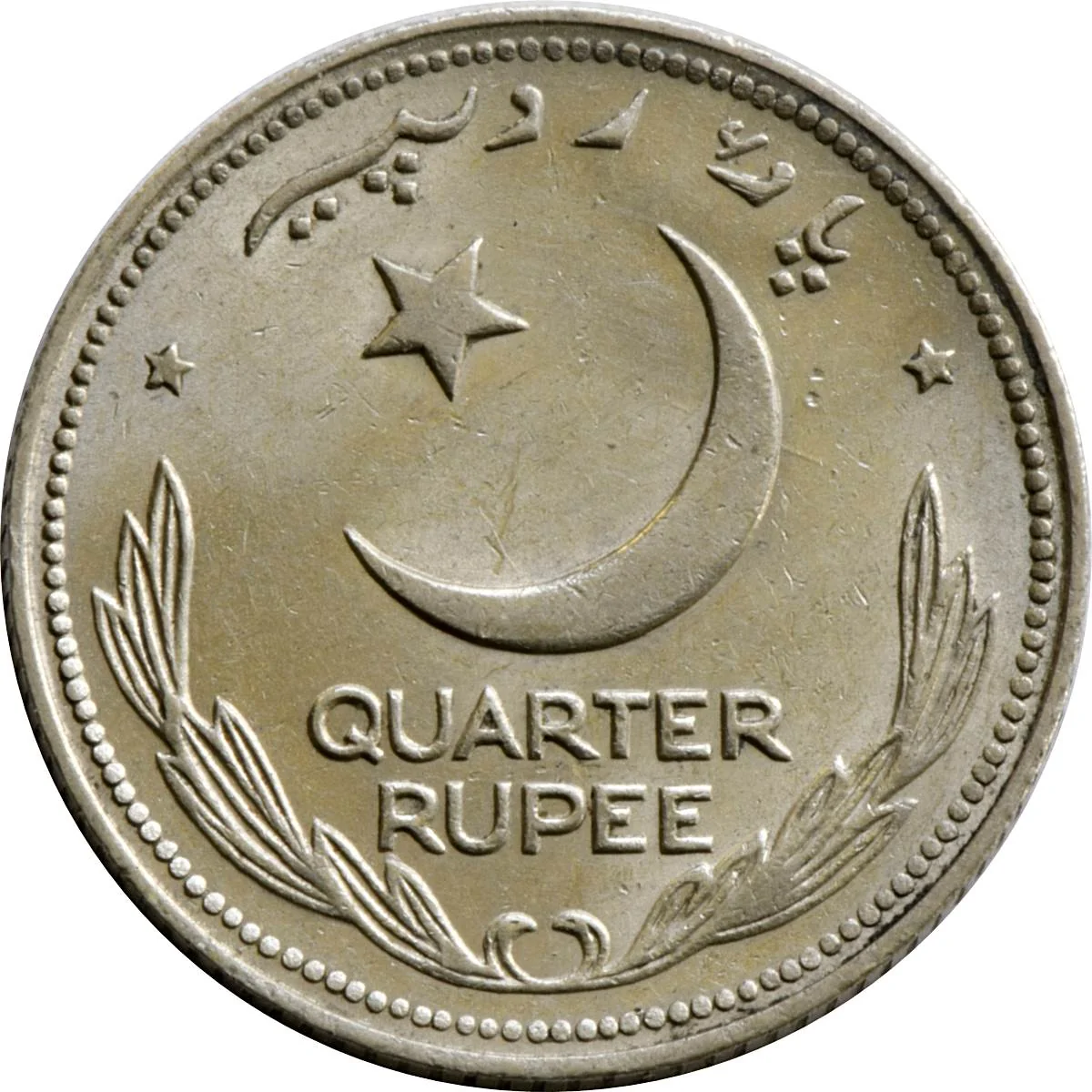
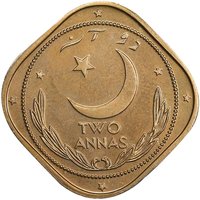
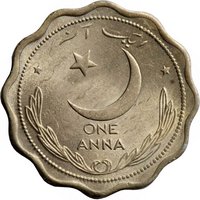
Reverse
Description:
Urdu legend, left-facing crescent moon, star, value above sprigs.
Inscription:
QUARTER
RUPEE
RUPEE
Edge
Reeded
Mintings
| Year | Mint Mark | Mintage | Quality | Collection |
|---|---|---|---|---|
| 1949 | — | — | ||
| 1950 | — | 19,400,000 | ||
| 1950 | — | — | Proof | |
| 1951 | — | — |
Historical background
In 1949, Pakistan faced a severe currency crisis rooted in the economic imbalances of its recent independence. As a new nation, Pakistan inherited a fragile economy heavily dependent on agricultural exports, particularly jute and cotton, while relying on imports for manufactured goods and machinery. The country's foreign exchange reserves were held in sterling balances in London, a legacy of the British Raj, but these were largely controlled by India due to the complex partition settlement, leaving Pakistan with limited access to hard currency.
The crisis was triggered in September 1949 when Britain devalued the pound sterling by 30.5%. India followed suit, devaluing the rupee to maintain its export competitiveness. However, Pakistan made the contentious decision not to devalue its rupee, believing that devaluation would increase the cost of its essential imports and worsen inflation without guaranteeing higher export revenues, as its primary export, raw jute, faced inelastic demand. This created an immediate and stark currency disparity, where the Pakistani rupee became significantly overvalued compared to the Indian rupee, effectively doubling the exchange rate overnight from 1:1 to 1:1.44.
The consequences were swift and damaging. India, Pakistan's largest trading partner, retaliated by imposing an almost total embargo on trade with Pakistan, crippling cross-border commerce. While Pakistan sought new markets, the overvalued currency made its exports less competitive globally. The 1949 currency standoff thus entrenched economic hostility with India, forced a painful and rapid reorientation of trade, and highlighted the profound challenges of establishing monetary sovereignty and stability in the fraught early years of the nation.
The crisis was triggered in September 1949 when Britain devalued the pound sterling by 30.5%. India followed suit, devaluing the rupee to maintain its export competitiveness. However, Pakistan made the contentious decision not to devalue its rupee, believing that devaluation would increase the cost of its essential imports and worsen inflation without guaranteeing higher export revenues, as its primary export, raw jute, faced inelastic demand. This created an immediate and stark currency disparity, where the Pakistani rupee became significantly overvalued compared to the Indian rupee, effectively doubling the exchange rate overnight from 1:1 to 1:1.44.
The consequences were swift and damaging. India, Pakistan's largest trading partner, retaliated by imposing an almost total embargo on trade with Pakistan, crippling cross-border commerce. While Pakistan sought new markets, the overvalued currency made its exports less competitive globally. The 1949 currency standoff thus entrenched economic hostility with India, forced a painful and rapid reorientation of trade, and highlighted the profound challenges of establishing monetary sovereignty and stability in the fraught early years of the nation.
🌟 Uncommon