

1 pataca – Macau
Add to wishlist
China
Context
Material
Diameter: 28 mm
Weight: 10.6 g
Shape: Round
Composition: Copper-nickel
Technique: Milled
Alignment: Coin alignment
flip
References
KM: #
Numista: #23992
Value
Exchange value: 1 MOP
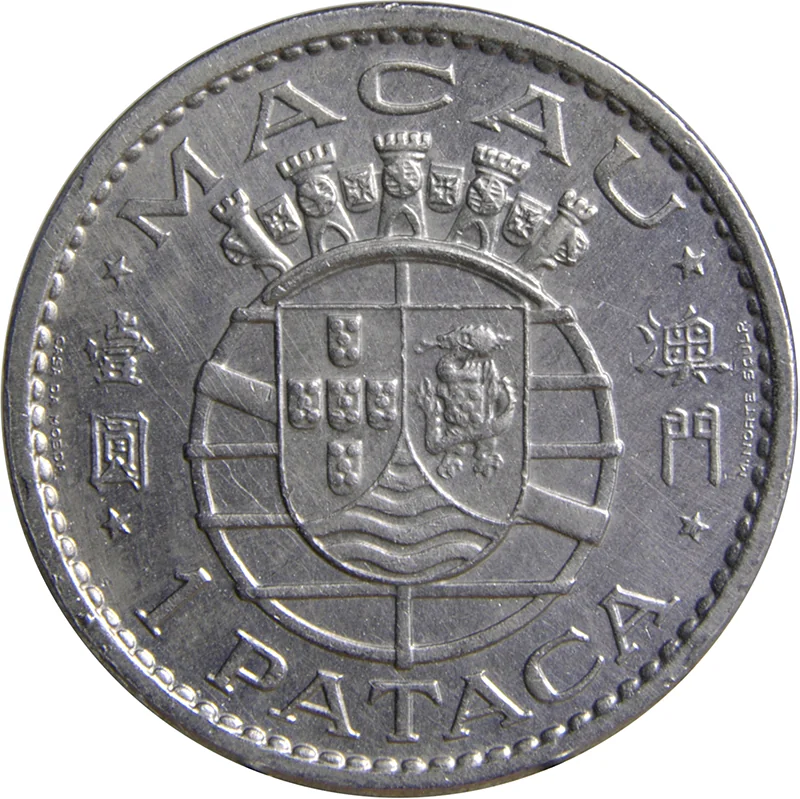
Obverse
Description:
Portuguese shield on globe with cross.
Inscription:
⋆ MACAU ⋆
CASA DA MOEDA M. NORTE SCULP
壹 澳
圓 門
⋆ 1 PATACA ⋆
CASA DA MOEDA M. NORTE SCULP
壹 澳
圓 門
⋆ 1 PATACA ⋆
Translation:
CASA DA MOEDA M. NORTE SCULP
ONE AU
PATACA MEN
ONE AU
PATACA MEN
Languages: Chinese, Portuguese
Engraver: Marcelino Norte de Almeida
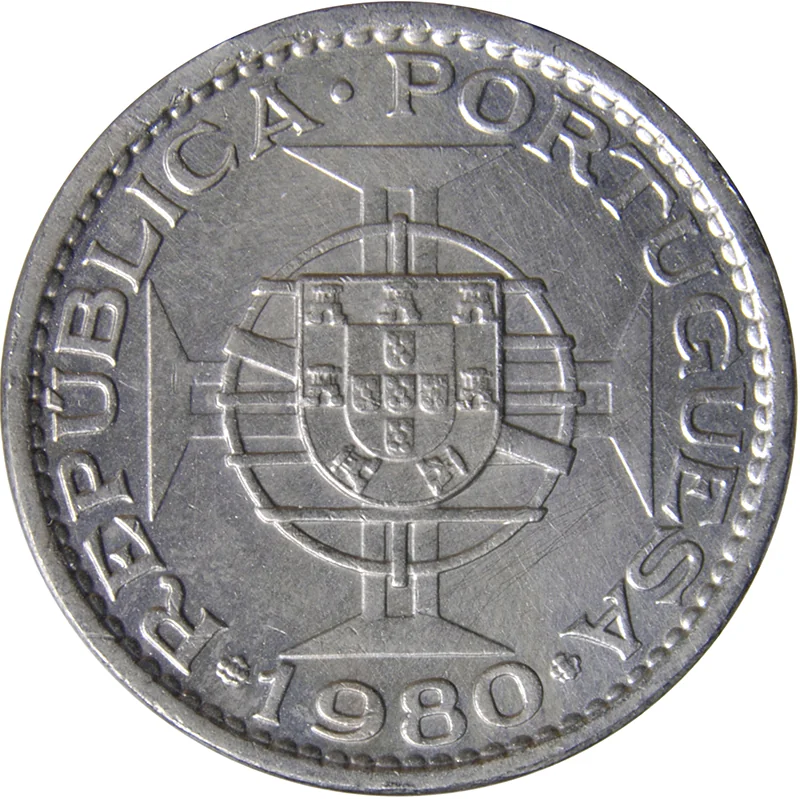
Reverse
Description:
Crowned globe with Macanese shield.
Inscription:
REPÚBLICA • PORTUGUESA
• 1980 •
• 1980 •
Translation:
PORTUGUESE REPUBLIC
• 1980 •
• 1980 •
Language: Portuguese
Engraver: Marcelino Norte de Almeida
Edge
Mints
| Name | Mark |
|---|---|
| Imprensa Nacional - Casa da Moeda | — |
Mintings
| Year | Mint Mark | Mintage | Quality | Collection |
|---|---|---|---|---|
| 1980 | — | 1,500,000 |
Historical background
In the early 1980s, Macau operated under a unique and informal multi-currency system, a legacy of its colonial status and economic ties. As a Portuguese-administered territory, the official currency was the Macau pataca (MOP), issued by two commercial banks—the Banco Nacional Ultramarino and, from 1982, the Banco da China. However, the pataca's circulation and public confidence were limited. Due to Macau's tiny economy and lack of a central bank with strong monetary policy, the pataca was pegged not to the Portuguese escudo but to the Hong Kong dollar (HKD) at a fixed rate of 1.03 patacas to 1 Hong Kong dollar, a linkage established in 1977 that provided crucial stability.
In practice, the Hong Kong dollar was the dominant medium for commerce and high-value transactions. It was widely accepted, even preferred, in sectors like real estate, foreign trade, and tourism, which was beginning to expand with the first casino concessions. This created a de facto dollarized economy where the pataca served primarily for small, everyday purchases and government transactions, while the Hong Kong dollar functioned as the region's unofficial reserve and transaction currency. The Portuguese escudo saw almost no practical use.
This currency duality reflected Macau's economic reality as a small, open entrepôt heavily dependent on its neighbors. Its stability was entirely anchored by the Hong Kong dollar, which itself was pegged to the US dollar in 1983. Therefore, Macau's monetary situation in the 1980s was one of imported stability, with the local pataca playing a secondary role to the more trusted and internationally convertible Hong Kong currency, a setup that would persist even after Macau's handover to China in 1999.
In practice, the Hong Kong dollar was the dominant medium for commerce and high-value transactions. It was widely accepted, even preferred, in sectors like real estate, foreign trade, and tourism, which was beginning to expand with the first casino concessions. This created a de facto dollarized economy where the pataca served primarily for small, everyday purchases and government transactions, while the Hong Kong dollar functioned as the region's unofficial reserve and transaction currency. The Portuguese escudo saw almost no practical use.
This currency duality reflected Macau's economic reality as a small, open entrepôt heavily dependent on its neighbors. Its stability was entirely anchored by the Hong Kong dollar, which itself was pegged to the US dollar in 1983. Therefore, Macau's monetary situation in the 1980s was one of imported stability, with the local pataca playing a secondary role to the more trusted and internationally convertible Hong Kong currency, a setup that would persist even after Macau's handover to China in 1999.
🌟 Uncommon