

4 pence – United Kingdom
Add to wishlist
United Kingdom
Context
Years: 1817–1820
Issuer: United Kingdom
Ruler: George III
Currency:
(1158—1970)
Total mintage: 7,128
Material
References
KM: #
Numista: #13194
Value
Bullion value: $4.36
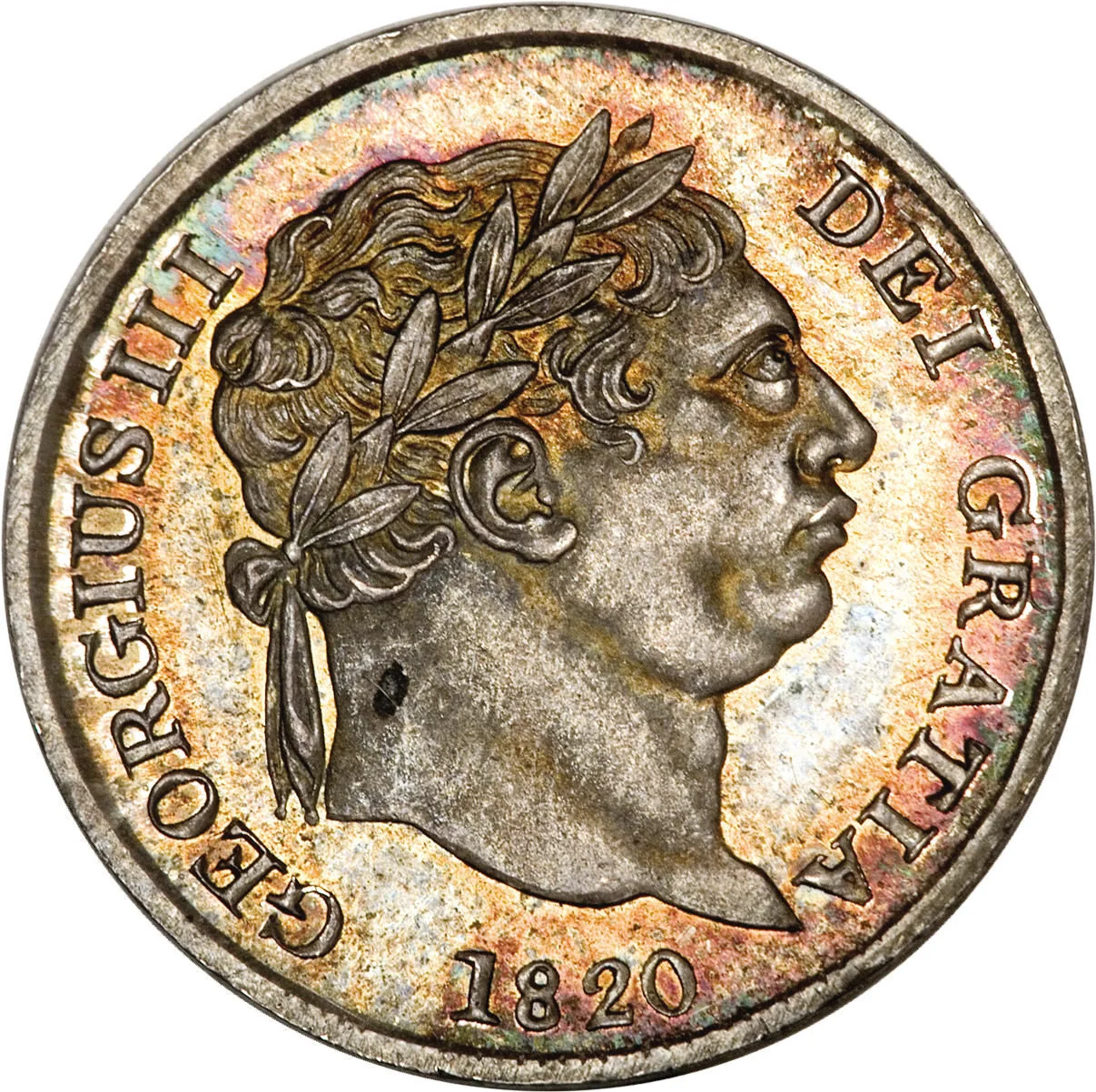
Obverse
Description:
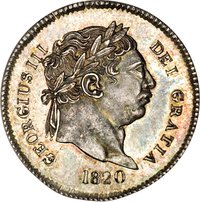
George III laureate bust right, legend around, date below.
Inscription:
GEORGIUS III DEI GRATIA
1818
1818
Translation:
George the Third by the Grace of God
Script: Latin
Language: Latin
Engraver: Benedetto Pistrucci
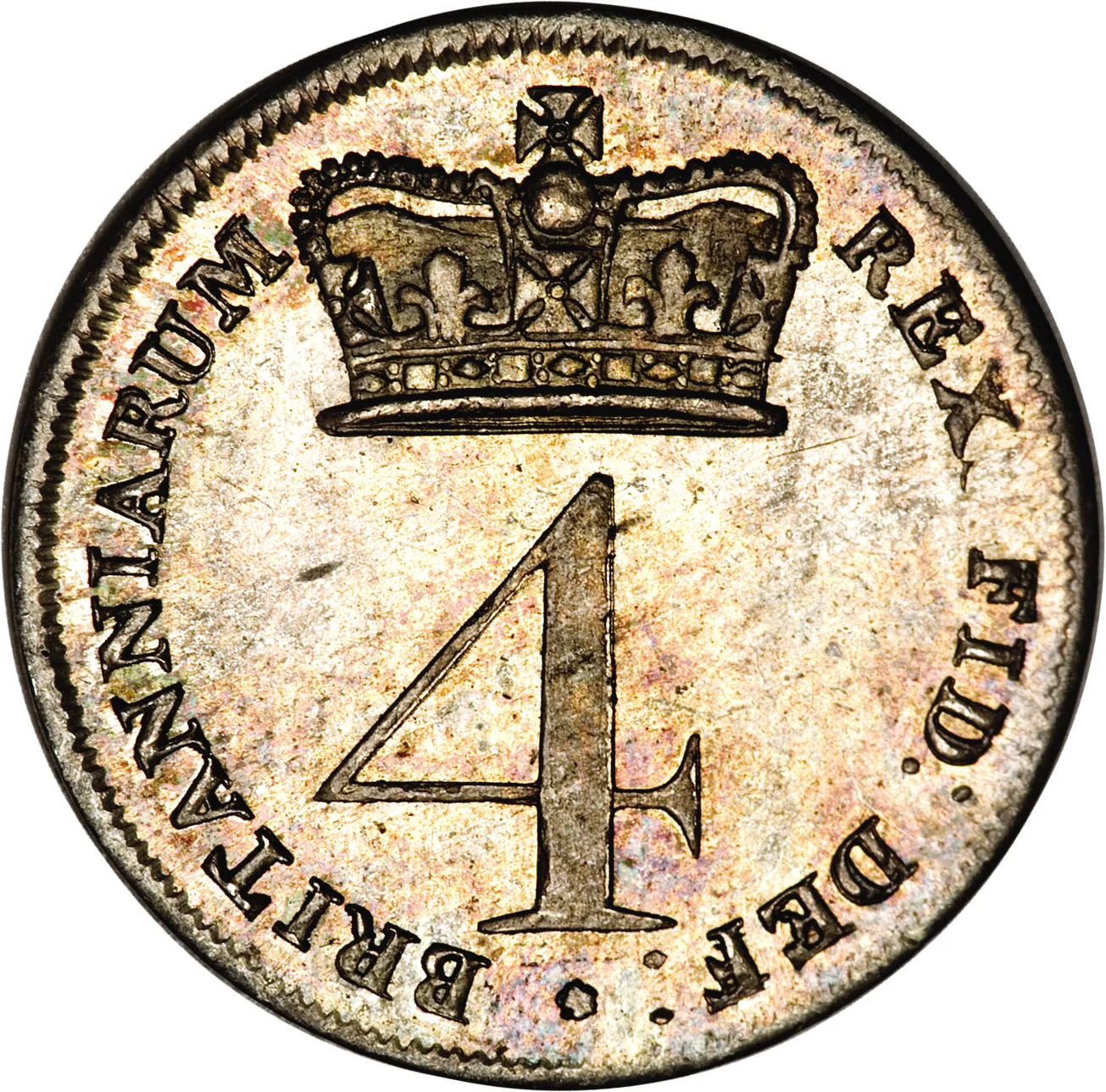
Reverse
Description:
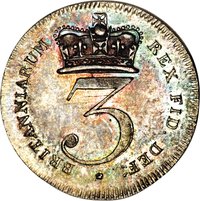
Crowned central design with encircling legend.
Inscription:
BRITANNIARUM REX FID: DEF: *
4
4
Translation:
King of the Britains, Defender of the Faith
Script: Latin
Language: Latin
Engraver: Benedetto Pistrucci
Edge
Mints
| Name | Mark |
|---|---|
| Royal Mint (Tower Hill) | — |
Mintings
| Year | Mint Mark | Mintage | Quality | Collection |
|---|---|---|---|---|
| 1817 | — | 1,386 | Proof | |
| 1817 | — | 1,386 | Prooflike | |
| 1818 | — | 1,188 | Proof | |
| 1818 | — | 1,188 | Prooflike | |
| 1820 | — | 990 | Proof | |
| 1820 | — | 990 | Prooflike |
Historical background
In 1817, Britain was navigating the complex aftermath of the Napoleonic Wars, with its currency system in a state of transition. Since 1797, the country had operated under the "Restriction Period," where the Bank of England was relieved from converting its banknotes into gold specie. This move, intended to prevent a run on the Bank's gold reserves during wartime, led to significant inflation and a depreciation of paper money against gold. By 1817, the war had ended at Waterloo two years prior, and there was intense political and economic pressure to return to the stability and discipline of the gold standard, a process known as "resumption."
The situation was defined by the recommendations of the 1810 Bullion Report, which had famously attributed the currency's depreciation to the over-issue of banknotes. Acting on this, Parliament passed the Coinage Act in 1816, which formally demonetised silver and established gold as the sole standard of value. The pivotal step came in 1817 with the introduction of a new gold coin—the sovereign, valued at one pound. This was a tangible symbol of the intended return to convertibility, though full resumption was not yet in effect. The new coins, containing 123.27 grains of standard gold, began to circulate alongside a still-substantial volume of paper notes and older, often worn or clipped, gold guineas.
However, the year 1817 represented a cautious interim rather than an immediate resolution. Full convertibility of Bank of England notes back into gold was not officially restored until 1821. The economy in 1817 was also suffering post-war depression and deflationary pressures, making a swift return to the pre-1797 parity a painful prospect for debtors and landowners. Thus, the currency situation was one of preparation and managed expectation: the physical embodiment of the gold standard was being minted and circulated, while the monetary authorities carefully managed the money supply to ensure a smooth transition back to the disciplined system that would define the next century of British finance.
The situation was defined by the recommendations of the 1810 Bullion Report, which had famously attributed the currency's depreciation to the over-issue of banknotes. Acting on this, Parliament passed the Coinage Act in 1816, which formally demonetised silver and established gold as the sole standard of value. The pivotal step came in 1817 with the introduction of a new gold coin—the sovereign, valued at one pound. This was a tangible symbol of the intended return to convertibility, though full resumption was not yet in effect. The new coins, containing 123.27 grains of standard gold, began to circulate alongside a still-substantial volume of paper notes and older, often worn or clipped, gold guineas.
However, the year 1817 represented a cautious interim rather than an immediate resolution. Full convertibility of Bank of England notes back into gold was not officially restored until 1821. The economy in 1817 was also suffering post-war depression and deflationary pressures, making a swift return to the pre-1797 parity a painful prospect for debtors and landowners. Thus, the currency situation was one of preparation and managed expectation: the physical embodiment of the gold standard was being minted and circulated, while the monetary authorities carefully managed the money supply to ensure a smooth transition back to the disciplined system that would define the next century of British finance.
💎 Extremely Rare