

1 pound – Ireland
Add to wishlist
Non-circulating coins
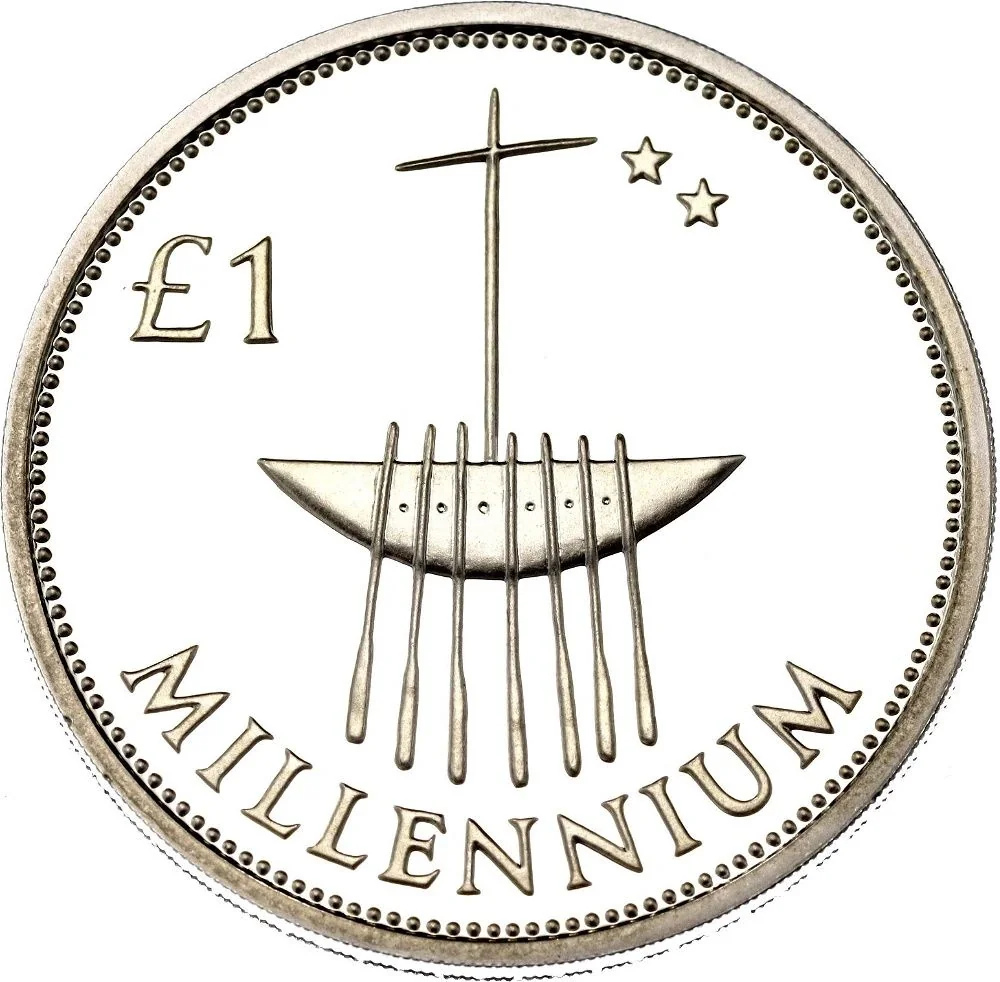
Commemoration: Millennium Punt
Ireland
Obverse
Description:
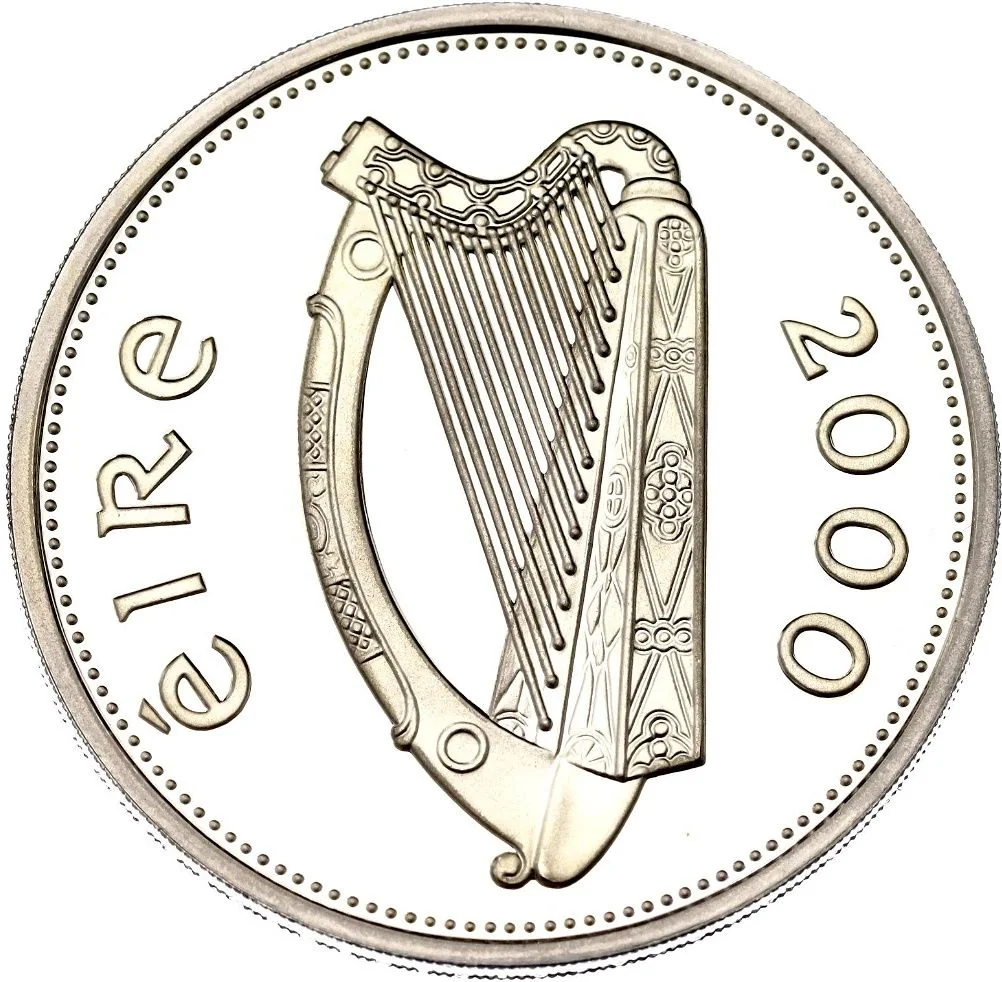
Cláirseach (Gaelic harp) center.
Inscription:
éIRe
2000
2000
Translation:
Ireland
2000
2000
Script: Latin (Gaelic)
Reverse
Edge
Sunken alternating lines and dots (milled and engrailed)
Categories
| Event> Millennium |
| Transportation> Watercraft |
Mints
| Name | Mark |
|---|---|
| Irish Mint | — |
Mintings
| Year | Mint Mark | Mintage | Quality | Collection |
|---|---|---|---|---|
| 2000 | — | 95,000 |
Historical background
In the year 2000, Ireland was in a unique and transitional currency situation, operating as a member of the European Union's Economic and Monetary Union (EMU) but not yet using euro cash. The Irish pound (or punt) remained the national legal tender, yet its value was irrevocably fixed. On January 1, 1999, Ireland had adopted the euro as its official currency in a scriptural (electronic) form, locking the exchange rate at €1 = IR£0.787564. This meant that all financial markets, government debt, and non-cash transactions were conducted in euros, while coins and banknotes in public circulation were still Irish pounds.
This period, known as the "transitional phase," created a dual-pricing environment where consumers often saw prices displayed in both Irish pounds and euros. The purpose was to familiarise the public with the new currency in preparation for the full cash changeover scheduled for January 1, 2002. Economically, Ireland was experiencing the "Celtic Tiger" boom, and the fixed parity with the euro provided exchange rate stability and low interest rates within the Eurozone framework, further fuelling investment and growth, albeit with emerging concerns about inflation and overheating.
Thus, the currency situation in 2000 was one of legal and practical duality, underpinned by a settled fixed rate. The Irish pound was effectively a national subunit of the euro, awaiting its final retirement in favour of physical euro notes and coins just over a year later. This seamless technical and logistical preparation positioned Ireland for a successful transition, marking the final chapter of the national currency before fully embracing its role in the single European currency area.
This period, known as the "transitional phase," created a dual-pricing environment where consumers often saw prices displayed in both Irish pounds and euros. The purpose was to familiarise the public with the new currency in preparation for the full cash changeover scheduled for January 1, 2002. Economically, Ireland was experiencing the "Celtic Tiger" boom, and the fixed parity with the euro provided exchange rate stability and low interest rates within the Eurozone framework, further fuelling investment and growth, albeit with emerging concerns about inflation and overheating.
Thus, the currency situation in 2000 was one of legal and practical duality, underpinned by a settled fixed rate. The Irish pound was effectively a national subunit of the euro, awaiting its final retirement in favour of physical euro notes and coins just over a year later. This seamless technical and logistical preparation positioned Ireland for a successful transition, marking the final chapter of the national currency before fully embracing its role in the single European currency area.
🌟 Limited