

Obverse
Description:
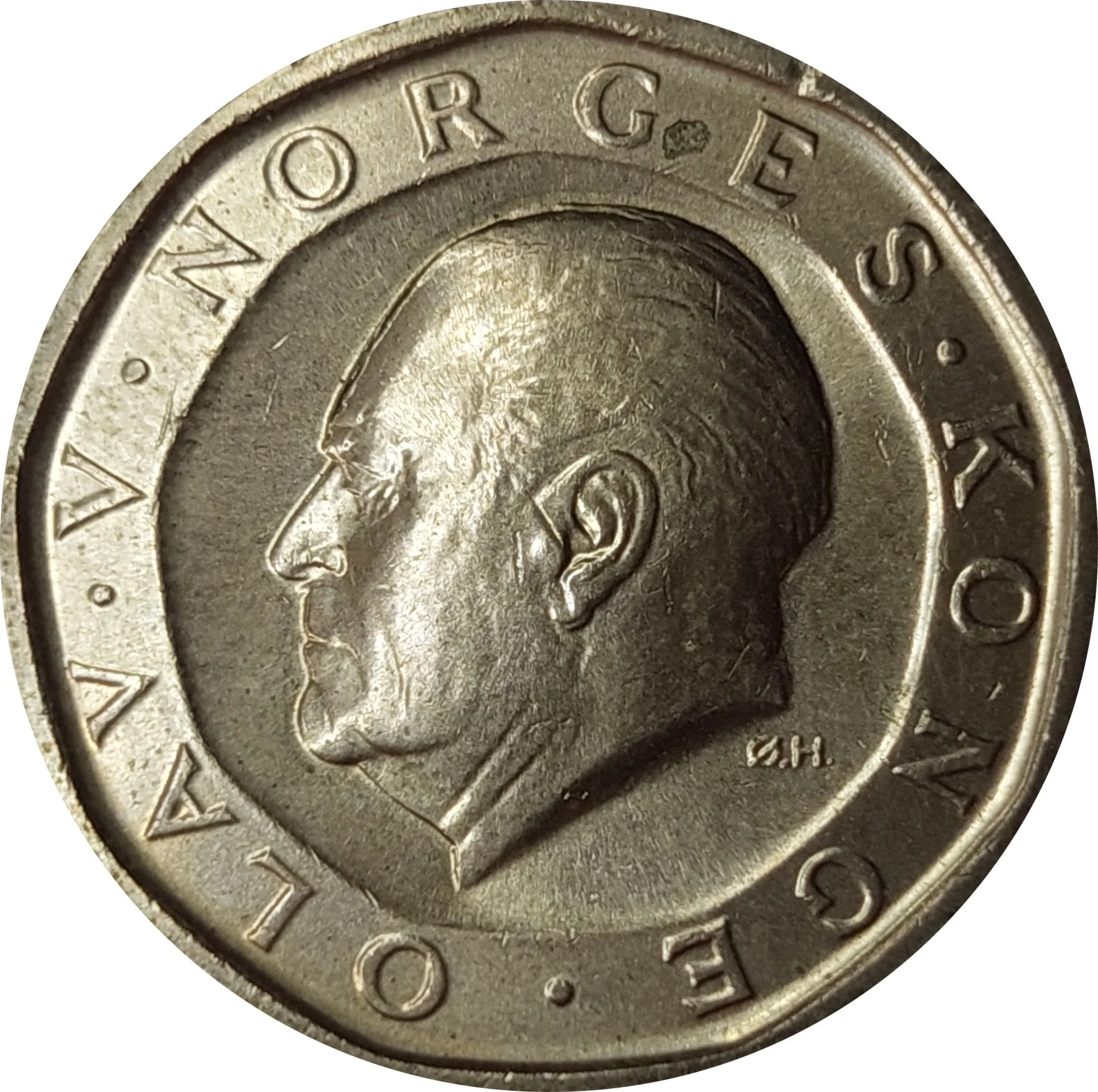
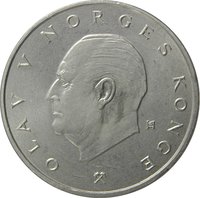
Bust of King Olav V facing left, surrounded by an inscription. Engraver's initials below the bust. Both the central image and the rim feature a raised nine-sided ring.
Inscription:
OLAV · V · NORGES · KONGE ·
Ø.H.
Ø.H.
Translation:
Olav V, Norway's King
Ø.H.
Ø.H.
Script: Latin
Engraver: Øivind Hansen
Reverse
Description:
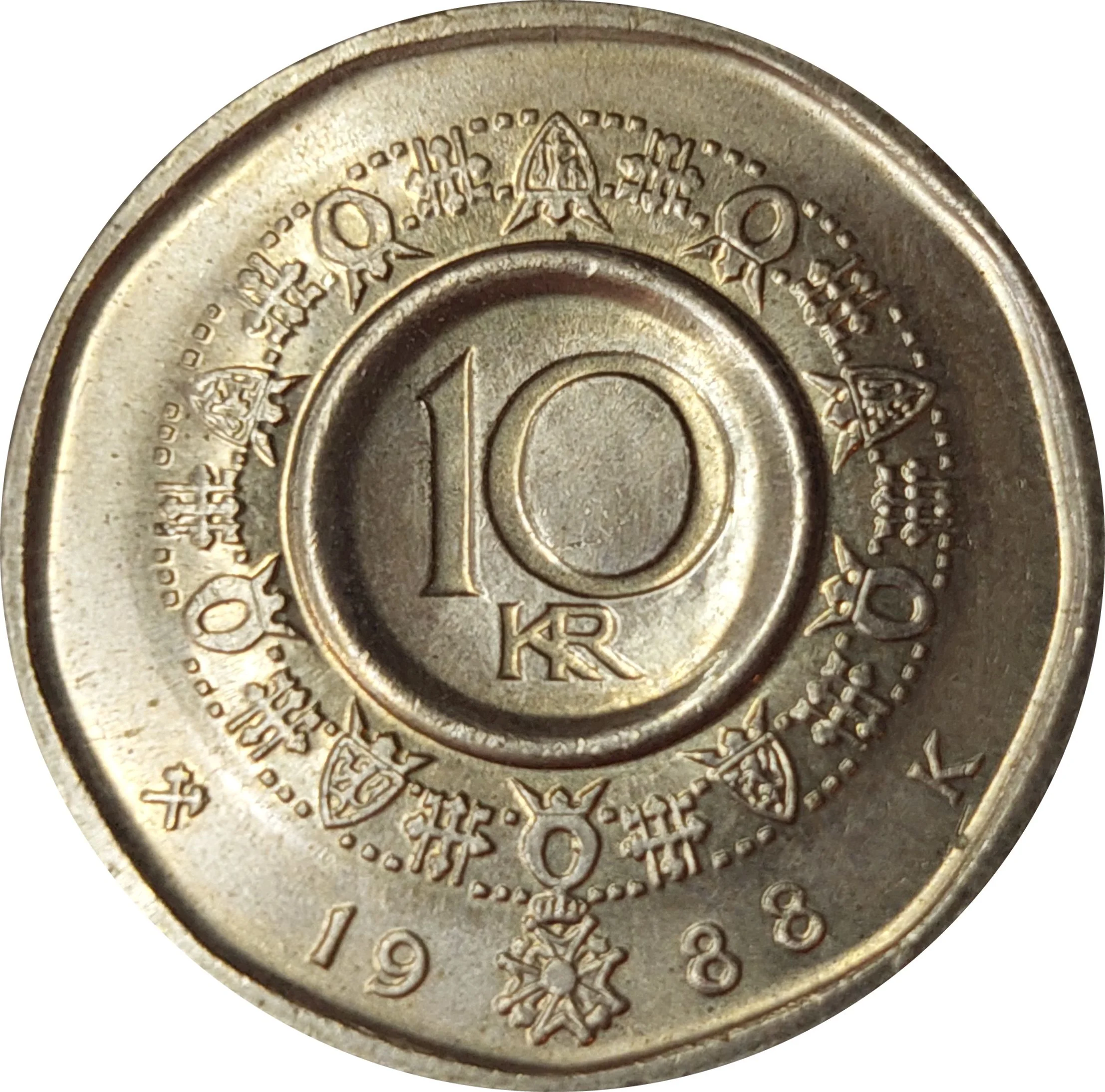
Value in two lines within a solid ring, encircled by the Chain of the Order of Saint Olaf. Date below, flanked by mintmark and mintmaster's initial. Outer rim is a solid 9-sided ring.
Inscription:
10
KR
⚒ 19 | 88 K
KR
⚒ 19 | 88 K
Script: Latin
Engraver: Øivind Hansen
Edge
Plain
Mints
| Name | Mark |
|---|---|
| Norwegian Mint | — |
Mintings
| Year | Mint Mark | Mintage | Quality | Collection |
|---|---|---|---|---|
| 1983 | — | 20,193,060 | ||
| 1984 | — | 10,972,500 | ||
| 1985 | — | 22,347,550 | ||
| 1986 | — | 28,960,950 | ||
| 1987 | — | 8,724,750 | ||
| 1988 | — | 2,528,500 | ||
| 1989 | — | 3,158,000 | ||
| 1990 | — | 2,901,000 | ||
| 1991 | — | 19,886,965 |
Historical background
In 1983, Norway's currency situation was defined by a managed exchange rate regime, with the Norwegian krone (NOK) pegged to a trade-weighted basket of currencies, primarily the US dollar and European currencies. This system, established in the late 1970s, aimed to provide stability and curb imported inflation by allowing the central bank (Norges Bank) to control the krone's value within a narrow band. However, maintaining this peg required significant intervention, as Norway was grappling with the economic aftershocks of the early 1980s global recession, which had depressed oil prices and exposed vulnerabilities beyond its burgeoning offshore oil sector.
The background was one of conflicting pressures. While the oil and gas industry was expanding rapidly, providing substantial export revenue and government income, the traditional mainland economy—especially manufacturing and export industries—faced severe competitiveness challenges. A strong krone, bolstered by oil revenues and the peg, made Norwegian non-oil exports more expensive on the world market, leading to what economists termed "Dutch Disease." This created a policy dilemma: whether to devalue the krone to aid struggling traditional industries or maintain a strong currency to control inflation and the cost of living.
Consequently, 1983 was a year of tense equilibrium. Norges Bank actively bought and sold foreign currency to defend the peg, leading to considerable volatility in interest rates as a secondary tool. Political debates centered on the sustainability of the peg and the broader economic restructuring required. This period set the stage for the dramatic policy shift that would come in 1986, when a collapse in oil prices forced Norway to abandon the fixed exchange rate and devalue the krone, moving towards a more flexible system.
The background was one of conflicting pressures. While the oil and gas industry was expanding rapidly, providing substantial export revenue and government income, the traditional mainland economy—especially manufacturing and export industries—faced severe competitiveness challenges. A strong krone, bolstered by oil revenues and the peg, made Norwegian non-oil exports more expensive on the world market, leading to what economists termed "Dutch Disease." This created a policy dilemma: whether to devalue the krone to aid struggling traditional industries or maintain a strong currency to control inflation and the cost of living.
Consequently, 1983 was a year of tense equilibrium. Norges Bank actively bought and sold foreign currency to defend the peg, leading to considerable volatility in interest rates as a secondary tool. Political debates centered on the sustainability of the peg and the broader economic restructuring required. This period set the stage for the dramatic policy shift that would come in 1986, when a collapse in oil prices forced Norway to abandon the fixed exchange rate and devalue the krone, moving towards a more flexible system.
🌱 Very Common