

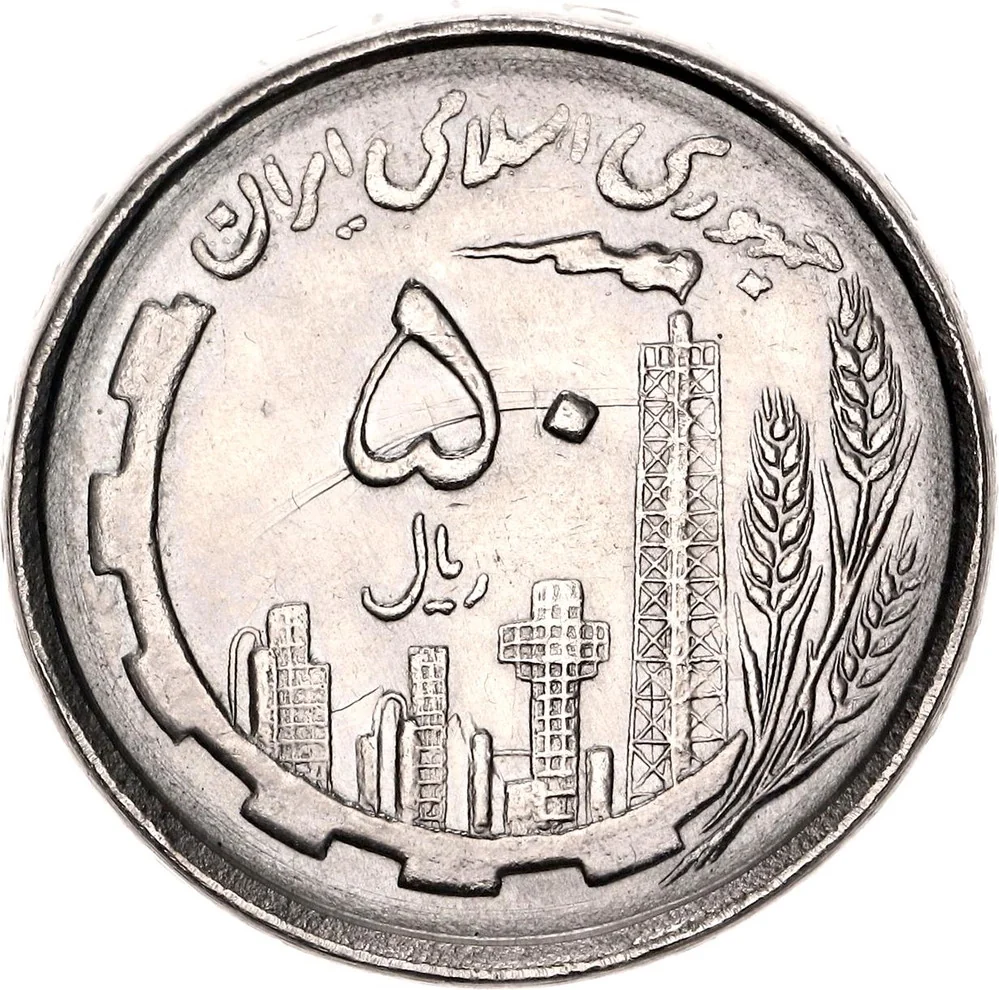
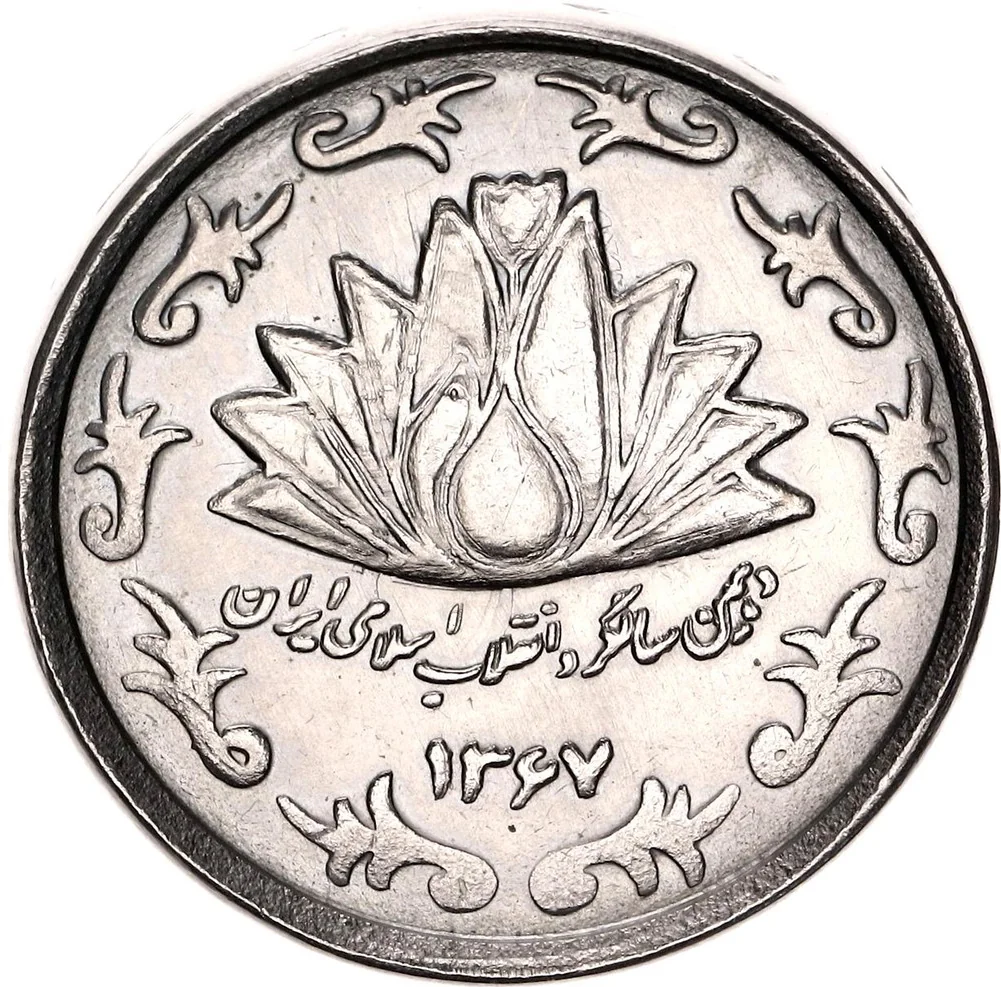
50 rials (Revolution) – Iran
Add to wishlist
Circulating commemorative coins
Commemoration: 10th Anniversary of Revolution
Iran
Context
Year: 1988
Iranian - Persian Year:: 1367
Issuer: Iran
Period:
(since 1979)
Currency:
(since 1932)
Demonetized: Yes
Material
Diameter: 26 mm
Weight: 7.2 g
Shape: Round
Composition: Copper-nickel
Technique: Milled
Alignment: Coin alignment
flip
References
KM: #
Numista: #23973
Value
Exchange value: 50 IRR
Obverse
Description:
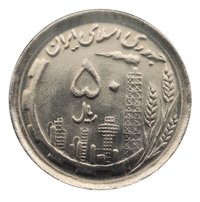
Value at top left: towers, half gear, oat sprigs.
Inscription:
۵۰
Reverse
Description:
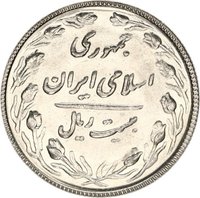
Floral motif above bordered inscription and date.
Inscription:
۱۳۶۷
Edge
Farsi lettering
Categories
| Agriculture |
| Event> Revolution |
| Industry |
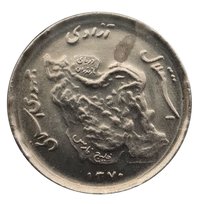
| Map |
Mintings
| Year | Mint Mark | Mintage | Quality | Collection |
|---|---|---|---|---|
| 1988 | — | — |
Historical background
In 1988, Iran's currency situation was deeply strained by the cumulative effects of the devastating eight-year war with Iraq (1980-1988). The conflict had drained the country's foreign exchange reserves, crippled oil infrastructure and exports (its primary revenue source), and led to massive military spending. This resulted in severe budget deficits, which the government financed primarily through borrowing from the central bank—effectively printing money. Consequently, the Iranian rial experienced significant inflationary pressure, with official and black-market exchange rates diverging sharply as confidence in the currency waned.
The economy was highly centralized and managed through a complex system of multiple exchange rates. The government maintained an official rate (around 70 rials to the US dollar) for essential imports like food and medicine, while a "competitive" rate and a much lower black-market rate (which could be several times higher) existed for other transactions. This multi-tier system, intended to conserve scarce hard currency and control prices, instead fostered corruption, rent-seeking, and a thriving black market for foreign exchange, further distorting the economy.
By the war's end in August 1988, the currency crisis was part of a broader economic emergency. Reconstruction needs were immense, but resources were depleted. The inflationary spiral, driven by wartime monetary expansion, was becoming entrenched, setting the stage for the difficult post-war adjustments of the early 1990s. The government faced the impending challenge of unifying the chaotic exchange rate system and stabilizing the rial, tasks that would require politically painful reforms and austerity measures in the coming years.
The economy was highly centralized and managed through a complex system of multiple exchange rates. The government maintained an official rate (around 70 rials to the US dollar) for essential imports like food and medicine, while a "competitive" rate and a much lower black-market rate (which could be several times higher) existed for other transactions. This multi-tier system, intended to conserve scarce hard currency and control prices, instead fostered corruption, rent-seeking, and a thriving black market for foreign exchange, further distorting the economy.
By the war's end in August 1988, the currency crisis was part of a broader economic emergency. Reconstruction needs were immense, but resources were depleted. The inflationary spiral, driven by wartime monetary expansion, was becoming entrenched, setting the stage for the difficult post-war adjustments of the early 1990s. The government faced the impending challenge of unifying the chaotic exchange rate system and stabilizing the rial, tasks that would require politically painful reforms and austerity measures in the coming years.
🌟 Uncommon