

8 maravedis – Spain
Add to wishlist
Spain
Context
Material
References
KM: #
Numista: #23910
Obverse
Description:
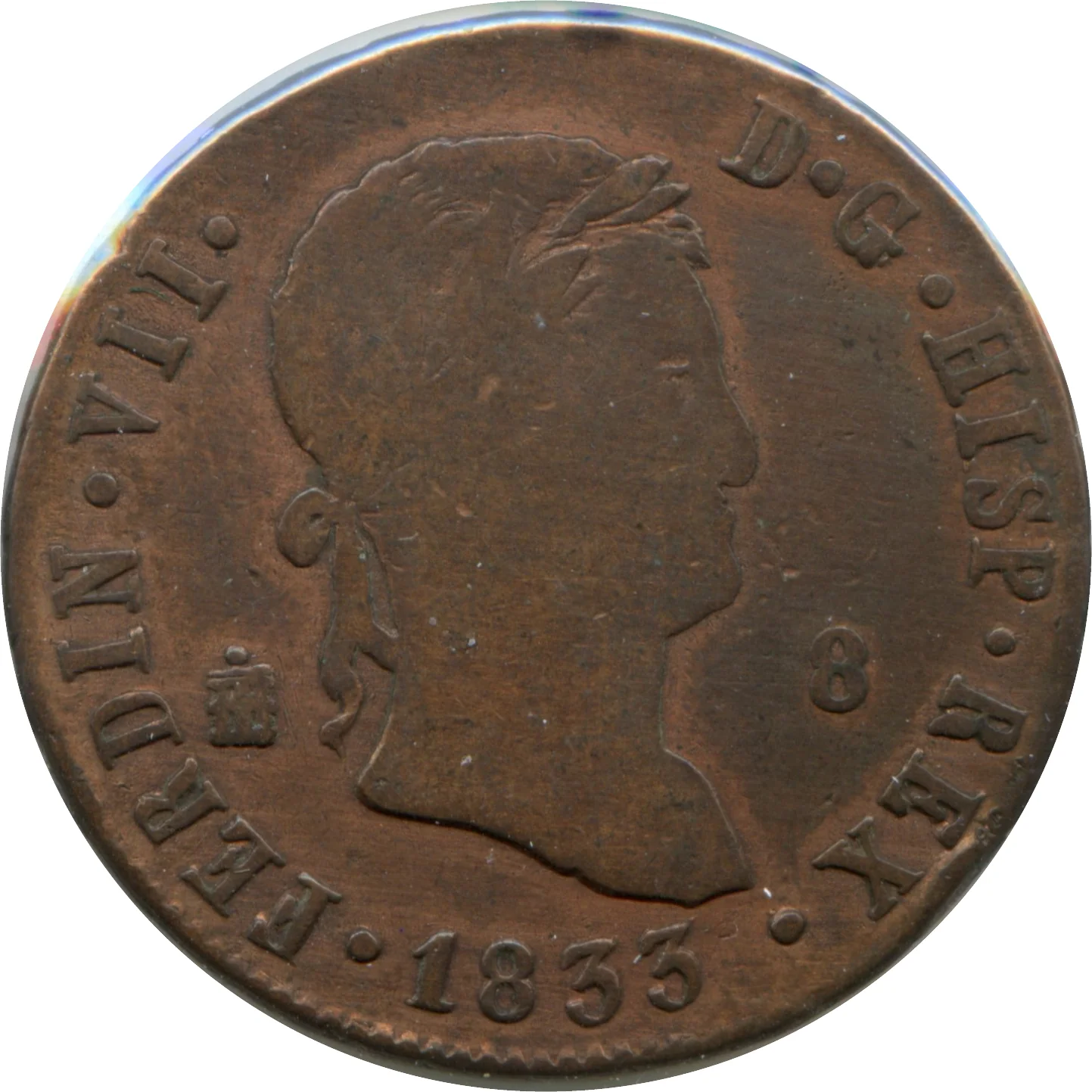
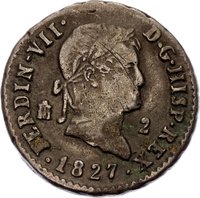
King Fernando VII facing right.
Inscription:
FERDIN · VII· D · G · HISP · REX
8
· 1833 ·
8
· 1833 ·
Translation:
FERDINAND VII BY THE GRACE OF GOD KING OF SPAIN
8
1833
8
1833
Script: Latin
Language: Latin
Engraver: Félix Sagau y Dalmau de Galcerán
Reverse
Description:
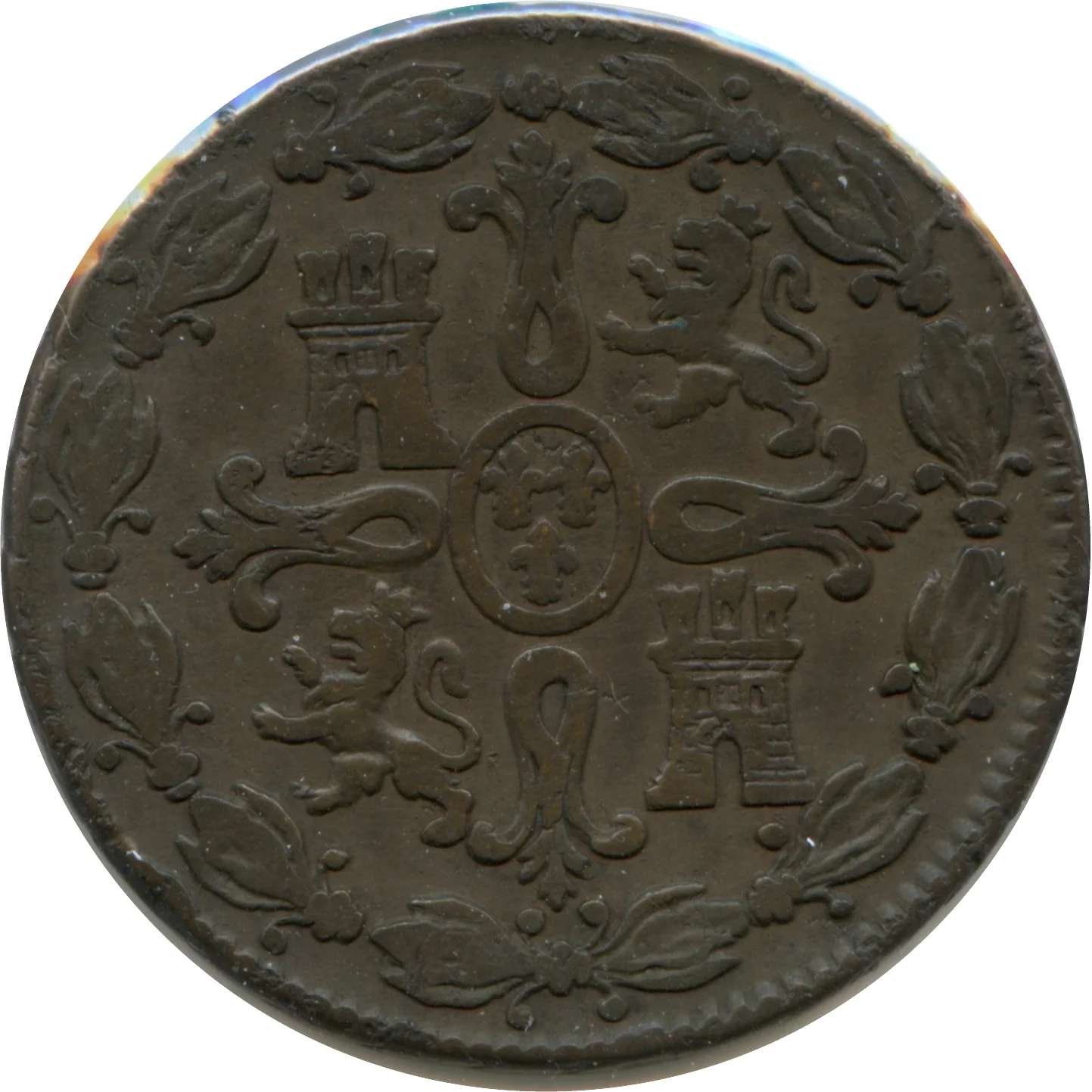
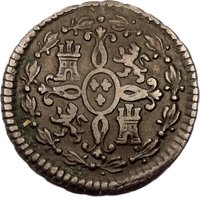
Cross of Don Pelayo featuring castles and lions for Castile and Leon, a central Bourbon fleur-de-lis oval, and a perimeter wreath.
Engraver: Félix Sagau y Dalmau de Galcerán
Edge
Plain
Categories
| Symbol> Fleur-de-lis |
| Symbol> Wreath |
| Animal> Feline |
| Building> Castle or fortification |
| Symbol> Cross |
Mints
| Name | Mark |
|---|---|
| Royal Mint of Segovia | — |
Mintings
| Year | Mint Mark | Mintage | Quality | Collection |
|---|---|---|---|---|
| 1815 | — | — | ||
| 1816 | — | — | ||
| 1817 | — | — | ||
| 1818 | — | — | ||
| 1819 | — | — | ||
| 1820 | — | — | ||
| 1821 | — | — | ||
| 1822 | — | — | ||
| 1823 | — | — | ||
| 1823 | P | — | ||
| 1824 | — | — | ||
| 1825 | — | — | ||
| 1826 | — | — | ||
| 1827 | — | — | ||
| 1828 | — | — | ||
| 1829 | — | — | ||
| 1830 | — | — | ||
| 1831 | — | — | ||
| 1832 | — | — | ||
| 1833 | — | — |
Historical background
In 1815, Spain was in the throes of a profound monetary crisis, a direct consequence of the Peninsular War (1808-1814) and the preceding decades of fiscal mismanagement. The war against Napoleon had devastated the economy, severed colonial trade routes, and forced both the French occupiers and the Spanish resistance governments to finance the conflict through massive borrowing and, most destructively, the unrestrained printing of paper money. This resulted in a catastrophic proliferation of vales reales (royal bonds) and other emergency paper issues, which flooded the market and became virtually worthless. The state was bankrupt, its credit ruined, and the coinage system was fractured, with precious metal coins being hoarded and disappearing from circulation.
The currency landscape was a chaotic mix of depreciated paper, scarce silver reales, and a bewildering variety of foreign coins, particularly French francs and Portuguese money, which circulated out of necessity. The fundamental problem was a complete loss of public confidence in the government's ability to honor its paper obligations, leading to a severe divergence between the nominal and market value of the vales reales. This hyperinflationary environment crippled commerce, as merchants refused paper and demanded payment in scarce silver, exacerbating economic stagnation. The restoration of King Ferdinand VII in 1814 did not bring fiscal discipline; instead, his absolutist regime continued to print money to cover deficits, further eroding trust.
This monetary disarray was symptomatic of the wider crisis of the Spanish Empire. The loss of effective control over its American colonies during the war severed the vital flow of silver pesos that had historically underpinned the Spanish economy. Without this colonial silver, the Crown had no means to stabilize the currency or back its paper promises. Consequently, in 1815, Spain lacked a unified, trustworthy circulating medium. The situation demanded a comprehensive monetary reform, which would eventually begin with the creation of the Bank of San Fernando in 1829, but in the immediate post-war years, financial chaos remained a defining feature of a nation struggling to recover its footing.
The currency landscape was a chaotic mix of depreciated paper, scarce silver reales, and a bewildering variety of foreign coins, particularly French francs and Portuguese money, which circulated out of necessity. The fundamental problem was a complete loss of public confidence in the government's ability to honor its paper obligations, leading to a severe divergence between the nominal and market value of the vales reales. This hyperinflationary environment crippled commerce, as merchants refused paper and demanded payment in scarce silver, exacerbating economic stagnation. The restoration of King Ferdinand VII in 1814 did not bring fiscal discipline; instead, his absolutist regime continued to print money to cover deficits, further eroding trust.
This monetary disarray was symptomatic of the wider crisis of the Spanish Empire. The loss of effective control over its American colonies during the war severed the vital flow of silver pesos that had historically underpinned the Spanish economy. Without this colonial silver, the Crown had no means to stabilize the currency or back its paper promises. Consequently, in 1815, Spain lacked a unified, trustworthy circulating medium. The situation demanded a comprehensive monetary reform, which would eventually begin with the creation of the Bank of San Fernando in 1829, but in the immediate post-war years, financial chaos remained a defining feature of a nation struggling to recover its footing.
🌱 Common