

25 dollars (World War II) – United States
Add to wishlist
Non-circulating coins
Commemoration: End of World War II 75th Anniversary
United States
Context
Material
Diameter: 27 mm
Weight: 15.55 g
Gold Weight:: 15.53 g
Shape: Round
Composition: 99.9% Gold
Standard: Silver half ounce
Magnetic: No
Technique: Milled
Alignment: Coin alignment
flip
References
Numista: #238823
Value
Exchange value: 25 USD = $25.00
Bullion value: $2368.31
Inflation-adjusted value: 31.40 USD
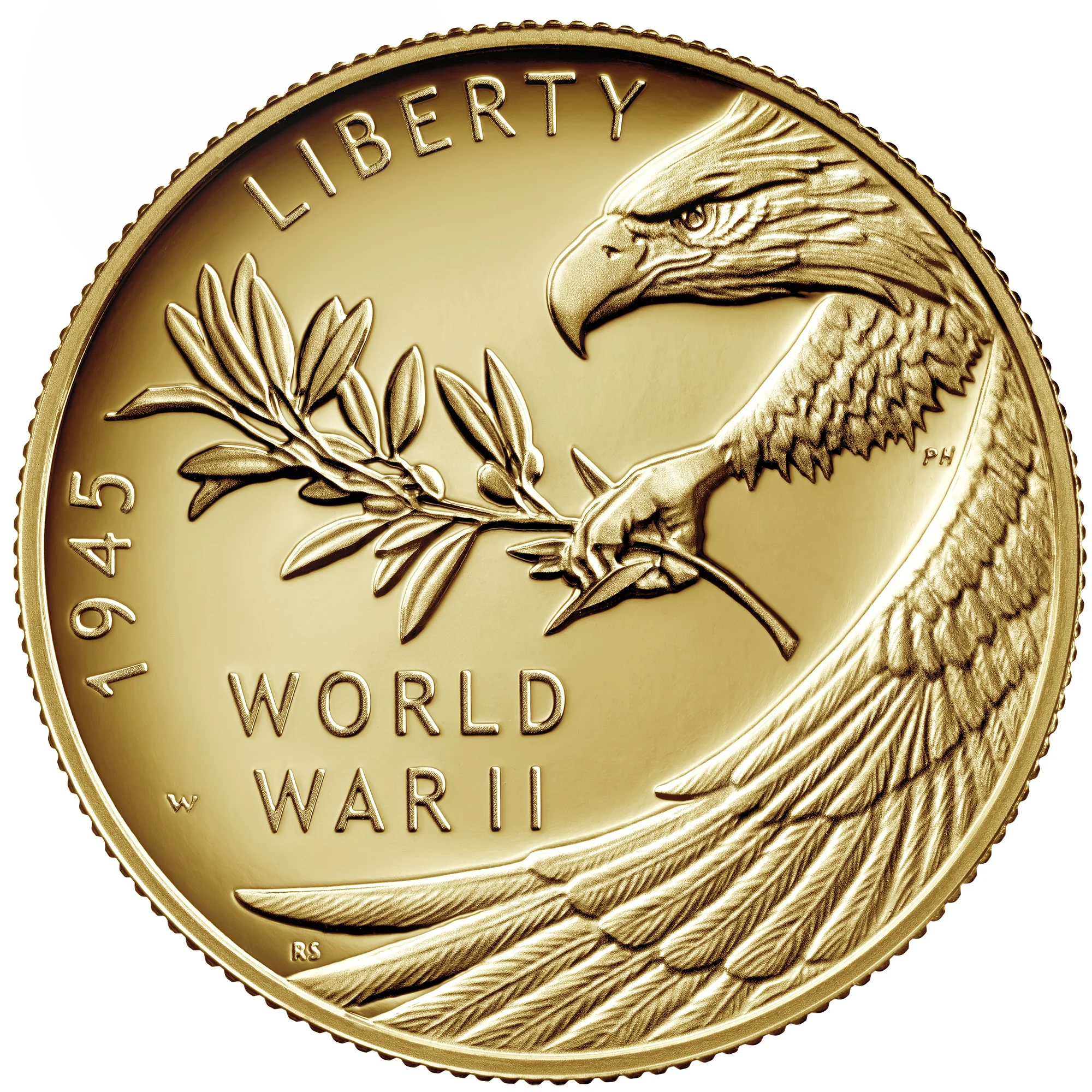
Obverse
Description:
An eagle in flight carrying an olive branch in its right talon, symbolizing peace.
Inscription:
1945 Liberty
World
War II
World
War II
Script: Latin
Engraver: Phebe Hemphill
Designer: Ronald D. Sanders
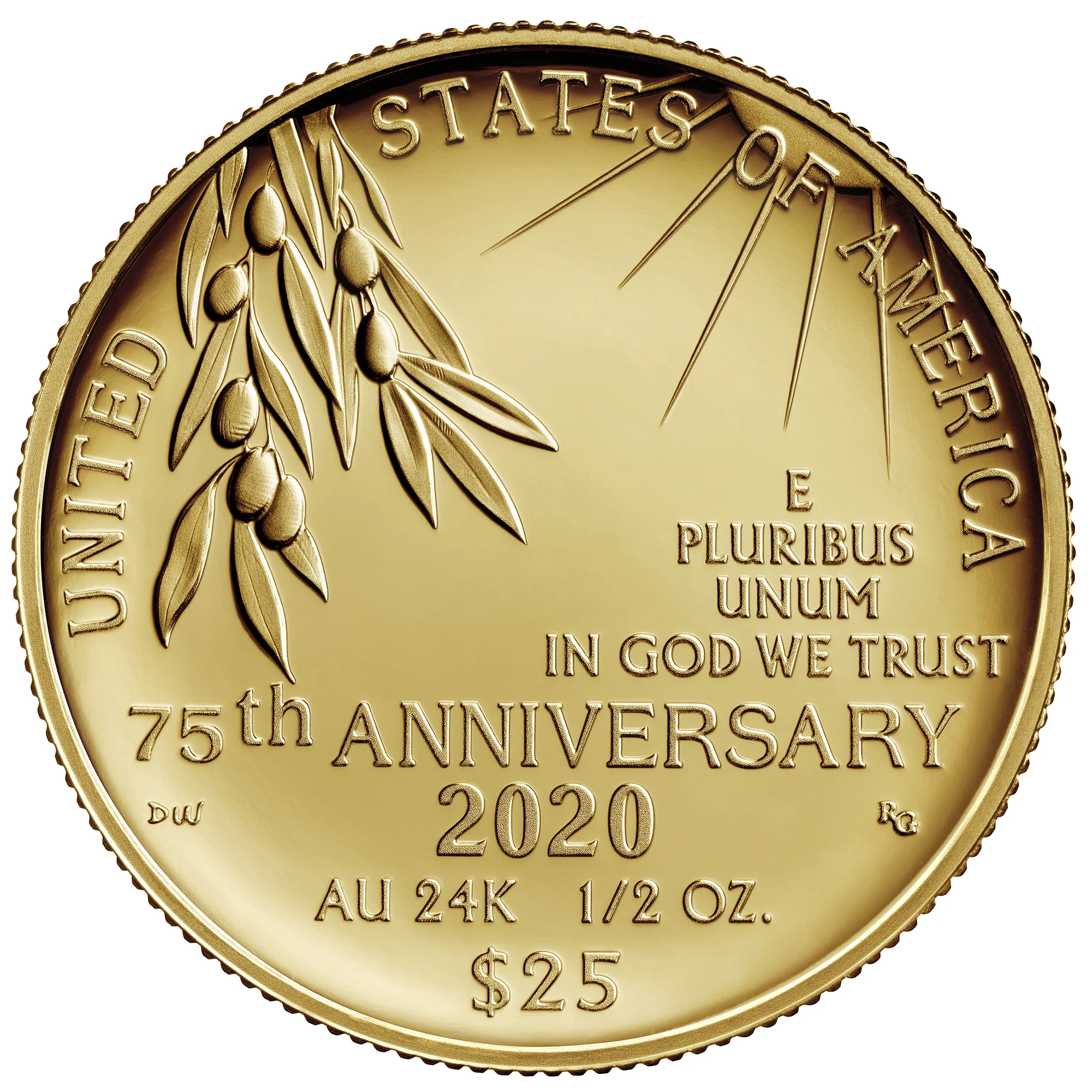
Reverse
Description:
The reverse design mirrors the sun on the 1945 Victory Medal's front. That sun, now risen to full brilliance, illuminates olive branches.
Inscription:
UNITED STATES OF AMERICA
E
PLURIBUS
UNUM
IN GOD WE TRUST
75th ANNIVERSARY
2020
AU 24K 1/2 OZ.
$25
E
PLURIBUS
UNUM
IN GOD WE TRUST
75th ANNIVERSARY
2020
AU 24K 1/2 OZ.
$25
Translation:
UNITED STATES OF AMERICA
OUT OF MANY, ONE
IN GOD WE TRUST
75th ANNIVERSARY
2020
GOLD 24 KARAT 1/2 OUNCE
$25
OUT OF MANY, ONE
IN GOD WE TRUST
75th ANNIVERSARY
2020
GOLD 24 KARAT 1/2 OUNCE
$25
Script: Latin
Language: English
Engraver: Renata Gordon
Designer: Donna Weaver
Edge
Reeded
Mints
| Name | Mark |
|---|---|
| United States Mint of West Point | W |
Mintings
| Year | Mint Mark | Mintage | Quality | Collection |
|---|---|---|---|---|
| 2020 | W | 7,500 | Proof |
Historical background
The United States entered 2020 with a relatively stable currency environment, but the COVID-19 pandemic triggered an unprecedented economic and monetary policy response that profoundly impacted the U.S. dollar. As lockdowns began in March, a global dash for cash caused a dramatic, short-lived surge in the dollar's value against other major currencies, reflecting its enduring role as the world's premier safe-haven asset. This "dollar shortage" threatened global financial stability, prompting the Federal Reserve to activate emergency currency swap lines with other central banks to provide liquidity and calm international markets.
Domestically, the Federal Reserve slashed interest rates to near zero and launched a massive quantitative easing program, purchasing trillions of dollars in Treasury and mortgage-backed securities. Concurrently, Congress passed historic fiscal stimulus packages, notably the $2.2 trillion CARES Act, injecting direct payments and expanded unemployment benefits into the economy. This combination of expansive monetary policy and aggressive fiscal spending was designed to prevent a deflationary spiral and support households and businesses, but it also significantly expanded the money supply and the national debt.
By the second half of 2020, the initial dollar strength had reversed into a sustained decline. As investor risk appetite returned and the Fed's commitment to low rates solidified, the dollar index fell to multi-year lows. This depreciation was viewed as a result of the ballooning U.S. deficit, ultra-low yields making dollar assets less attractive, and growing optimism about a global recovery that would benefit other currencies. Thus, the year encapsulated the dollar's dual nature: its initial spike demonstrated its critical global role in a crisis, while its subsequent weakening reflected the long-term inflationary and debt implications of the policy choices made to combat the pandemic's economic shock.
Domestically, the Federal Reserve slashed interest rates to near zero and launched a massive quantitative easing program, purchasing trillions of dollars in Treasury and mortgage-backed securities. Concurrently, Congress passed historic fiscal stimulus packages, notably the $2.2 trillion CARES Act, injecting direct payments and expanded unemployment benefits into the economy. This combination of expansive monetary policy and aggressive fiscal spending was designed to prevent a deflationary spiral and support households and businesses, but it also significantly expanded the money supply and the national debt.
By the second half of 2020, the initial dollar strength had reversed into a sustained decline. As investor risk appetite returned and the Fed's commitment to low rates solidified, the dollar index fell to multi-year lows. This depreciation was viewed as a result of the ballooning U.S. deficit, ultra-low yields making dollar assets less attractive, and growing optimism about a global recovery that would benefit other currencies. Thus, the year encapsulated the dollar's dual nature: its initial spike demonstrated its critical global role in a crisis, while its subsequent weakening reflected the long-term inflationary and debt implications of the policy choices made to combat the pandemic's economic shock.
✨ Legendary