

5 Zlotys (November Uprising) – Poland
Circulating commemorative coins
Commemoration: 100th Anniversary of the November Uprising
Poland

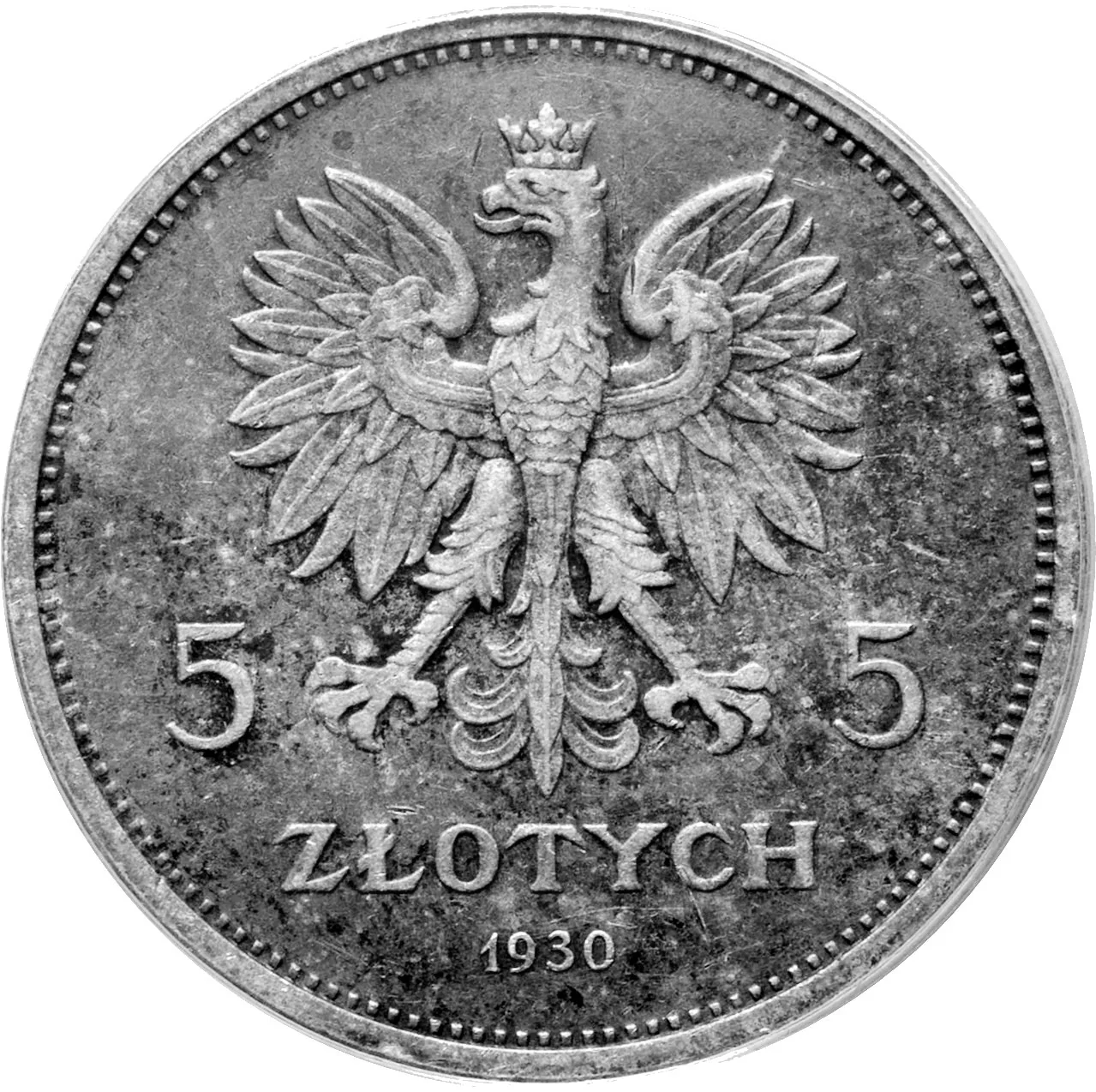
Obverse
Inscription:
5 Złotych
Translation:
5 Zlotych
Script: Latin
Language: Polish
Engraver: Wojciech Jastrzębowski
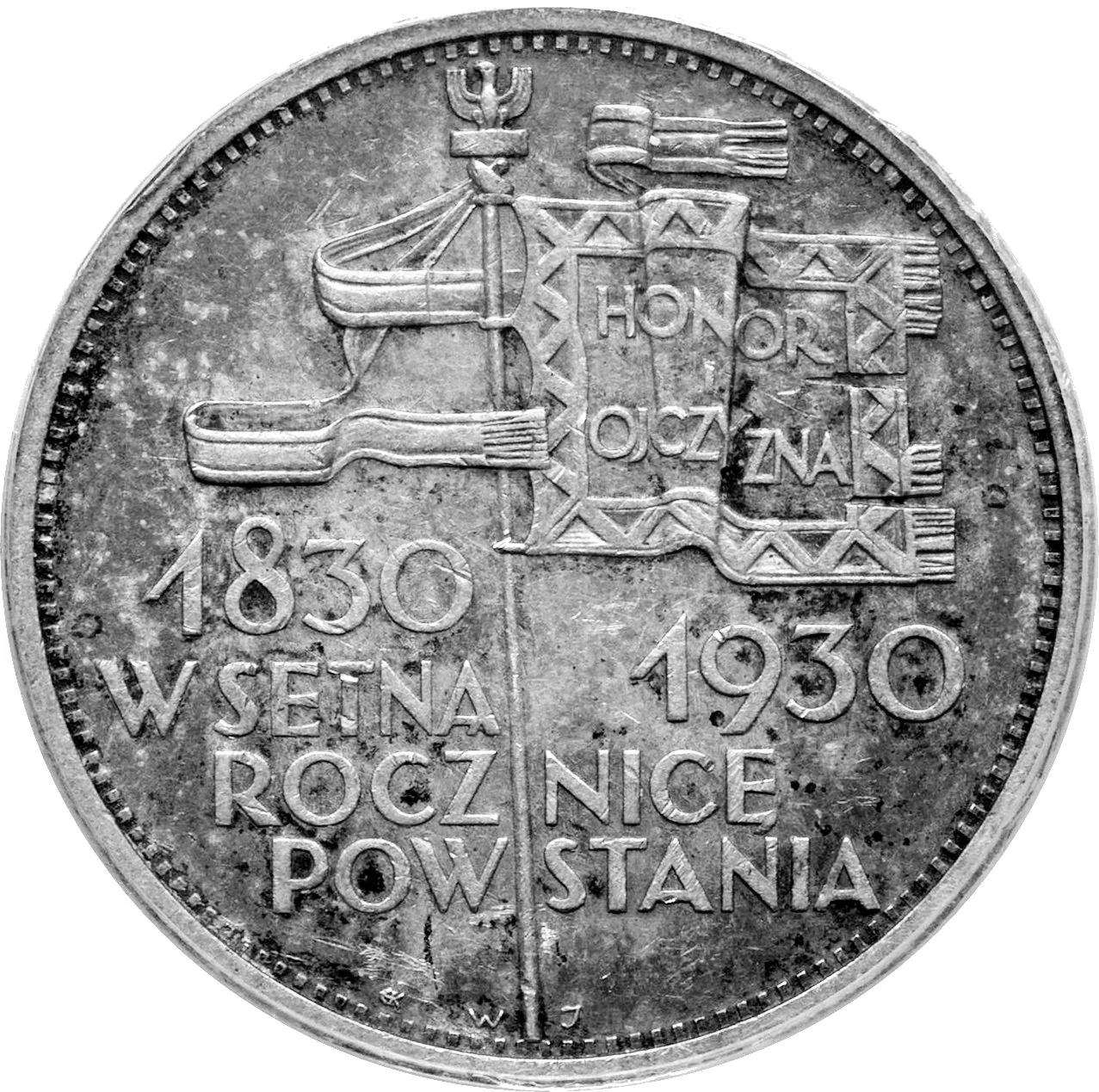
Reverse
Inscription:
1830 - 1930
W setną Rocznicę Powstania
W setną Rocznicę Powstania
Translation:
On the Hundredth Anniversary of the Uprising
Script: Latin
Language: Polish
Engraver: Wojciech Jastrzębowski
Edge
Inscripted
Legend:
SALUS REIPUBLICAE SUPREMA LEX
Mints
| Name | Mark |
|---|---|
| Mint of Poland | W |
Mintings
| Year | Mint Mark | Mintage | Quality | Collection |
|---|---|---|---|---|
| 1930 | W | 1,000,000 |
Historical background
In 1930, Poland's currency, the złoty, was in a precarious but temporarily stabilized position following a period of severe hyperinflation in the early 1920s. The currency had been fundamentally reformed in 1924 under Prime Minister Władysław Grabski, who established the Bank of Poland and introduced a new złoty backed by gold. This "Grabski złoty" initially succeeded in restoring confidence, pegging the currency to a fixed gold standard and stabilizing the economy after the devastation of World War I and the Polish-Soviet War.
However, by the end of the 1920s, underlying weaknesses began to surface. Poland's economy was heavily dependent on agricultural exports, and the onset of the Great Depression in 1929 triggered a catastrophic collapse in global commodity prices. This led to a sharp decline in export revenues and a growing trade deficit, putting severe pressure on the złoty's gold reserves. Furthermore, the state's budget deficit was widening due to significant spending on industrial development and military modernization, financed largely by foreign loans that became harder to service as the depression deepened.
Consequently, 1930 marked the beginning of the end for the gold-standard złoty. The Bank of Poland was forced to engage in increasingly costly interventions to defend the currency's peg, depleting its reserves. While a formal devaluation would not occur until 1936, the year 1930 set the stage for the crisis, as deflationary pressures, falling industrial output, and growing unemployment eroded the foundations of the 1924 reform. The currency's stability became artificial, maintained through restrictive monetary policy that further stifled the struggling economy, positioning Poland for a prolonged period of financial and economic hardship throughout the decade.
However, by the end of the 1920s, underlying weaknesses began to surface. Poland's economy was heavily dependent on agricultural exports, and the onset of the Great Depression in 1929 triggered a catastrophic collapse in global commodity prices. This led to a sharp decline in export revenues and a growing trade deficit, putting severe pressure on the złoty's gold reserves. Furthermore, the state's budget deficit was widening due to significant spending on industrial development and military modernization, financed largely by foreign loans that became harder to service as the depression deepened.
Consequently, 1930 marked the beginning of the end for the gold-standard złoty. The Bank of Poland was forced to engage in increasingly costly interventions to defend the currency's peg, depleting its reserves. While a formal devaluation would not occur until 1936, the year 1930 set the stage for the crisis, as deflationary pressures, falling industrial output, and growing unemployment eroded the foundations of the 1924 reform. The currency's stability became artificial, maintained through restrictive monetary policy that further stifled the struggling economy, positioning Poland for a prolonged period of financial and economic hardship throughout the decade.
⭐ Somewhat Rare