

20 Franken – Liechtenstein
Liechtenstein
Context
Year: 1930
Issuer: Liechtenstein 
Ruler: Francis I
Currency:
(since 1924)
Demonetized: Yes
Total mintage: 2,500
Material
References
Y: #Click to copy to clipboard12
Numista: #23787
Value
Exchange value: 20 CHF = $25.85
Bullion value: $967.87
Obverse
Description:
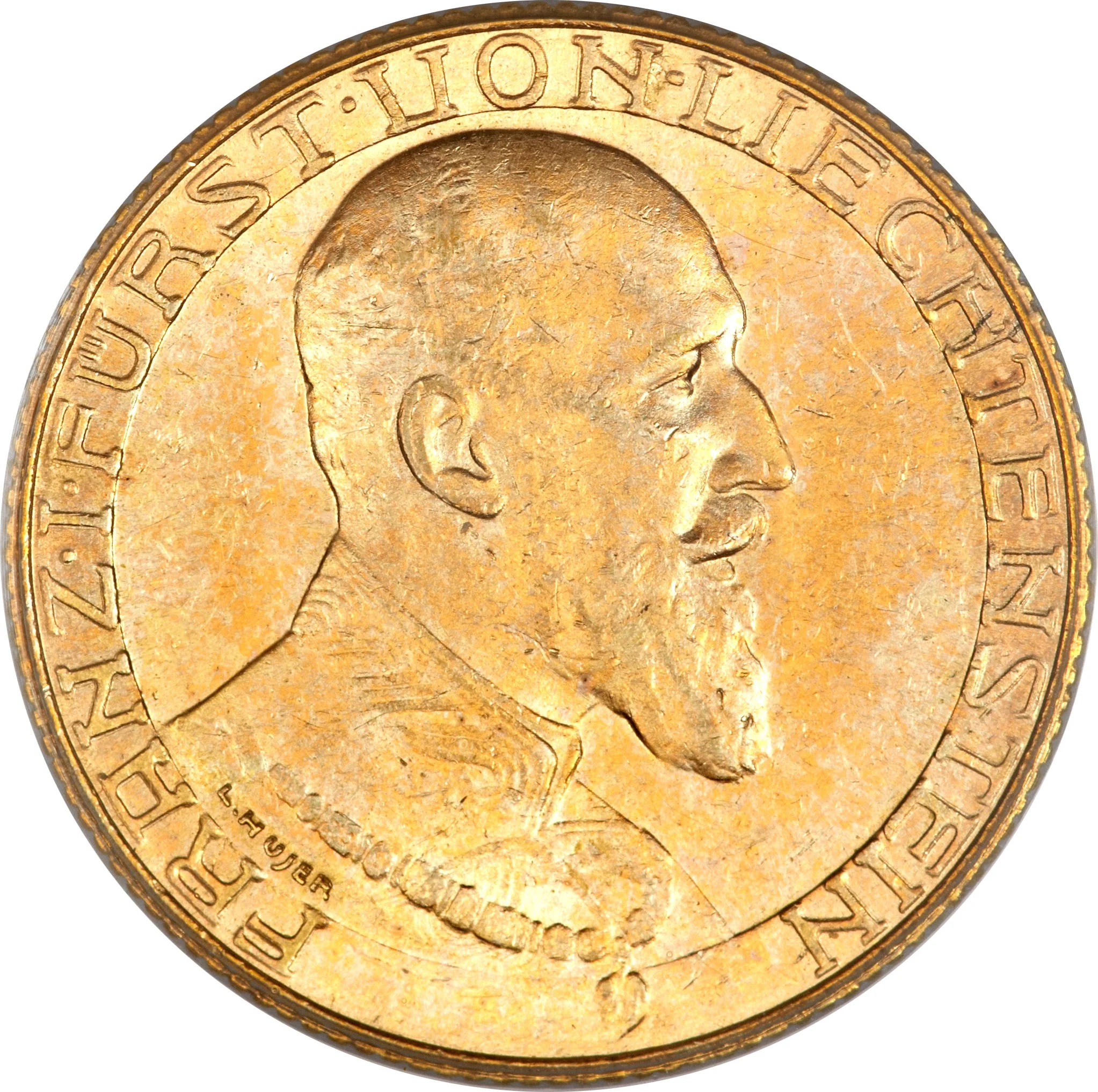
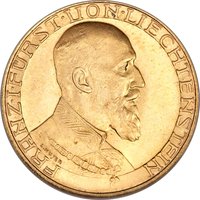
Bust of Franz I right, surrounded by lettering.
Inscription:
FRANZ·I·FÜRST·VON·LIECHTENSTEIN
L.HUJER
L.HUJER
Translation:
FRANZ I, PRINCE OF LIECHTENSTEIN
L. HUJER
L. HUJER
Script: Latin
Language: German
Engraver: Ludwig Hujer
Reverse
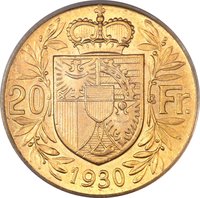
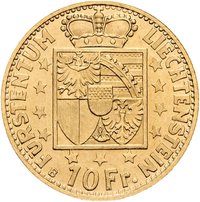
Description:
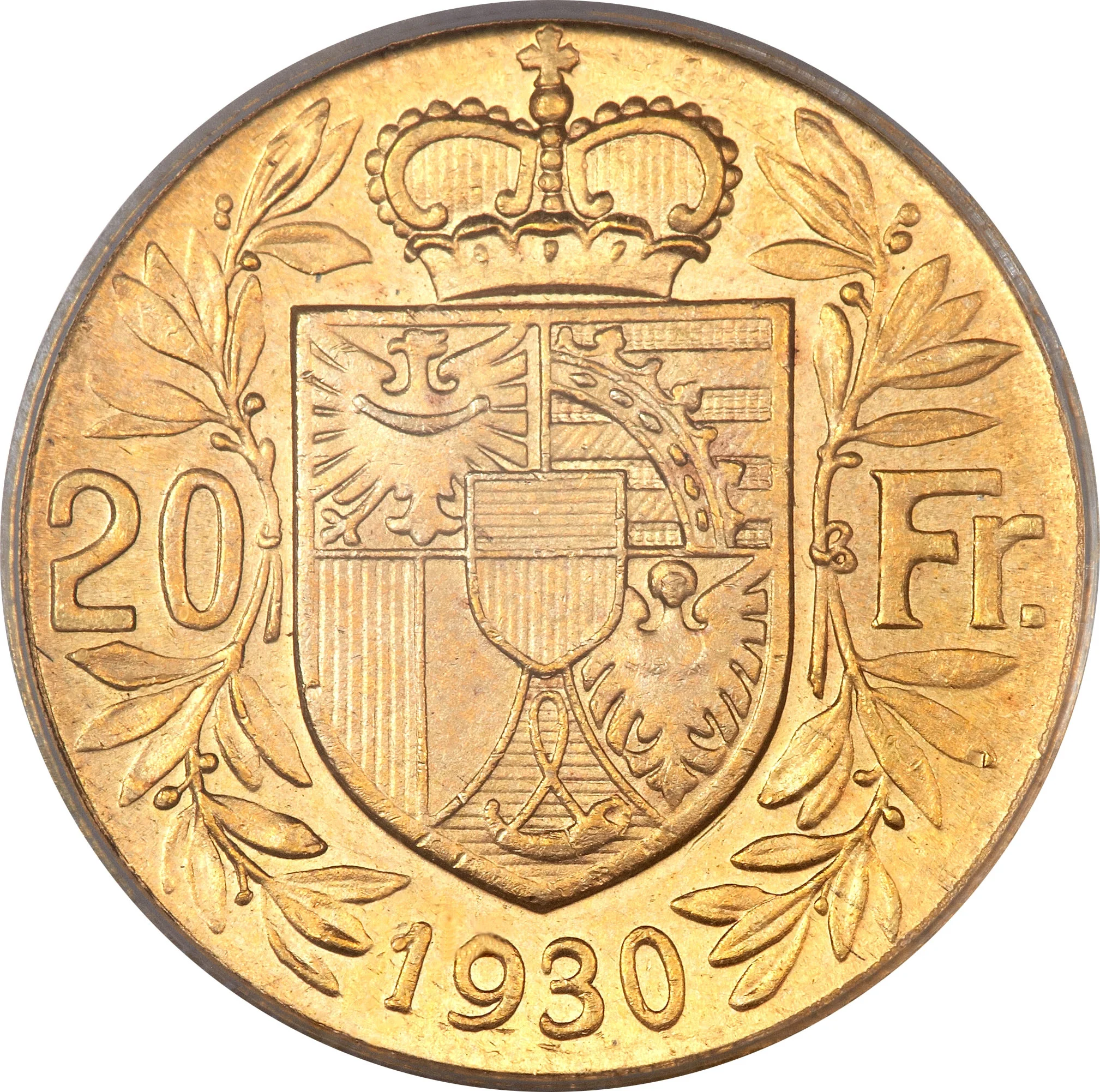
Coat of arms centered between two branch pairs, value left and "Fr." right, date below.
Inscription:
20 Fr.
1930
1930
Translation:
20 Francs
1930
1930
Script: Latin
Language: French
Engraver: Ludwig Hujer
Edge
Categories
| Symbols> Coat of Arms |
| Person> Monarch |
Mintings
| Year | Mint Mark | Mintage | Quality | Collection |
|---|---|---|---|---|
| 1930 | — | 2,500 |
Historical background
In 1930, Liechtenstein's currency situation was fundamentally defined by its close economic and customs union with Switzerland, established by the Treaty of 1924. This agreement effectively replaced the Austrian krone, which had become worthless after the collapse of the Austro-Hungarian Empire, with the Swiss franc as the principality's official legal tender. Consequently, Liechtenstein did not issue its own banknotes or coinage for circulation; the Swiss National Bank served as its central bank, and Swiss currency was used exclusively in daily transactions.
This arrangement provided Liechtenstein with immense stability during a period of global financial turmoil. While many European nations grappled with hyperinflation, banking crises, and the early shocks of the Great Depression, Liechtenstein's economy was shielded by its anchor to the robust and conservative Swiss financial system. The Swiss franc's reputation for stability prevented the currency crises that afflicted neighboring Austria and Germany, allowing Liechtenstein's nascent banking and industrial sectors to develop within a secure monetary environment.
However, this integration also meant Liechtenstein had fully ceded its monetary sovereignty to Switzerland. The principality had no independent monetary policy or lender of last resort, making its economy entirely dependent on Swiss decisions. While this was a beneficial trade-off for security in 1930, it highlighted Liechtenstein's unique status as a sovereign state without a national currency, a defining characteristic that continues to the present day.
This arrangement provided Liechtenstein with immense stability during a period of global financial turmoil. While many European nations grappled with hyperinflation, banking crises, and the early shocks of the Great Depression, Liechtenstein's economy was shielded by its anchor to the robust and conservative Swiss financial system. The Swiss franc's reputation for stability prevented the currency crises that afflicted neighboring Austria and Germany, allowing Liechtenstein's nascent banking and industrial sectors to develop within a secure monetary environment.
However, this integration also meant Liechtenstein had fully ceded its monetary sovereignty to Switzerland. The principality had no independent monetary policy or lender of last resort, making its economy entirely dependent on Swiss decisions. While this was a beneficial trade-off for security in 1930, it highlighted Liechtenstein's unique status as a sovereign state without a national currency, a defining characteristic that continues to the present day.
💎 Extremely Rare