

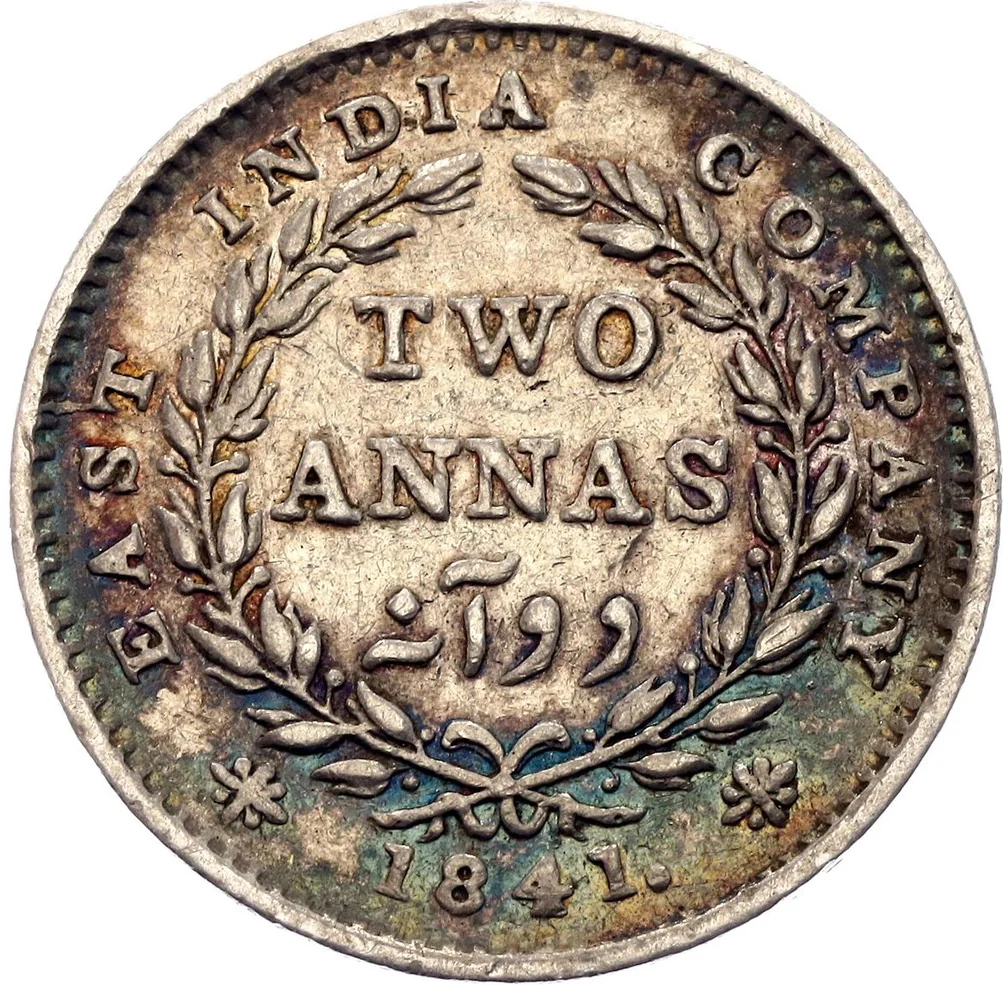
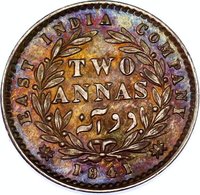
2 Annas – India - British
India
Context
Year: 1841
Country: India 
Issuer: India - British
Issuing organization: East India Company
Ruler: Victoria
Currency:
(1770—1947)
Demonetized: Yes
Total mintage: 11,430,800
Material
References
KM: #Click to copy to clipboard459
Numista: #23777
Value
Bullion value: $3.81
Obverse
Description:
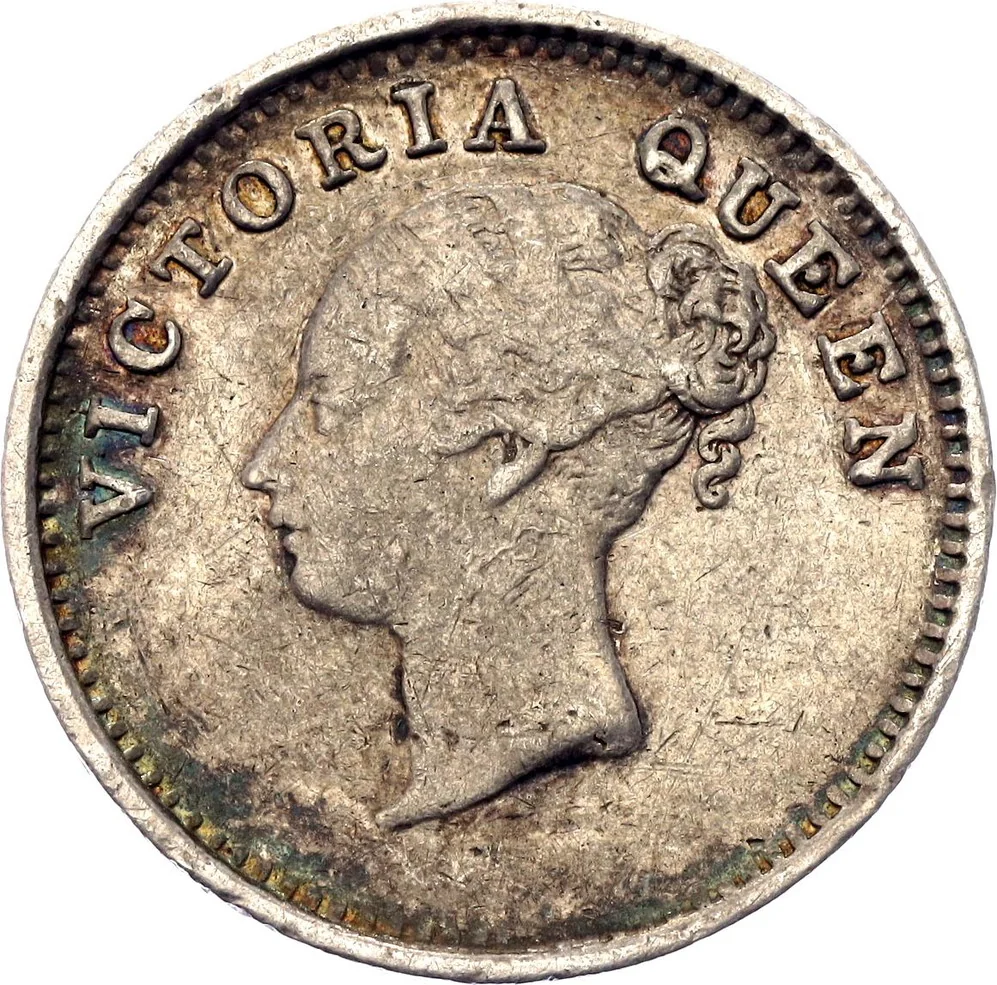
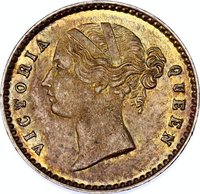
Queen Victoria left-facing bust, English legend, toothed rim.
Inscription:
VICTORIA QUEEN
Engraver: William Wyon
Reverse
Edge
Plain
Mints
| Name | Mark |
|---|---|
| Chennai / Madras | — |
| Kolkata / Calcutta / Murshidabad | — |
| Mumbai / Bombay | — |
Mintings
| Year | Mint Mark | Mintage | Quality | Collection |
|---|---|---|---|---|
| 1841 | — | 11,430,800 |
Historical background
In 1841, the currency situation in British India was a complex and transitional system, dominated by the silver rupee but strained by the Company's fiscal policies. The East India Company had officially established the silver rupee as the standard currency, with the gold mohur also in circulation but its value fluctuating against silver. However, the system was not uniform; a plethora of older, locally minted rupees and coins from princely states remained in use, creating a chaotic exchange environment. Furthermore, the Company's chronic budget deficits, driven by military campaigns and administrative costs, led to heavy borrowing and the issuance of paper Company's Rupees, which were essentially promissory notes. This paper currency, while convenient, was not fully trusted and circulated alongside, and often at a discount to, silver coin.
The period was marked by a significant drain of silver from India to Britain, primarily to service the "Home Charges" – the costs of administration, dividends to shareholders, and purchases of British goods. This outward flow, combined with the global scarcity of silver following Latin American independence wars, created a persistent shortage of specie (coin). The scarcity debased the value of the paper currency and caused hardship for ordinary people, who relied on copper and silver for daily transactions. The Company's mints struggled to produce enough standardized coinage, leading to widespread use of cut or worn coins and facilitating forgery.
Ultimately, the currency instability of 1841 was a symptom of the colonial economy's extractive nature. The system was designed to facilitate revenue collection and trade surplus for Britain, not to ensure a stable monetary environment for India. This instability would persist until the Currency Act of 1861, which abolished the right of private and presidency banks to issue notes and established a government paper currency, a step toward a more unified system. Thus, 1841 represents a point of monetary tension, caught between a fading past of diverse metallic currency and a not-yet-realized future of centralized colonial control.
The period was marked by a significant drain of silver from India to Britain, primarily to service the "Home Charges" – the costs of administration, dividends to shareholders, and purchases of British goods. This outward flow, combined with the global scarcity of silver following Latin American independence wars, created a persistent shortage of specie (coin). The scarcity debased the value of the paper currency and caused hardship for ordinary people, who relied on copper and silver for daily transactions. The Company's mints struggled to produce enough standardized coinage, leading to widespread use of cut or worn coins and facilitating forgery.
Ultimately, the currency instability of 1841 was a symptom of the colonial economy's extractive nature. The system was designed to facilitate revenue collection and trade surplus for Britain, not to ensure a stable monetary environment for India. This instability would persist until the Currency Act of 1861, which abolished the right of private and presidency banks to issue notes and established a government paper currency, a step toward a more unified system. Thus, 1841 represents a point of monetary tension, caught between a fading past of diverse metallic currency and a not-yet-realized future of centralized colonial control.
🌱 Fairly Common