

3 rubles (Foundation of the Republic of Mari El) – Russian Federation
Add to wishlist
Non-circulating coins
Commemoration: 100th Anniversary of the Foundation of the Republic of Mari El
Russia
Context
Year: 2020
Country: Russia
Issuer: Russian Federation
Period:
(since 1991)
Currency:
(since 1998)
Total mintage: 3,000
Material
References
Value
Exchange value: 3 RUB
Bullion value: $76.41
Inflation-adjusted value: 5.28 RUB
Obverse
Description:
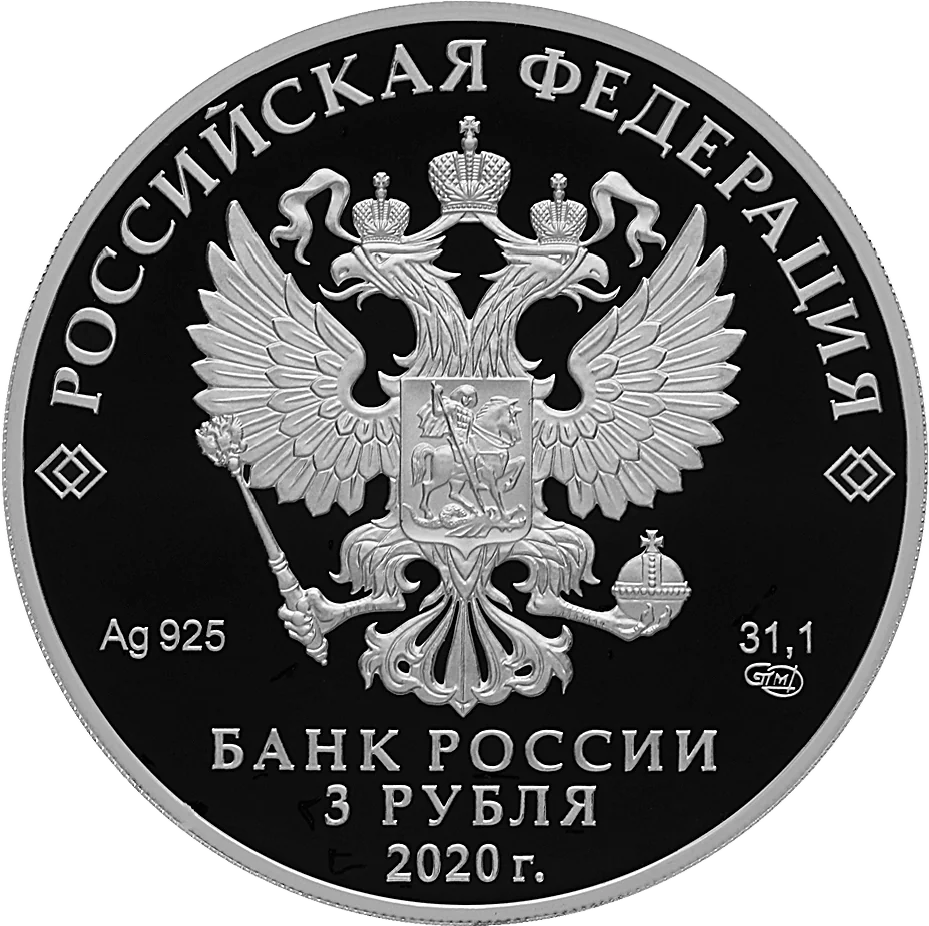
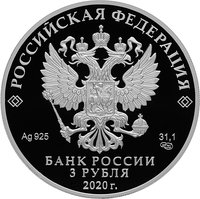
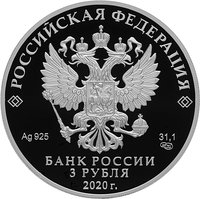
The obverse features the Russian Federation coat of arms with the inscription "РОССИЙСКАЯ ФЕДЕРАЦИЯ" above. Below are the metal specifications and mint mark, with "БАНК РОССИИ", "3 РУБЛЯ", and "2020 г." at the bottom.
Inscription:
РОССИЙСКАЯ ФЕДЕРАЦИЯ
Ag 925 31,1
СПМД
БАНК РОССИИ
3 РУБЛЯ
2020 г.
Ag 925 31,1
СПМД
БАНК РОССИИ
3 РУБЛЯ
2020 г.
Translation:
RUSSIAN FEDERATION
Ag 925 31.1
SPMD
BANK OF RUSSIA
3 ROUBLES
2020
Ag 925 31.1
SPMD
BANK OF RUSSIA
3 ROUBLES
2020
Language: Russian
Engraver: Alexandra Arsenyevna Dolgopolova
Designer: Elena Viktorovna Kramskaya
Reverse
Description:
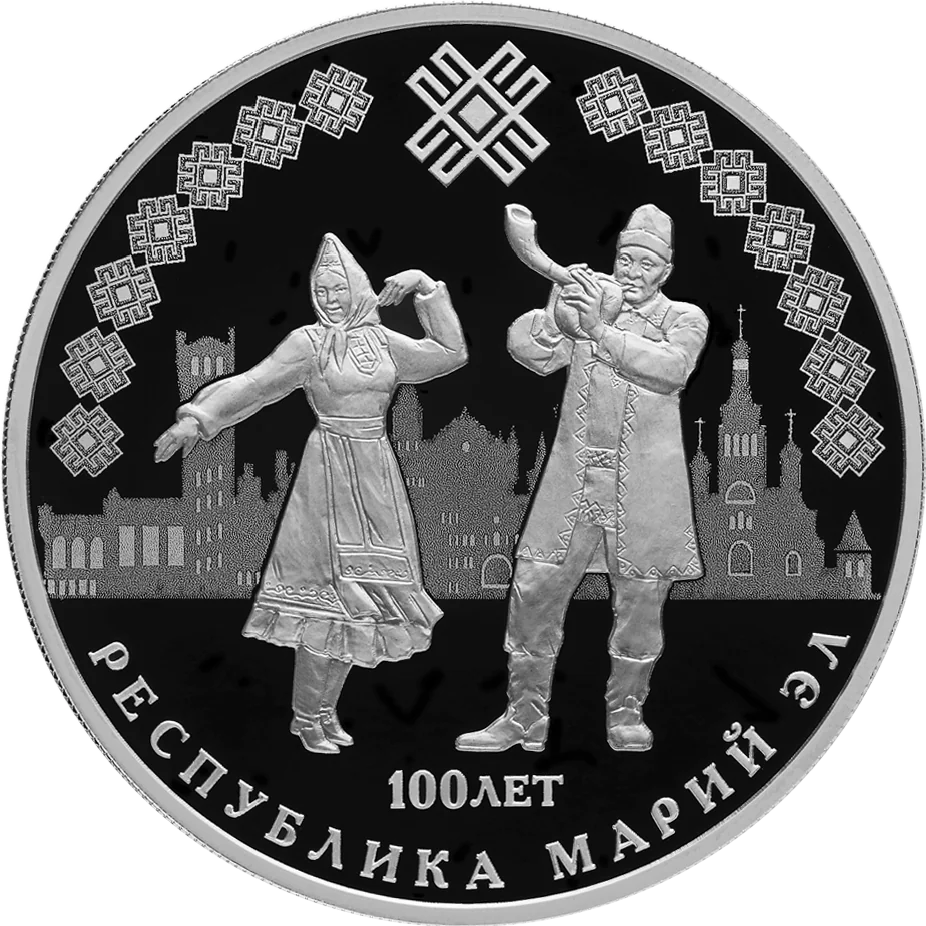
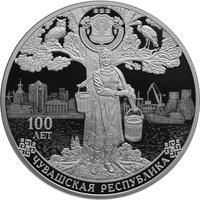
The disc features a relief of a Mari bagpiper in national costume and a woman dancing against a stylized cityscape. A traditional Mari ornament runs along the top rim, with "РЕСПУБЛИКА МАРИЙ ЭЛ" and "100 ЛЕТ" inscribed below.
Inscription:
100 ЛЕТ
РЕСПУБЛИКА МАРИЙ ЭЛ
РЕСПУБЛИКА МАРИЙ ЭЛ
Translation:
100 Years
Republic of Mari El
Republic of Mari El
Script: Cyrillic
Language: Russian
Designer and engraver: Alexey Vladimirovich Gnidin
Edge
300 corrugations
Categories
| Building> Religious building |
| Building> Tower |
| Art> Dance |
| Art> Music |
| Symbols> Coat of Arms |
| Geography> Region |
Mints
| Name | Mark |
|---|---|
| Saint Petersburg | (СПМД) |
Mintings
| Year | Mint Mark | Mintage | Quality | Collection |
|---|---|---|---|---|
| 2020 | СПМД | 3,000 | Proof |
Historical background
In 2020, the Russian ruble faced one of its most volatile years in recent history, primarily driven by the dual shocks of the COVID-19 pandemic and a dramatic collapse in global oil prices. As the pandemic triggered worldwide lockdowns and reduced economic activity, demand for crude oil plummeted. This was exacerbated in March by the breakdown of the OPEC+ agreement, leading to a price war between Saudi Arabia and Russia, which sent Brent crude prices below $25 per barrel. Given that oil and gas revenues traditionally form a significant portion of the Russian federal budget and export earnings, this shock caused severe strain on the currency. The ruble lost over 20% of its value against the US dollar in the first quarter alone, falling from around 61 RUB/USD in January to a historic low beyond 80 RUB/USD in March.
The Russian government and the Central Bank of Russia (CBR) responded with a series of measures to stabilize the financial system and the currency. The CBR initially intervened in the foreign exchange market, selling its substantial reserves, but soon shifted its priority to controlling inflation and supporting the banking sector. It sharply increased its key interest rate and then provided significant liquidity to banks. Crucially, the government implemented a new fiscal rule mechanism, whereby it began selling foreign currency from the National Wealth Fund to cover budget deficits, a move designed to support the ruble by increasing demand for it. These actions, combined with a gradual recovery in oil prices following new OPEC+ production cuts in April, helped the ruble partially recover, ending the year around 74 RUB/USD.
The year's currency turbulence had profound domestic consequences, accelerating inflation and eroding real incomes for the population. However, the 2020 crisis also demonstrated the resilience built into Russia's macroeconomic framework since the 2014 sanctions. The country entered the crisis with low public debt, high international reserves, and a floating exchange rate that acted as a shock absorber. By year's end, the situation had stabilized, but it underscored the Russian economy's ongoing fundamental vulnerability to external commodity price cycles and set the stage for continued efforts to reduce this dependency in the years to follow.
The Russian government and the Central Bank of Russia (CBR) responded with a series of measures to stabilize the financial system and the currency. The CBR initially intervened in the foreign exchange market, selling its substantial reserves, but soon shifted its priority to controlling inflation and supporting the banking sector. It sharply increased its key interest rate and then provided significant liquidity to banks. Crucially, the government implemented a new fiscal rule mechanism, whereby it began selling foreign currency from the National Wealth Fund to cover budget deficits, a move designed to support the ruble by increasing demand for it. These actions, combined with a gradual recovery in oil prices following new OPEC+ production cuts in April, helped the ruble partially recover, ending the year around 74 RUB/USD.
The year's currency turbulence had profound domestic consequences, accelerating inflation and eroding real incomes for the population. However, the 2020 crisis also demonstrated the resilience built into Russia's macroeconomic framework since the 2014 sanctions. The country entered the crisis with low public debt, high international reserves, and a floating exchange rate that acted as a shock absorber. By year's end, the situation had stabilized, but it underscored the Russian economy's ongoing fundamental vulnerability to external commodity price cycles and set the stage for continued efforts to reduce this dependency in the years to follow.

✨ Legendary