

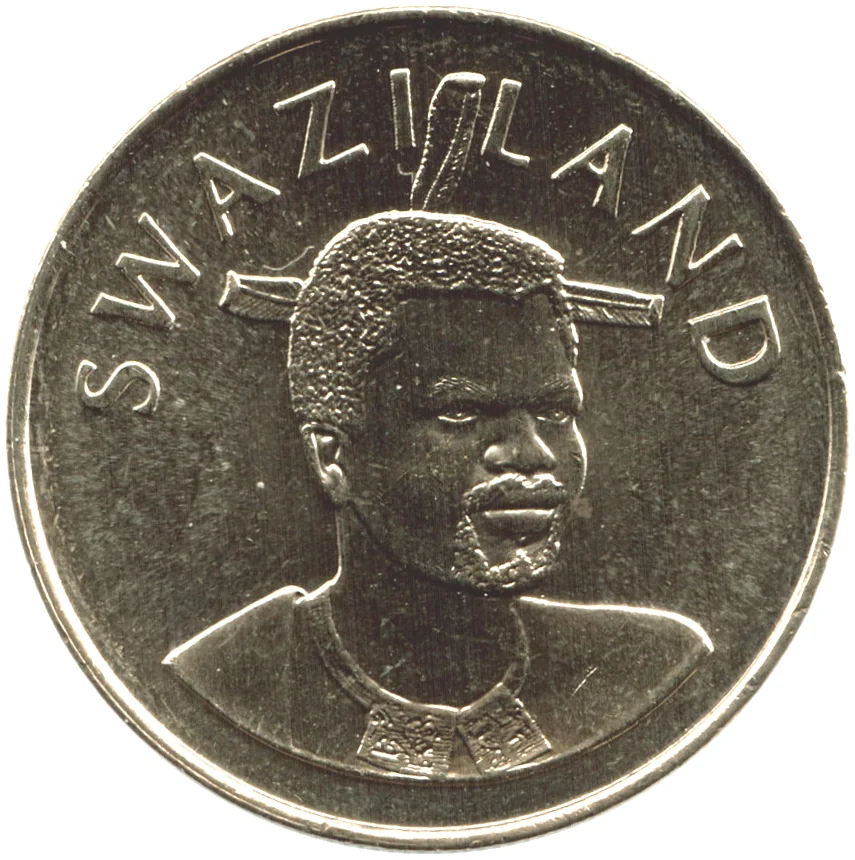
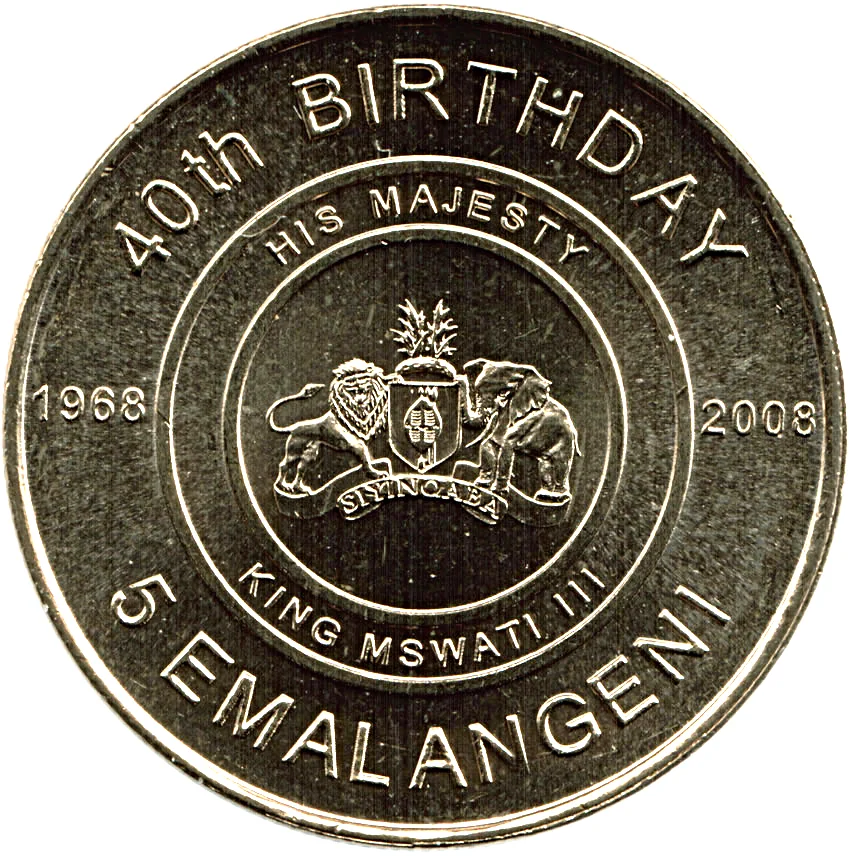
5 Emalangeni (King Mswati III) – Kingdom of Swaziland
Circulating commemorative coins
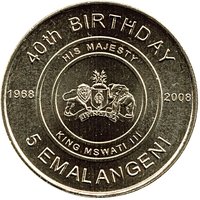
Commemoration: 40th Birthday of King Mswati III.
Eswatini
Context
Year: 2008
Country: Eswatini 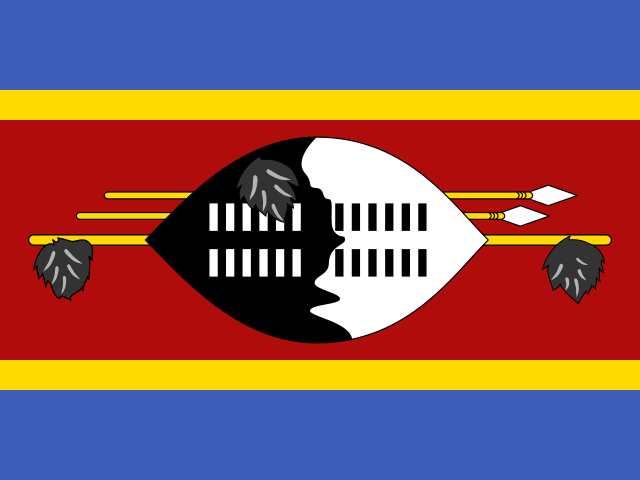
Issuer: Kingdom of Swaziland
Ruler: Mswati III
Currency:
(1974—2018)
Demonetization: 1 February 2016
Total mintage: 250
Material
References
KM: #Click to copy to clipboard55
Numista: #23738
Value
Exchange value: 5 SZL
Obverse
Reverse
Description:
Central coat of arms.
Inscription:
40th BIRTHDAY
HIS MAJESTY
1968 2008
KING MSWATI III
5 EMALANGENI
HIS MAJESTY
1968 2008
KING MSWATI III
5 EMALANGENI
Script: Latin
Edge
Reeded
Categories
| Animal> Feline |
| Animal> Elephant |
| Event> Birth anniversary |
| Person> Monarch |
| Symbols> Coat of Arms |
Mints
| Name | Mark |
|---|---|
| South African Mint | — |
Mintings
| Year | Mint Mark | Mintage | Quality | Collection |
|---|---|---|---|---|
| 2008 | — | — | ||
| 2008 | — | 250 | Proof |
Historical background
In 2008, the Kingdom of Swaziland (renamed Eswatini in 2018) operated under a unique currency arrangement as a member of the Common Monetary Area (CMA) with South Africa, Lesotho, and Namibia. The country's currency, the Swazi lilangeni (SZL), was pegged at par (1:1) to the South African rand (ZAR), which was also legal tender within the kingdom. This arrangement effectively ceded Swaziland's independent monetary policy to the South African Reserve Bank, meaning domestic interest rates and broader monetary conditions were largely dictated by South Africa's economic needs and inflationary pressures.
The year presented significant economic challenges that strained this system. Swaziland faced a severe fiscal crisis, driven by a sharp decline in revenue from the Southern African Customs Union (SACU), which typically contributed over half of government income. This revenue collapse coincided with high public expenditure, leading to large budget deficits. Consequently, pressure mounted on the lilangeni's peg as investor confidence wavered, foreign reserves dwindled, and the government sought financing. The situation highlighted the vulnerability of a fixed exchange rate when domestic fiscal discipline falters, even within a supportive monetary union.
Despite these fiscal pressures, the currency peg itself remained formally intact throughout 2008, a testament to the fundamental stability of the CMA framework and Swaziland's access to regional financial mechanisms. However, the crisis underscored the kingdom's profound economic dependencies. The episode forced a national conversation about fiscal sustainability and the need for economic diversification, as the twin pillars of the currency peg and SACU revenue revealed their limitations in shielding the small, landlocked monarchy from external shocks.
The year presented significant economic challenges that strained this system. Swaziland faced a severe fiscal crisis, driven by a sharp decline in revenue from the Southern African Customs Union (SACU), which typically contributed over half of government income. This revenue collapse coincided with high public expenditure, leading to large budget deficits. Consequently, pressure mounted on the lilangeni's peg as investor confidence wavered, foreign reserves dwindled, and the government sought financing. The situation highlighted the vulnerability of a fixed exchange rate when domestic fiscal discipline falters, even within a supportive monetary union.
Despite these fiscal pressures, the currency peg itself remained formally intact throughout 2008, a testament to the fundamental stability of the CMA framework and Swaziland's access to regional financial mechanisms. However, the crisis underscored the kingdom's profound economic dependencies. The episode forced a national conversation about fiscal sustainability and the need for economic diversification, as the twin pillars of the currency peg and SACU revenue revealed their limitations in shielding the small, landlocked monarchy from external shocks.
🌱 Fairly Common