

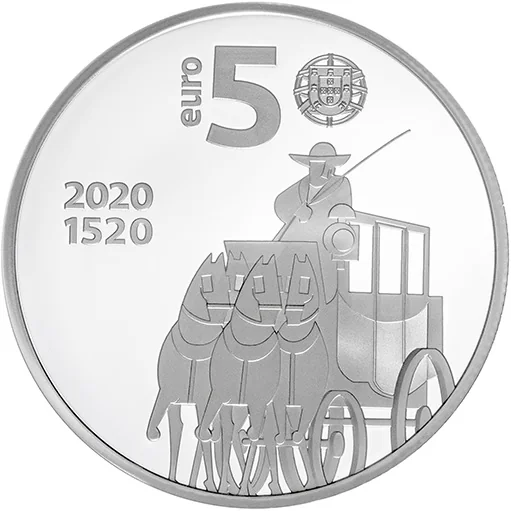

5 Euro (Portuguese post office) – Portugal
Non-circulating coins
Commemoration: 500 years of portuguese post office
Portugal


Obverse
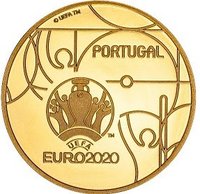
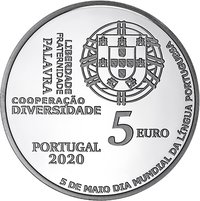
Reverse
Edge
Mints
| Name | Mark |
|---|---|
| Imprensa Nacional - Casa da Moeda | — |
Mintings
| Year | Mint Mark | Mintage | Quality | Collection |
|---|---|---|---|---|
| 2020 | — | 1,293 | Proof |
Historical background
In 2020, Portugal's currency situation was defined by its continued and stable membership in the Eurozone, using the euro (€) as its sole legal tender. This integration, established in 1999, meant that Portugal's monetary policy was not set domestically but by the European Central Bank (ECB) in Frankfurt. The primary focus for Portuguese authorities was therefore not on currency valuation or printing money, but on managing fiscal policy and public debt within the constraints of the European Union's stability and growth pact. The country's economic resilience was still being tested following the austerity measures of the 2010-2014 bailout period, with public debt remaining high at around 135% of GDP.
The year was dominated by the unprecedented economic shock of the COVID-19 pandemic, which triggered a severe recession. The currency framework, however, provided a crucial shield. Being part of the euro eliminated any risk of a speculative currency crisis or capital flight specific to Portugal, which had historically plagued the country. Instead, the shared currency provided stability, and the critical response came from the ECB, which launched massive stimulus programs, notably the Pandemic Emergency Purchase Programme (PEPP). This ensured liquidity in the financial system and kept sovereign borrowing costs for Portugal at historically low levels, preventing a debt spiral.
Consequently, the "currency situation" in 2020 was one of passive stability amid acute economic distress. The euro's strength and the ECB's actions were vital in allowing the Portuguese government to implement substantial fiscal support packages for businesses and households without facing a market panic. The debate in Portugal was not about the currency itself, but about leveraging the stability of the euro to navigate the pandemic crisis and advocating for greater EU-level fiscal solidarity, which culminated in the landmark agreement on the EU's Next Generation EU recovery fund, a significant source of future grants and loans for the Portuguese economy.
The year was dominated by the unprecedented economic shock of the COVID-19 pandemic, which triggered a severe recession. The currency framework, however, provided a crucial shield. Being part of the euro eliminated any risk of a speculative currency crisis or capital flight specific to Portugal, which had historically plagued the country. Instead, the shared currency provided stability, and the critical response came from the ECB, which launched massive stimulus programs, notably the Pandemic Emergency Purchase Programme (PEPP). This ensured liquidity in the financial system and kept sovereign borrowing costs for Portugal at historically low levels, preventing a debt spiral.
Consequently, the "currency situation" in 2020 was one of passive stability amid acute economic distress. The euro's strength and the ECB's actions were vital in allowing the Portuguese government to implement substantial fiscal support packages for businesses and households without facing a market panic. The debate in Portugal was not about the currency itself, but about leveraging the stability of the euro to navigate the pandemic crisis and advocating for greater EU-level fiscal solidarity, which culminated in the landmark agreement on the EU's Next Generation EU recovery fund, a significant source of future grants and loans for the Portuguese economy.


✨ Legendary