

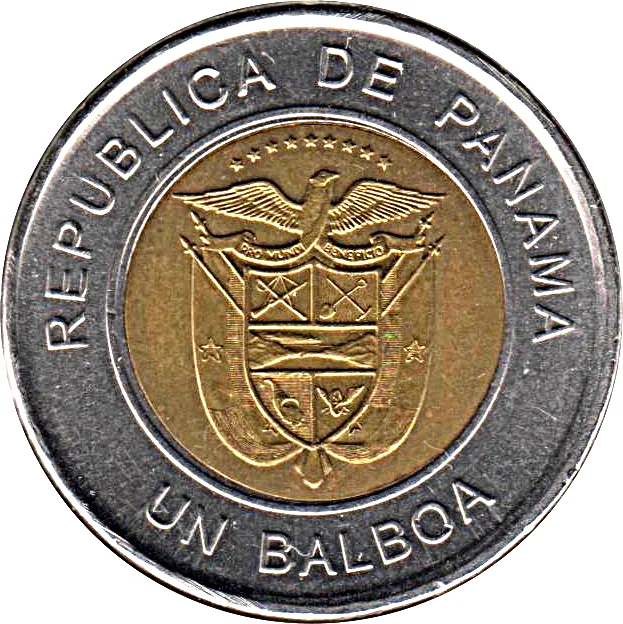
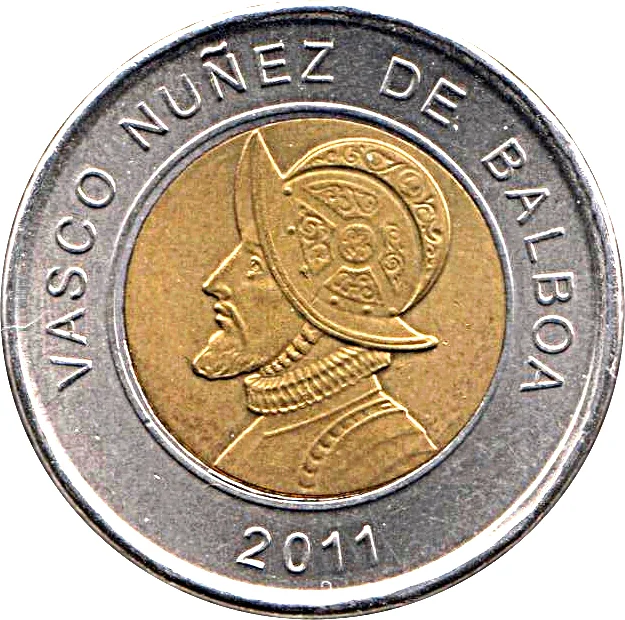
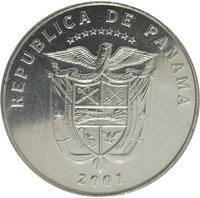
Obverse
Reverse
Edge
Legend:
PANAMA 1 BALBOA
Categories
| Symbols> Coat of Arms |
| Person> Explorer |
Mints
| Name | Mark |
|---|---|
| Royal Canadian Mint of Winnipeg | — |
Mintings
| Year | Mint Mark | Mintage | Quality | Collection |
|---|---|---|---|---|
| 2011 | — | 40,000,000 | ||
| 2017 | — | 4,000,000 | ||
| 2018 | — | 4,000,000 | ||
| 2019 | — | — |
Historical background
Panama's currency situation in 2011 was defined by its unique and long-standing monetary framework, which remained a cornerstone of its economic stability. Since 1904, the country has used the US dollar as its official legal tender, a system known as full dollarization. This meant the Panamanian balboa existed only as coins (pegged 1:1 to the USD), while all paper currency in circulation was the US dollar. The country had no central bank to conduct independent monetary policy, relying instead on the fiscal discipline imposed by this system and the monetary policy decisions of the US Federal Reserve.
The year 2011 saw this model continue to provide significant benefits, particularly in maintaining low inflation and fostering confidence for international trade and investment. Panama's economy was booming, with GDP growth exceeding 10% that year, driven largely by the expansion of the Panama Canal and a robust services sector. The dollarized environment eliminated exchange rate risk, facilitated capital inflows, and supported the country's role as a regional banking and logistics hub. However, the system also carried inherent limitations, as Panama had no ability to devalue its currency to boost competitiveness or act as a lender of last resort to its banking system during liquidity crises.
Despite the global economic uncertainties following the 2008-09 financial crisis, Panama's dollarized economy in 2011 was notably resilient. The primary challenge related to currency was not instability but rather the lack of monetary tools to manage the overheating economy and credit growth. Authorities relied on fiscal policy and banking regulation to temper inflationary pressures. Furthermore, the country's success was contingent on maintaining strict fiscal discipline, as it could not print money to finance deficits. Overall, 2011 represented a period where Panama's dollarization continued to be perceived as a net positive, underpinning its remarkable economic expansion while presenting familiar constraints on macroeconomic policy.
The year 2011 saw this model continue to provide significant benefits, particularly in maintaining low inflation and fostering confidence for international trade and investment. Panama's economy was booming, with GDP growth exceeding 10% that year, driven largely by the expansion of the Panama Canal and a robust services sector. The dollarized environment eliminated exchange rate risk, facilitated capital inflows, and supported the country's role as a regional banking and logistics hub. However, the system also carried inherent limitations, as Panama had no ability to devalue its currency to boost competitiveness or act as a lender of last resort to its banking system during liquidity crises.
Despite the global economic uncertainties following the 2008-09 financial crisis, Panama's dollarized economy in 2011 was notably resilient. The primary challenge related to currency was not instability but rather the lack of monetary tools to manage the overheating economy and credit growth. Authorities relied on fiscal policy and banking regulation to temper inflationary pressures. Furthermore, the country's success was contingent on maintaining strict fiscal discipline, as it could not print money to finance deficits. Overall, 2011 represented a period where Panama's dollarization continued to be perceived as a net positive, underpinning its remarkable economic expansion while presenting familiar constraints on macroeconomic policy.

🌱 Very Common