

1 Pound (Gibraltar Coinage) – Gibraltar
Circulating commemorative coins
Commemoration: 150th Anniversary of Gibraltar Coinage
United Kingdom
Context
Material
Diameter: 22.5 mm
Weight: 9.5 g
Shape: Round
Composition: Nickel brass
Magnetic: No
Technique: Milled
Alignment: Medal alignment
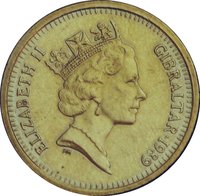
flip
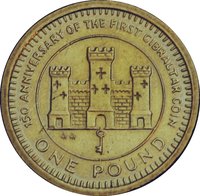
References
KM: #Click to copy to clipboard32
Numista: #23601
Value
Exchange value: 1 GIP
Inflation-adjusted value: 3.43 GIP
Obverse
Description:
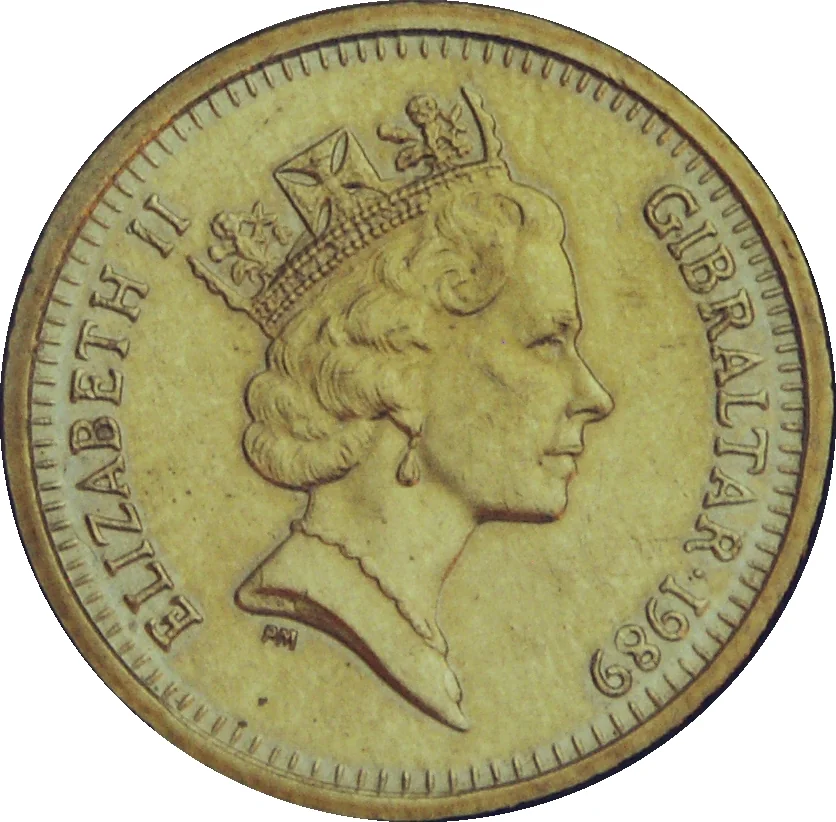
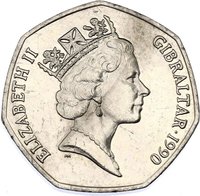
Queen Elizabeth II facing right, wearing the George IV State Diadem.
Inscription:
ELIZABETH II GIBRALTAR · 1989
RDM
PM
RDM
PM
Script: Latin
Designer: Raphael David Maklouf
Reverse
Description:
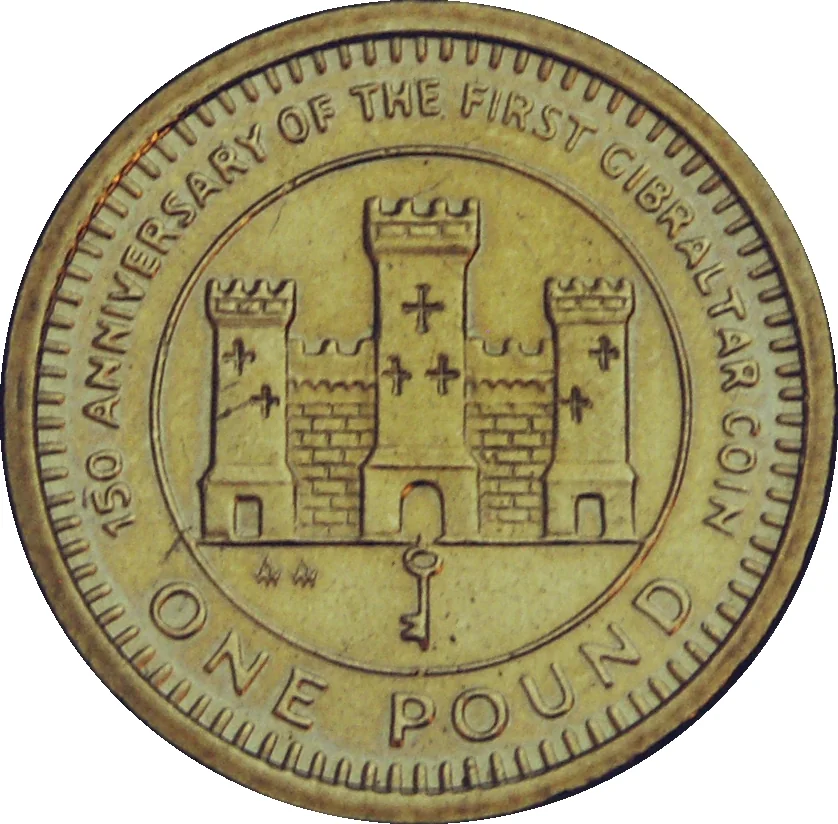
Castle, key, legend above, value below.
Inscription:
150 ANNIVERSARY OF THE FIRST GIBRALTAR COIN
AA
ONE POUND
AA
ONE POUND
Script: Latin
Edge
Alternating plain and reeded sections (3 each)
Categories
| Building> Castle or fortification |
| Building> Tower |
Mints
| Name | Mark |
|---|---|
| Pobjoy Mint | (PM) |
Mintings
| Year | Mint Mark | Mintage | Quality | Collection |
|---|---|---|---|---|
| 1989 | PM | — |
Historical background
In 1989, Gibraltar's currency situation was a unique and practical hybrid, reflecting its status as a British Overseas Territory with deep economic ties to neighbouring Spain. The official legal tender was the Gibraltar pound (GIP), issued by the Government of Gibraltar and pegged at par with the British pound sterling (GBP). Sterling notes and coins also circulated freely and were accepted interchangeably with local currency, underscoring Gibraltar's constitutional link to the United Kingdom.
However, the day-to-day reality was one of effective de facto dual circulation. Due to the volume of cross-border workers and tourists from Spain, the Spanish peseta was also widely accepted, especially in retail, hospitality, and services. This pragmatic acceptance facilitated commerce but introduced complexity, with exchange rates fluctuating and businesses needing to manage two cash flows. The border with Spain, fully reopened in 1985 after years of restriction, had significantly increased this economic interaction.
The period was one of stability for the Gibraltar pound itself, but it occurred within a broader context of monetary debate. As a member of the European Economic Community (EEC) alongside the UK, Gibraltar was part of the European Monetary System but not in the Exchange Rate Mechanism. Discussions about European monetary integration were advancing, yet Gibraltar's fundamental currency question remained balancing its sterling-based system with the practical necessities of its geographic and economic position on the Iberian Peninsula.
However, the day-to-day reality was one of effective de facto dual circulation. Due to the volume of cross-border workers and tourists from Spain, the Spanish peseta was also widely accepted, especially in retail, hospitality, and services. This pragmatic acceptance facilitated commerce but introduced complexity, with exchange rates fluctuating and businesses needing to manage two cash flows. The border with Spain, fully reopened in 1985 after years of restriction, had significantly increased this economic interaction.
The period was one of stability for the Gibraltar pound itself, but it occurred within a broader context of monetary debate. As a member of the European Economic Community (EEC) alongside the UK, Gibraltar was part of the European Monetary System but not in the Exchange Rate Mechanism. Discussions about European monetary integration were advancing, yet Gibraltar's fundamental currency question remained balancing its sterling-based system with the practical necessities of its geographic and economic position on the Iberian Peninsula.
🌟 Limited