

50 Rubles – Russian Federation
Russia
Context
Years: 2006–2015
Country: Russia 
Issuer: Russian Federation
Period:
(since 1991)
Currency:
(since 1998)
Total mintage: 4,260,000
Material
Diameter: 22.6 mm
Weight: 7.89 g
Gold weight: 7.88 g
Thickness: 1.6 mm
Shape: Round
Composition: 99.9% Gold
Standard: Silver quarter ounce
Magnetic: No
Technique: Milled
Alignment: Medal alignment
flip
References
Value
Exchange value: 50 RUB
Bullion value: $1312.08
Inflation-adjusted value: 258.66 RUB
Obverse
Description:
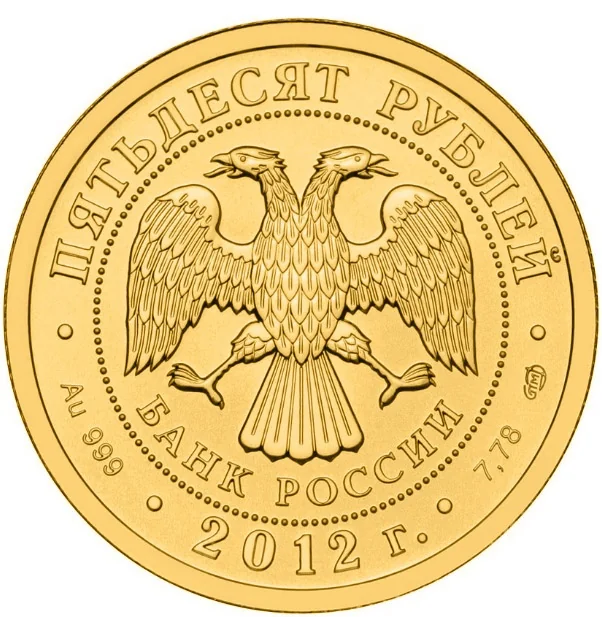
The center features the Bank of Russia emblem (a two-headed eagle with wings down, above the inscription "БАНК РОССИИ"), surrounded by a dotted circle. The rim inscriptions: top – "ПЯТЬДЕСЯТ РУБЛЕЙ", bottom – the year "2009"; left – metal and fineness, right – pure metal content and mint mark.
Inscription:
ПЯТЬДЕСЯТ РУБЛЕЙ
БАНК РОССИИ
• Au 999 • 2009 г. • 7,78 СПМД •
БАНК РОССИИ
• Au 999 • 2009 г. • 7,78 СПМД •
Translation:
FIFTY RUBLES
BANK OF RUSSIA
• Au 999 • 2009 • 7.78 SPMD •
BANK OF RUSSIA
• Au 999 • 2009 • 7.78 SPMD •
Language: Russian
Designer and engraver: Alexander Vasilyevich Baklanov
Reverse
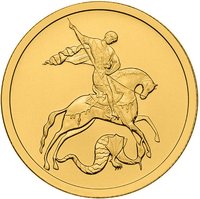
Description:
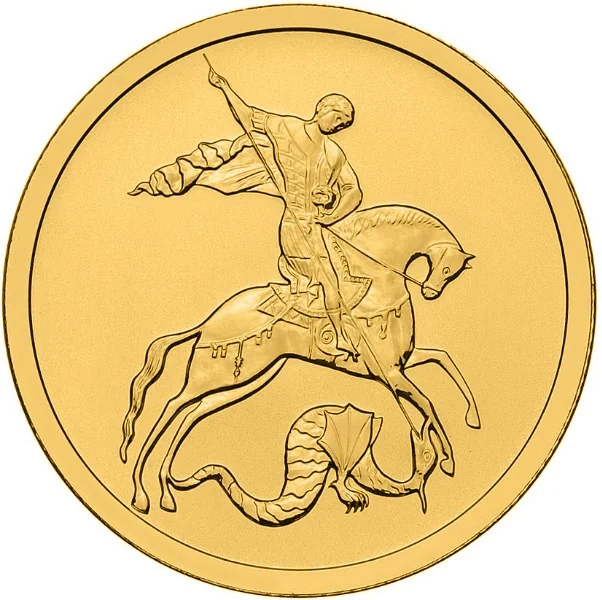
Saint George on horseback slaying a dragon.
Designer and engraver: Alexander Vasilyevich Baklanov
Edge
134 corrugations
Categories
| Mythology> Fantastic animal |
| Animal> Horse |
| Object> Cold weapons |
Mints
| Name | Mark |
|---|---|
| Moscow Mint | (ММД) |
| Saint Petersburg | (СПМД) |
Mintings
| Year | Mint Mark | Mintage | Quality | Collection |
|---|---|---|---|---|
| 2006 | ММД | 150,000 | ||
| 2006 | СПМД | — | ||
| 2007 | ММД | 500,000 | ||
| 2007 | СПМД | — | ||
| 2008 | ММД | 630,000 | ||
| 2008 | СПМД | — | ||
| 2009 | ММД | 1,500,000 | ||
| 2009 | СПМД | — | ||
| 2010 | ММД | 640,000 | ||
| 2010 | СПМД | — | ||
| 2012 | ММД | 10,000 | Proof | |
| 2013 | ММД | 500,000 | ||
| 2013 | СПМД | — | ||
| 2014 | ММД | 300,000 | ||
| 2014 | СПМД | — | ||
| 2015 | ММД | 30,000 | ||
| 2015 | СПМД | — | BU |
Historical background
In 2006, the Russian Federation's currency situation was characterized by robust stability and significant accumulation of foreign reserves, marking a period of strength following the turbulence of the 1998 financial crisis. The key driver was the sustained high price of oil, Russia's primary export, which created a large trade and current account surplus. This influx of petrodollars led to a consistent appreciation pressure on the Russian ruble (RUB). To manage this appreciation and maintain export competitiveness, the Central Bank of Russia (CBR) actively intervened in foreign exchange markets, purchasing US dollars and euros, which caused the country's international reserves to swell dramatically, surpassing $300 billion by year's end and becoming the world's third-largest.
The government's fiscal policy, guided by the newly established Stabilization Fund, played a crucial role in sterilizing the inflationary effects of the oil windfall. This fund sequestered excess oil revenues from the federal budget, preventing excessive money supply growth and "Dutch disease," where other economic sectors become uncompetitive. As a result, inflation was on a downward trend, though it remained stubbornly high at around 9% annually, still above official targets. The CBR continued its policy of a controlled, gradual nominal appreciation of the ruble against a dual-currency basket (USD and EUR), allowing it to strengthen steadily, which helped curb inflation but concerned some domestic industrialists.
Overall, the 2006 currency landscape reflected a confident economy. The ruble was convertible, and discussions about making it a fully freely floating currency were gaining momentum, though the CBR maintained a tight grip on volatility. The primary challenges were managing inflation, sterilizing the vast liquidity inflows, and deciding on the pace of ruble liberalization without harming non-oil sectors. This period of stability and accumulation provided a formidable buffer for the Russian economy, which it would later draw upon during the global financial crisis of 2008-2009.
The government's fiscal policy, guided by the newly established Stabilization Fund, played a crucial role in sterilizing the inflationary effects of the oil windfall. This fund sequestered excess oil revenues from the federal budget, preventing excessive money supply growth and "Dutch disease," where other economic sectors become uncompetitive. As a result, inflation was on a downward trend, though it remained stubbornly high at around 9% annually, still above official targets. The CBR continued its policy of a controlled, gradual nominal appreciation of the ruble against a dual-currency basket (USD and EUR), allowing it to strengthen steadily, which helped curb inflation but concerned some domestic industrialists.
Overall, the 2006 currency landscape reflected a confident economy. The ruble was convertible, and discussions about making it a fully freely floating currency were gaining momentum, though the CBR maintained a tight grip on volatility. The primary challenges were managing inflation, sterilizing the vast liquidity inflows, and deciding on the pace of ruble liberalization without harming non-oil sectors. This period of stability and accumulation provided a formidable buffer for the Russian economy, which it would later draw upon during the global financial crisis of 2008-2009.
💎 Very Rare