

3 Rubles – Russian Federation
Russia
Context
Years: 2009–2015
Country: Russia 
Issuer: Russian Federation
Period:
(since 1991)
Currency:
(since 1998)
Total mintage: 880,000
Material
Diameter: 39 mm
Weight: 31.5 g
Silver weight: 31.47 g
Thickness: 3.1 mm
Shape: Round
Composition: 99.9% Silver
Standard: Silver ounce
Magnetic: No
Technique: Milled
Alignment: Medal alignment
flip
References
Value
Exchange value: 3 RUB
Bullion value: $89.46
Inflation-adjusted value: 11.38 RUB
Obverse
Description:
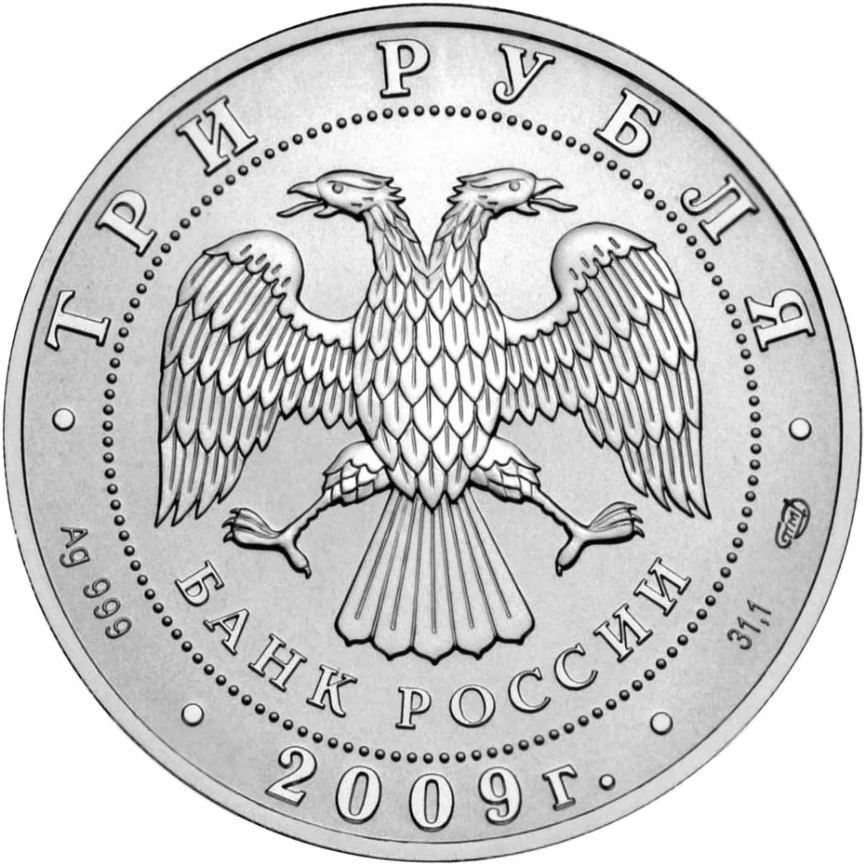
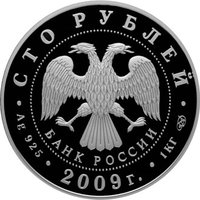
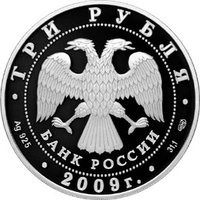
Center: Bank of Russia emblem (two-headed eagle, wings down, with "БАНК РОССИИ" below), within a dotted circle. Rim inscriptions: top - "ТРИ РУБЛЯ"; bottom left - metal and fineness; center - "2009 г."; bottom right - metal content and mint mark.
Inscription:
ТРИ РУБЛЯ
БАНК РОССИИ
• Ag 925 • 2009 г. • 31,1 СПМД •
БАНК РОССИИ
• Ag 925 • 2009 г. • 31,1 СПМД •
Translation:
THREE RUBLES
BANK OF RUSSIA
• Ag 925 • 2009 • 31.1 SPMD •
BANK OF RUSSIA
• Ag 925 • 2009 • 31.1 SPMD •
Language: Russian
Designer and engraver: Alexander Vasilyevich Baklanov
Reverse
Description:
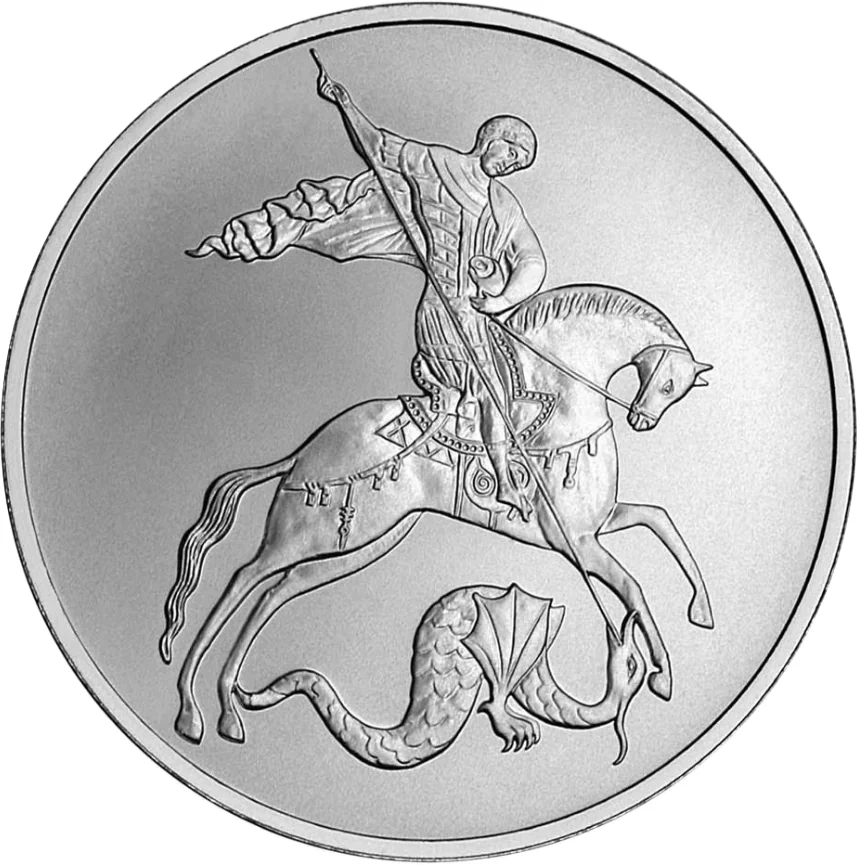
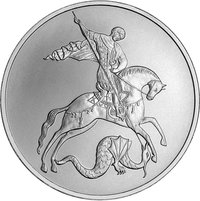
Saint George on horseback spearing a dragon.
Designer and engraver: Alexander Vasilyevich Baklanov
Edge
300 corrugations
Categories
| Mythology> Fantastic animal |
| Animal> Horse |
| Object> Cold weapons |
Mints
| Name | Mark |
|---|---|
| Moscow Mint | (ММД) |
| Saint Petersburg | (СПМД) |
Mintings
| Year | Mint Mark | Mintage | Quality | Collection |
|---|---|---|---|---|
| 2009 | ММД | 280,000 | ||
| 2009 | СПМД | — | ||
| 2010 | ММД | 500,000 | ||
| 2010 | СПМД | — | ||
| 2015 | ММД | 100,000 | ||
| 2015 | СПМД | — |
Historical background
In 2009, the Russian Federation faced a severe currency crisis, a direct consequence of the global financial meltdown that began in 2008. The situation was precipitated by a catastrophic collapse in global oil prices, as crude fell from over $140 per barrel in mid-2008 to around $40 by early 2009. Since oil and gas exports constituted the backbone of the Russian economy and federal budget, this shock triggered a massive capital flight, estimated at $130 billion for the year, and placed intense downward pressure on the ruble. The Central Bank of Russia (CBR) initially spent nearly a third of its substantial international reserves (around $200 billion) in a futile attempt to defend a gradual devaluation band, leading to a slow but steady erosion of the currency's value.
Facing unsustainable reserve depletion, the CBR shifted policy in January 2009, allowing for a sharper, one-time devaluation of the ruble. The currency lost approximately 35% of its value against the US dollar-euro basket from its peak in mid-2008. This dramatic devaluation, while painful for the population, aimed to correct the external imbalance and protect remaining reserves. The government simultaneously implemented a large anti-crisis package, injecting liquidity into the banking system and providing support to key industries. However, the devaluation sharply increased the cost of foreign-denominated debt for Russian companies and contributed to a severe economic contraction, with GDP falling by 7.8% in 2009—the deepest recession in over a decade.
By late 2009, the currency situation had stabilized, but at a significantly depreciated level. The ruble's decline, combined with a partial recovery in oil prices, helped narrow the current account deficit and allowed the economy to begin a tentative recovery. The crisis exposed the fundamental vulnerability of Russia's commodity-dependent economic model and underscored the risks of large corporate foreign currency borrowing during boom years. The experience of 2009 led to lasting policy changes, including a greater official emphasis on building larger foreign exchange reserves and moving towards a more flexible exchange rate regime in the following years.
Facing unsustainable reserve depletion, the CBR shifted policy in January 2009, allowing for a sharper, one-time devaluation of the ruble. The currency lost approximately 35% of its value against the US dollar-euro basket from its peak in mid-2008. This dramatic devaluation, while painful for the population, aimed to correct the external imbalance and protect remaining reserves. The government simultaneously implemented a large anti-crisis package, injecting liquidity into the banking system and providing support to key industries. However, the devaluation sharply increased the cost of foreign-denominated debt for Russian companies and contributed to a severe economic contraction, with GDP falling by 7.8% in 2009—the deepest recession in over a decade.
By late 2009, the currency situation had stabilized, but at a significantly depreciated level. The ruble's decline, combined with a partial recovery in oil prices, helped narrow the current account deficit and allowed the economy to begin a tentative recovery. The crisis exposed the fundamental vulnerability of Russia's commodity-dependent economic model and underscored the risks of large corporate foreign currency borrowing during boom years. The experience of 2009 led to lasting policy changes, including a greater official emphasis on building larger foreign exchange reserves and moving towards a more flexible exchange rate regime in the following years.
🌟 Limited