

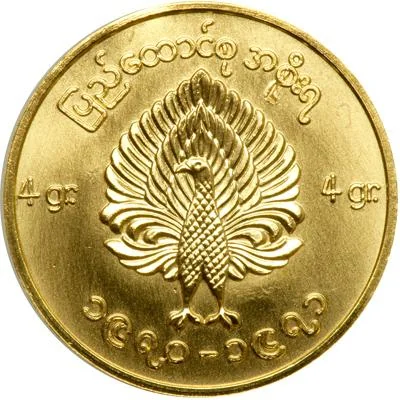

Obverse
Description:
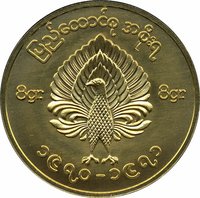
Peacock of Myanmar
Inscription:
ပြည်ထောင်စု အစိုးရ
4gr 4gr
၁၉၇၀-၁၉၇၁
4gr 4gr
၁၉၇၀-၁၉၇၁
Translation:
Union Government
4gr 4gr
1970-1971
4gr 4gr
1970-1971
Language: Burmese
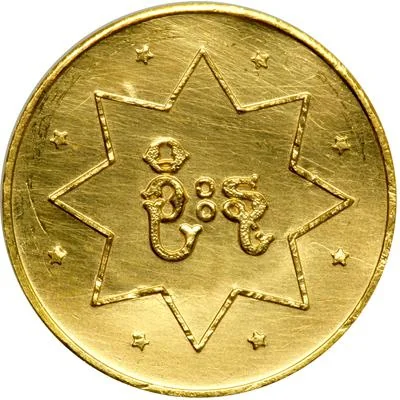
Reverse
Description:
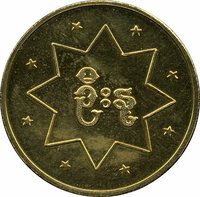
Inscription of Burmese nationalist leader U Nu.
Inscription:
ဦးနု
Translation:
U Nu
Language: Burmese
Edge
Mintings
| Year | Mint Mark | Mintage | Quality | Collection |
|---|---|---|---|---|
| 1970 | — | — |
Historical background
In 1970, Myanmar's currency situation was characterized by the strict control and isolation of the socialist "Burmese Way to Socialism," instituted by General Ne Win following the 1962 coup. The national currency, the kyat, was officially pegged to major currencies like the British pound and the US dollar at a fixed, overvalued rate set by the Union Bank of Burma. However, this official rate was largely theoretical for most international transactions, as the country had nationalized all major industries and banks, severely restricting foreign trade and private exchange.
This rigidity created a thriving black market for foreign currency, where the actual value of the kyat was significantly lower than the government mandate. The disparity between the official and black-market rates reflected the wider economic malaise: declining agricultural exports, particularly rice, industrial inefficiency, and a scarcity of imported goods. The government's demonetization of high-value banknotes (50 and 100 kyat) in 1964 had already eroded public trust in the currency, pushing more economic activity into informal channels.
Consequently, Myanmar's currency system in 1970 was one of duality and dysfunction. While the state maintained a facade of stability through its fixed exchange rate, the practical economy operated under a different set of rules dictated by a robust parallel market. This situation stifled legitimate foreign investment and contributed to a period of economic stagnation and increasing poverty, setting the stage for the deeper crises that would unfold in the decades to follow.
This rigidity created a thriving black market for foreign currency, where the actual value of the kyat was significantly lower than the government mandate. The disparity between the official and black-market rates reflected the wider economic malaise: declining agricultural exports, particularly rice, industrial inefficiency, and a scarcity of imported goods. The government's demonetization of high-value banknotes (50 and 100 kyat) in 1964 had already eroded public trust in the currency, pushing more economic activity into informal channels.
Consequently, Myanmar's currency system in 1970 was one of duality and dysfunction. While the state maintained a facade of stability through its fixed exchange rate, the practical economy operated under a different set of rules dictated by a robust parallel market. This situation stifled legitimate foreign investment and contributed to a period of economic stagnation and increasing poverty, setting the stage for the deeper crises that would unfold in the decades to follow.
💎 Extremely Rare