

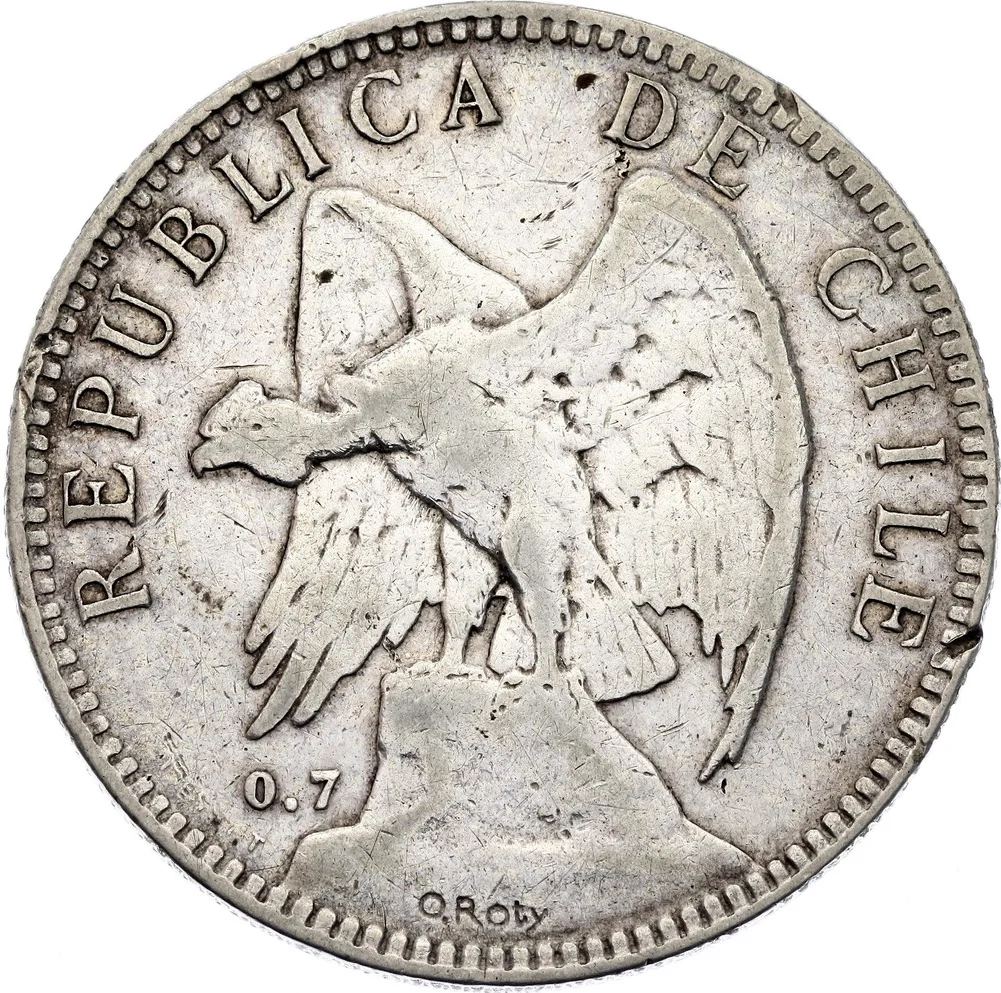
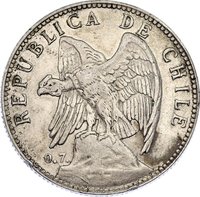
Obverse
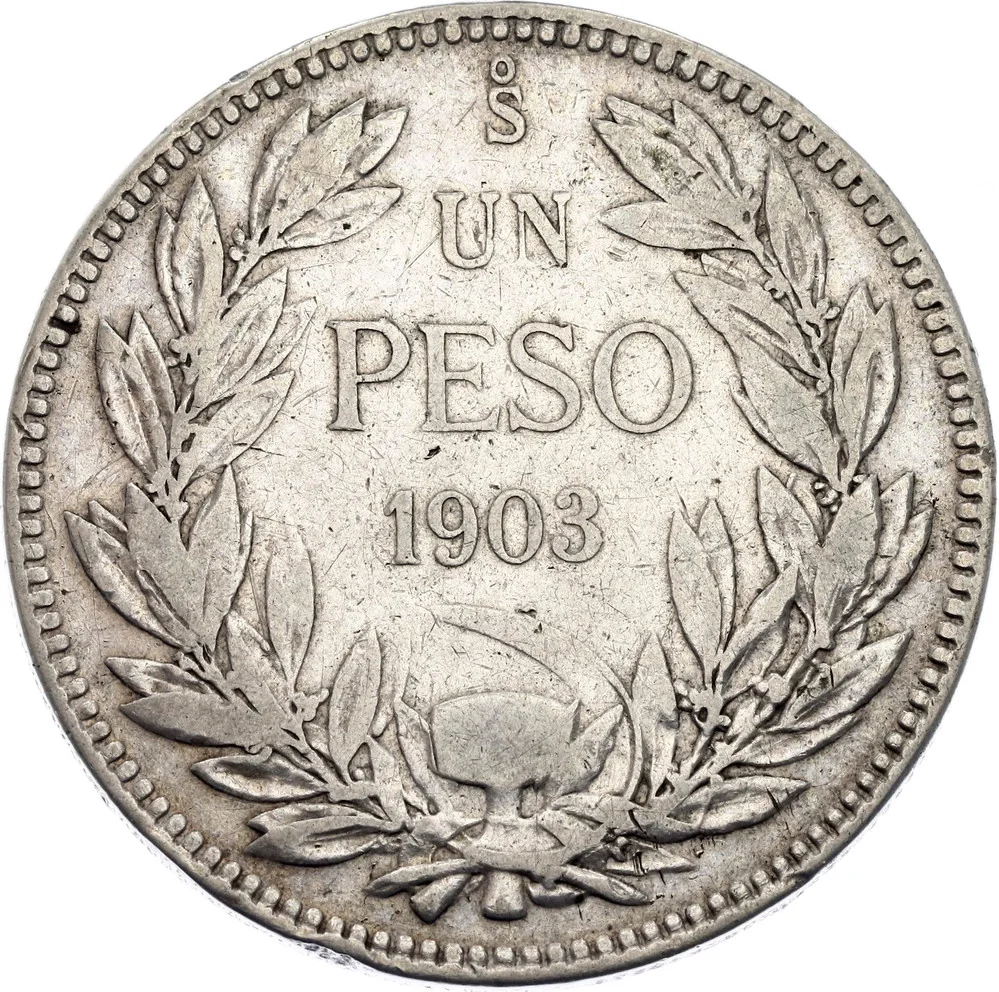
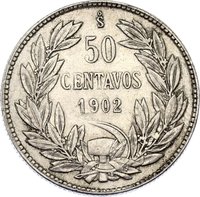
Reverse
Edge
Reeded
Categories
| Animal> Bird |
| Symbol> Hammer and sickle |
Mints
| Name | Mark |
|---|---|
| Casa de Moneda de Chile | (So) |
Mintings
| Year | Mint Mark | Mintage | Quality | Collection |
|---|---|---|---|---|
| 1902 | So | 178,000 | ||
| 1903 | So | 372,000 | ||
| 1905 | So | 429,000 |
Historical background
In 1902, Chile's currency system was in a state of transition, anchored by the gold standard but facing significant practical challenges. The official currency was the peso, defined by the Conversion Law of 1895, which pegged it to the British pound sterling and established a gold exchange standard. This meant the peso's value was theoretically backed by and convertible into gold, a policy designed to attract foreign investment, stabilize international trade, and control inflation after the economic turbulence following the War of the Pacific. The Banco Central de Chile, however, would not be founded until 1925, so currency issuance was managed by several private banks under government supervision, leading to a complex and sometimes inconsistent money supply.
Despite the legal framework, the actual circulation of gold coins was limited. The everyday economy relied heavily on fiduciary money—banknotes issued by private banks like the Banco de Chile and the Banco Español-Chile. These notes were only partially backed by gold reserves, creating a fragile system vulnerable to public confidence. Furthermore, a chronic shortage of small change plagued commerce, leading to the widespread use of tokens, scrip, and even postage stamps for minor transactions. This disconnect between the high-value gold-backed peso and the practical needs of the domestic economy created persistent friction.
The year 1902 fell within a period of relative economic stability and growth, driven by nitrate exports, which provided the foreign currency to support the gold peg. However, the system's inherent vulnerabilities were clear. Political debates centered on the need for a stronger, more centralized control over money to prevent bank runs and ensure uniformity. The situation would remain largely unchanged until the shocks of World War I disrupted global gold markets, eventually leading to the abandonment of the gold standard in the 1930s and the eventual creation of a central banking authority.
Despite the legal framework, the actual circulation of gold coins was limited. The everyday economy relied heavily on fiduciary money—banknotes issued by private banks like the Banco de Chile and the Banco Español-Chile. These notes were only partially backed by gold reserves, creating a fragile system vulnerable to public confidence. Furthermore, a chronic shortage of small change plagued commerce, leading to the widespread use of tokens, scrip, and even postage stamps for minor transactions. This disconnect between the high-value gold-backed peso and the practical needs of the domestic economy created persistent friction.
The year 1902 fell within a period of relative economic stability and growth, driven by nitrate exports, which provided the foreign currency to support the gold peg. However, the system's inherent vulnerabilities were clear. Political debates centered on the need for a stronger, more centralized control over money to prevent bank runs and ensure uniformity. The situation would remain largely unchanged until the shocks of World War I disrupted global gold markets, eventually leading to the abandonment of the gold standard in the 1930s and the eventual creation of a central banking authority.
🌟 Limited