

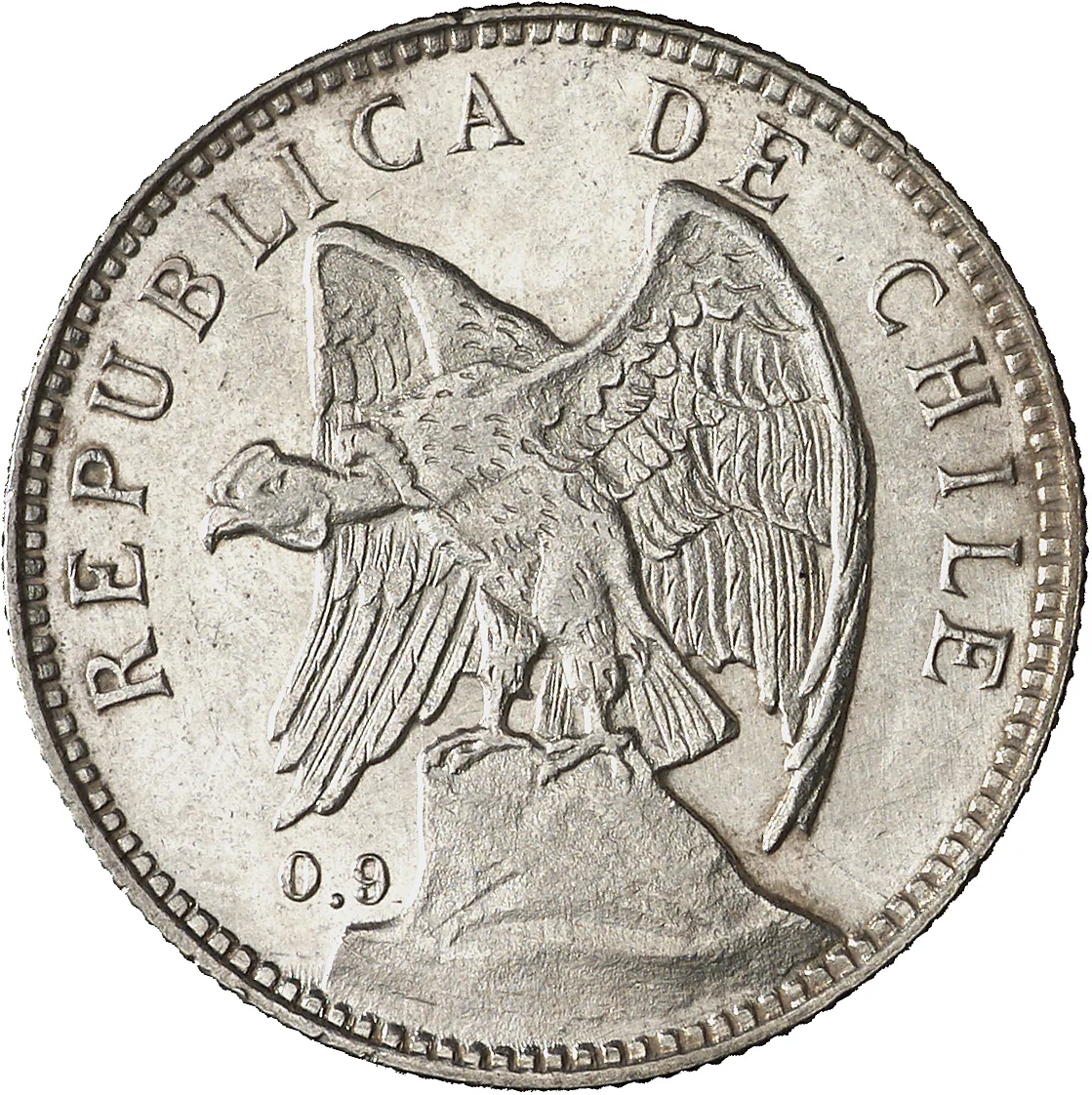
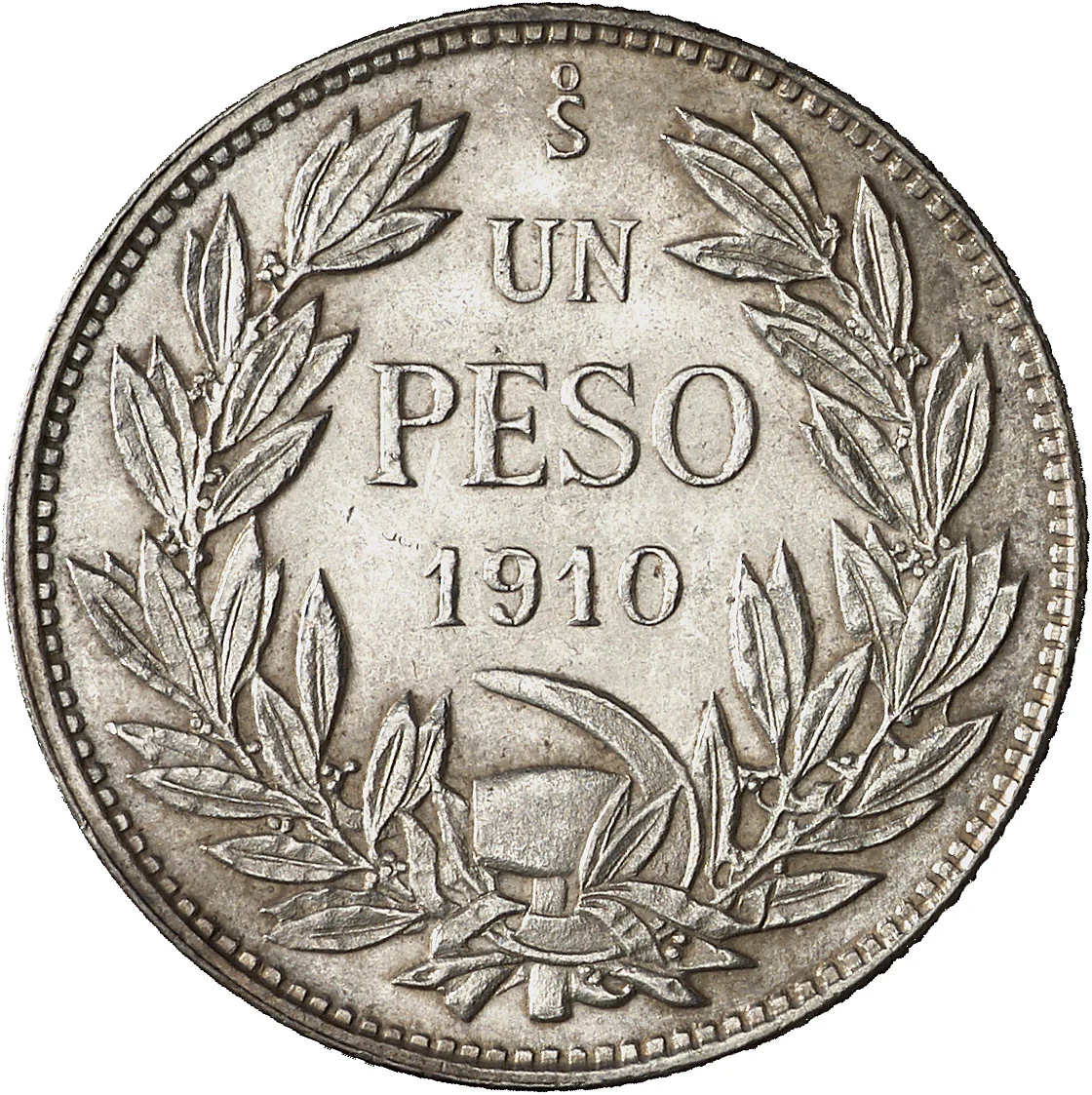
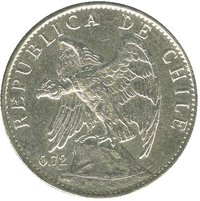
Obverse
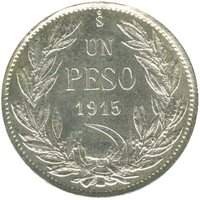
Reverse
Edge
Reeded
Categories
| Animal> Bird |
| Symbol> Hammer and sickle |
Mints
| Name | Mark |
|---|---|
| Casa de Moneda de Chile | (So) |
Mintings
| Year | Mint Mark | Mintage | Quality | Collection |
|---|---|---|---|---|
| 1910 | So | 2,166,000 |
Historical background
In 1910, Chile's currency system was firmly anchored to the gold standard, a regime formally adopted in 1895. This meant the value of the Chilean peso was directly convertible into a fixed quantity of gold, providing a period of notable monetary stability and facilitating international trade. The primary circulating coins were gold condores (equivalent to 10 pesos) and silver pesos, with paper money issued by private banks but requiring full gold-backed reserves. This discipline was intended to prevent inflation and build confidence, both domestically and among foreign investors, in a nation heavily reliant on nitrate exports.
However, this apparent stability rested on a vulnerable economic foundation. Chile's fiscal health was almost entirely dependent on nitrate revenues from the northern territories acquired after the War of the Pacific (1879-1883). While this generated substantial government income, it created a volatile, single-commodity economy. Any shift in global nitrate prices or demand could rapidly strain public finances. Furthermore, the strict gold standard limited the government's ability to adjust the money supply or devalue the currency in response to economic shocks, a rigidity that would prove problematic in the coming decades.
Thus, the currency situation in 1910 represented a calm before the storm. The system was orthodox and internationally respected, yet it masked a deep structural fragility. The outbreak of World War I in 1914 would soon trigger a collapse in nitrate exports, leading to a severe fiscal crisis. This would force Chile to abandon gold convertibility in 1914, ending the era of classical stability and ushering in a prolonged period of monetary experimentation, inflation, and debate about the management of the peso that would characterize much of the 20th century.
However, this apparent stability rested on a vulnerable economic foundation. Chile's fiscal health was almost entirely dependent on nitrate revenues from the northern territories acquired after the War of the Pacific (1879-1883). While this generated substantial government income, it created a volatile, single-commodity economy. Any shift in global nitrate prices or demand could rapidly strain public finances. Furthermore, the strict gold standard limited the government's ability to adjust the money supply or devalue the currency in response to economic shocks, a rigidity that would prove problematic in the coming decades.
Thus, the currency situation in 1910 represented a calm before the storm. The system was orthodox and internationally respected, yet it masked a deep structural fragility. The outbreak of World War I in 1914 would soon trigger a collapse in nitrate exports, leading to a severe fiscal crisis. This would force Chile to abandon gold convertibility in 1914, ending the era of classical stability and ushering in a prolonged period of monetary experimentation, inflation, and debate about the management of the peso that would characterize much of the 20th century.
🌟 Uncommon