

2 leva – Bulgaria
Add to wishlist
Circulating commemorative coins
Commemoration: Bulgarian Presidency of the Council of the European Union - 2018
Bulgaria
Context
Material
References
KM: #
Numista: #131726
Value
Exchange value: 2 BGN
Obverse
Description:
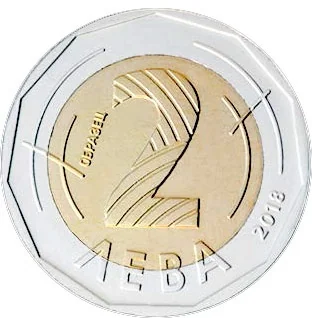
The coin's obverse centers a '2' with line texture. A crosshatch pattern covers both the inner circle and outer ring. Below, "ЛЕВA" spans from the ring into the circle, with "2018" on the ring to its right.
Inscription:
2
ΛЕВА 2018
ΛЕВА 2018
Translation:
LION 2018
Script: Cyrillic
Language: Russian
Engraver: Vanya Dimitrova
Reverse
Description:
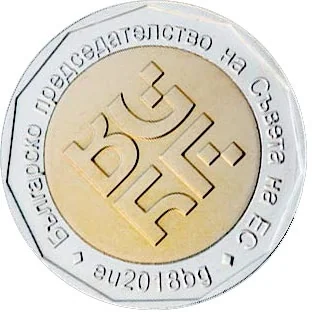
The reverse shows the logo and inscription "Българско председателство на Съвета на ЕС" encircling "eu2018bg" for the 2018 Bulgarian Presidency of the EU Council.
Inscription:
Българско председателство на Съвета на ЕС
eu2018bg
eu2018bg
Translation:
Bulgarian Presidency of the Council of the EU
eu2018bg
eu2018bg
Script: Cyrillic
Language: Bulgarian
Engraver: Vanya Dimitrova
Edge
Alternately serrated and flat sectors
Mints
| Name | Mark |
|---|---|
| Bulgarian Mint | — |
Mintings
| Year | Mint Mark | Mintage | Quality | Collection |
|---|---|---|---|---|
| 2018 | — | 500,000 |
Historical background
In 2018, Bulgaria's currency situation was defined by its dual-track pursuit of deeper European integration. The country was operating under a Currency Board Arrangement (CBA), which had been in place since 1997 to tame hyperinflation. This system pegged the Bulgarian lev (BGN) firmly to the euro at a fixed rate of 1.95583 leva per euro, ensuring monetary stability and low inflation. The CBA strictly tied the supply of lev in circulation to the Bulgarian National Bank's foreign exchange reserves, effectively outsourcing monetary policy and providing a crucial anchor of credibility for the economy.
That year marked a significant political milestone on this path. In July 2018, Bulgaria officially applied to join the European Exchange Rate Mechanism II (ERM II), the mandatory "waiting room" for euro adoption. This move was part of a concerted push by the center-right government, which had made joining the eurozone a strategic priority. The application was bundled with a commitment to simultaneously participate in the EU's Banking Union, a step aimed at strengthening financial sector supervision and demonstrating the country's preparedness for deeper integration.
Consequently, the core currency narrative of 2018 was one of preparation and convergence, rather than any market volatility or devaluation pressure. Economic discussions focused on meeting the Maastricht criteria, particularly regarding inflation and legislative alignment, rather than the stability of the peg itself, which was unquestioned. The year ended with the European Commission and the European Central Bank beginning their detailed assessments, setting the stage for the eventual formal entry into ERM II in July 2020. Thus, 2018 was a pivotal year of laying the technical and political groundwork for Bulgaria's intended future transition to the euro.
That year marked a significant political milestone on this path. In July 2018, Bulgaria officially applied to join the European Exchange Rate Mechanism II (ERM II), the mandatory "waiting room" for euro adoption. This move was part of a concerted push by the center-right government, which had made joining the eurozone a strategic priority. The application was bundled with a commitment to simultaneously participate in the EU's Banking Union, a step aimed at strengthening financial sector supervision and demonstrating the country's preparedness for deeper integration.
Consequently, the core currency narrative of 2018 was one of preparation and convergence, rather than any market volatility or devaluation pressure. Economic discussions focused on meeting the Maastricht criteria, particularly regarding inflation and legislative alignment, rather than the stability of the peg itself, which was unquestioned. The year ended with the European Commission and the European Central Bank beginning their detailed assessments, setting the stage for the eventual formal entry into ERM II in July 2020. Thus, 2018 was a pivotal year of laying the technical and political groundwork for Bulgaria's intended future transition to the euro.
🌱 Common