

200 Korún (Jozef Ciger Hronsky) – Slovakia
Non-circulating coins
Commemoration: 100th Anniversary - Birth of Jozef Ciger Hronsky
Slovakia
Context
Material
References
KM: #Click to copy to clipboard32
Numista: #23342
Value
Exchange value: 200 SKK
Bullion value: $43.38
Inflation-adjusted value: 728.85 SKK
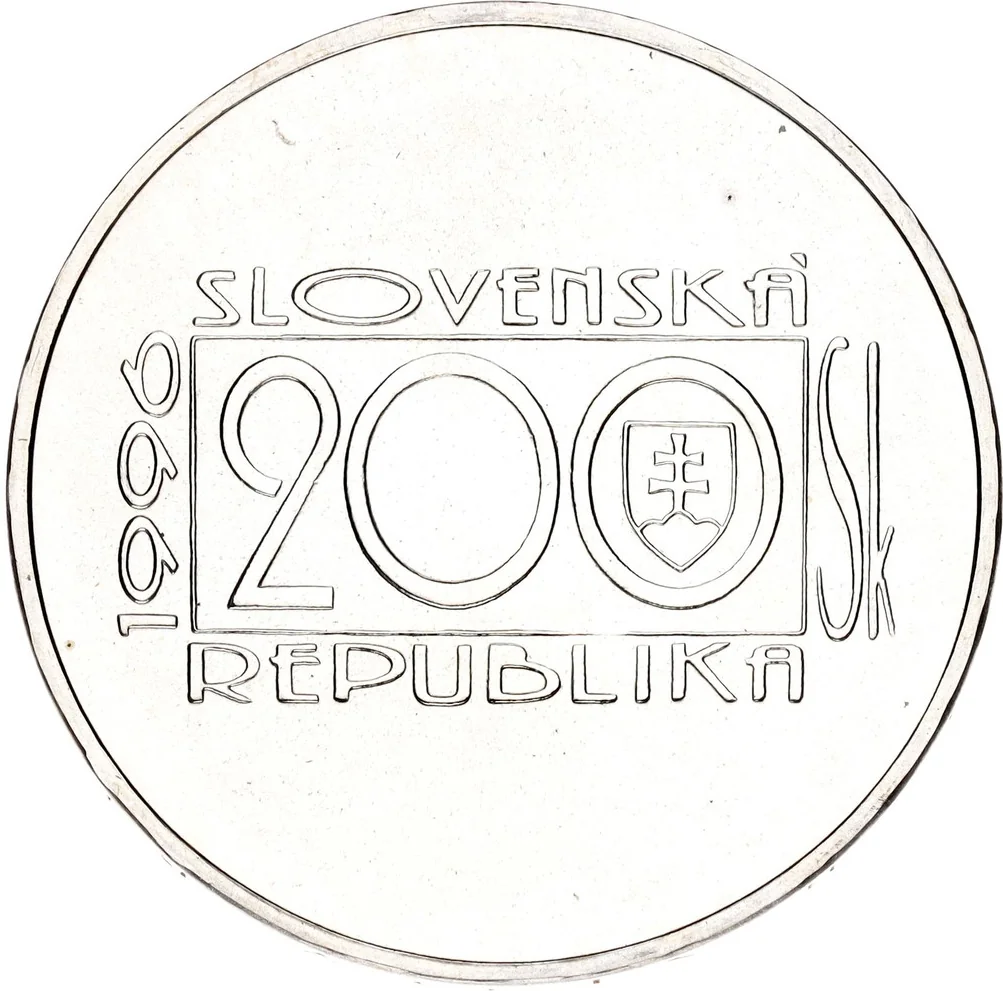
Obverse
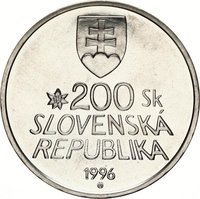
Inscription:
SLOVENSKÁ REPUBLIKA
200 Sk
1996
200 Sk
1996
Translation:
Slovak Republic
200 Sk
1996
200 Sk
1996
Script: Latin
Language: Slovak
Engraver: Patrik Kovačovský
Reverse
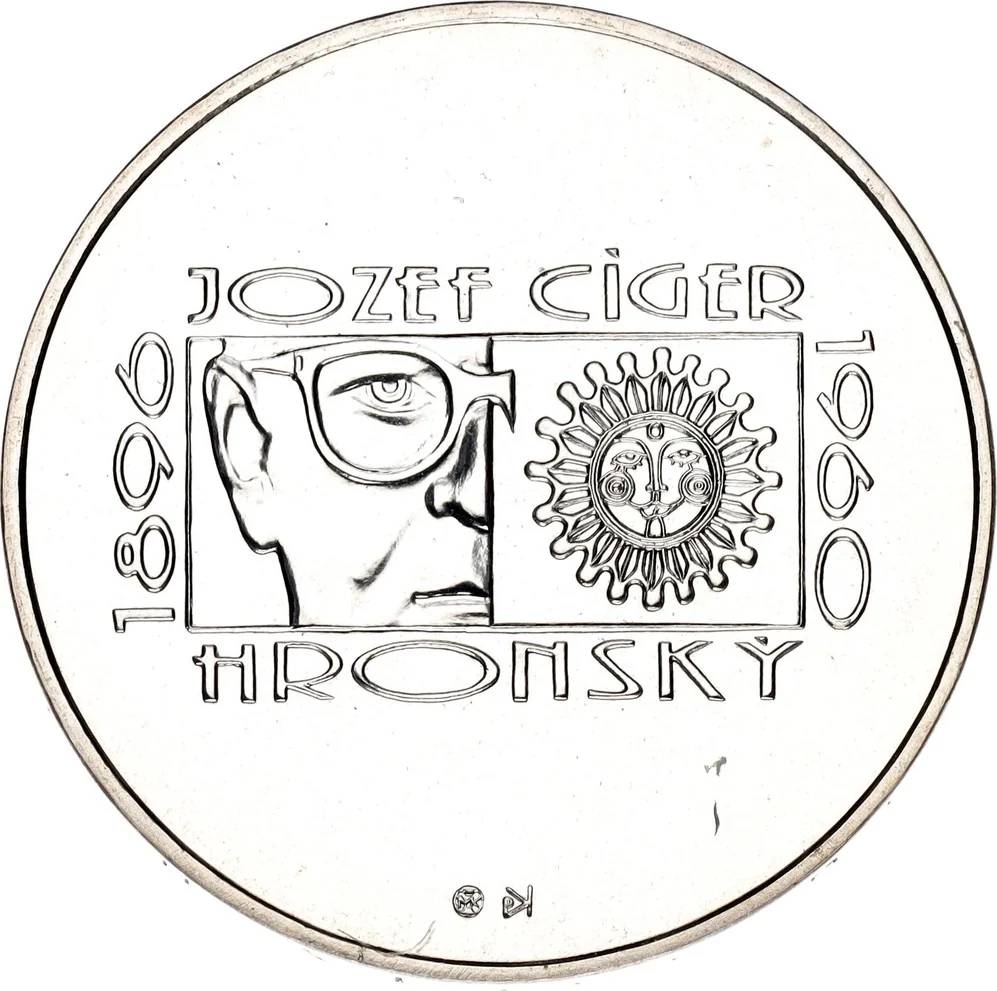
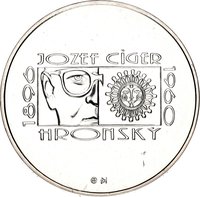
Description:
Jozef Cíger Hronský, a Slovak children's author and secretary of Matica Slovenská.
Inscription:
JOZEF CÍGER
1896 1960
HRONSKÝ
1896 1960
HRONSKÝ
Translation:
Jozef Cíger
1896 1960
Hronský
1896 1960
Hronský
Script: Latin
Language: Slovak
Engraver: Patrik Kovačovský
Edge
Lettering
Legend:
NIET KRAJŠÍCH SLOV AKO SKUTKY
Translation:
No finer words than deeds.
Language: Slovak
Categories
| Event> Birth anniversary |
Mints
| Name | Mark |
|---|---|
| Kremnica | (MK) |
Mintings
| Year | Mint Mark | Mintage | Quality | Collection |
|---|---|---|---|---|
| 1996 | MK | 20,500 | ||
| 1996 | MK | 1,500 | Proof |
Historical background
In 1996, Slovakia was navigating a critical and complex period in its monetary history, just three years after the peaceful dissolution of Czechoslovakia. The country continued to use the Czechoslovak koruna until February 8, 1993, when it introduced its own temporary currency, the Slovak koruna (SKK), initially at par with the former federal currency. By 1996, the new currency had been fully established, but its management was a central issue within the broader context of Slovakia's challenging post-divorce economic transition and the political climate under Prime Minister Vladimír Mečiar.
The economic backdrop was difficult, characterized by the pressures of privatization, restructuring of large industrial enterprises, and concerns from international institutions about transparency and democratic standards. The National Bank of Slovakia (NBS), led by Governor Vladimír Masár, pursued a relatively tight monetary policy aimed at controlling inflation and stabilizing the currency. However, the koruna was not fully convertible, and its exchange rate was managed through a fixed peg to a basket of currencies (initially the US dollar and German mark), which provided stability but required significant foreign exchange reserves to maintain, limiting monetary policy flexibility.
Internationally, the currency situation reflected Slovakia's isolated position. Due to political tensions with the Mečiar government, Slovakia was not included in the first wave of NATO expansion and saw its path to European Union membership effectively put on hold. This political isolation had economic consequences, discouraging foreign direct investment and creating uncertainty. Consequently, while the Slovak koruna was stable on the surface in 1996, it operated within a constrained and somewhat fragile economic environment, with its long-term prospects heavily dependent on broader political and institutional reforms that would only materialize after the change of government in 1998.
The economic backdrop was difficult, characterized by the pressures of privatization, restructuring of large industrial enterprises, and concerns from international institutions about transparency and democratic standards. The National Bank of Slovakia (NBS), led by Governor Vladimír Masár, pursued a relatively tight monetary policy aimed at controlling inflation and stabilizing the currency. However, the koruna was not fully convertible, and its exchange rate was managed through a fixed peg to a basket of currencies (initially the US dollar and German mark), which provided stability but required significant foreign exchange reserves to maintain, limiting monetary policy flexibility.
Internationally, the currency situation reflected Slovakia's isolated position. Due to political tensions with the Mečiar government, Slovakia was not included in the first wave of NATO expansion and saw its path to European Union membership effectively put on hold. This political isolation had economic consequences, discouraging foreign direct investment and creating uncertainty. Consequently, while the Slovak koruna was stable on the surface in 1996, it operated within a constrained and somewhat fragile economic environment, with its long-term prospects heavily dependent on broader political and institutional reforms that would only materialize after the change of government in 1998.
💎 Very Rare